
🇺🇸 United States
This page describes how schools in United States grade pupils, from the first year of primary school (year 1, about age 6–7) to the end of upper secondary, and how to build the same system in MarkBook. Back to Find Your Country.
Full step-by-step guide
There is a full guide for this country, with every click: United States full guide.
Check the current rules
This description comes from public sources (ministry pages, national laws, Eurydice) read in October 2026. Rules change with reforms, and schools often have local rules. Check the current official text for anything your school reports to the ministry.
How pupils are graded
Before year 1: Kindergarten (age 5-6) is the first year of K-12 and usually gets a standards-based progress report (developing / secure, or 1-4), never letter grades. Pre-K is not graded. K-12 is 13 years: Kindergarten + Grades 1-12.
| Years | Stage | Scale | Pass | Recipe |
|---|---|---|---|---|
| 1-5 (plus Kindergarten before year 1) | Elementary school (Kindergarten-Grade 5) | Most common today: standards-based 1-4 (4 best) per standard. Some districts use letter codes (E/M/P/N) or still A-F in grades 3-5. | 3 (Meets the standard) is the target; there is no formal pass mark in elementary school | School decides |
| 6-8 | Middle school / junior high (Grades 6-8) | A-F, usually with +/-, from a 0-100 percentage | D (usually 60%); some districts require C or 70% to pass a course | Letters |
| 9-12 | High school (Grades 9-12) | A-F with +/-; course grades converted to GPA on a 4.0 scale (A=4, B=3, C=2, D=1, F=0); weighted GPA for Honors/AP/IB often 5.0 | D (60%) earns credit in most districts | Letters |
Values in Elementary school (Kindergarten-Grade 5)
| Value | Local word | English |
|---|---|---|
| 4 | Exceeds the Standard | Exceeds the standard |
| 3 | Meeting the Standard | Meets the standard |
| 2 | Approaching the Standard | Approaching the standard |
| 1 | Limited Progress to the Standard | Limited progress |
The year. Set by districts. Most common: two semesters, each split into two quarters (9-week grading periods), with a report card every quarter and interim progress reports mid-quarter. Many elementary schools use trimesters. High school transcripts record semester (or full-year) final grades.
Averages and rounding. Teacher-set and district-set. Usually a weighted mean of category percentages (e.g. tests 50%, quizzes 20%, homework 15%, classwork 15%) or total points earned / points possible. Semester grade often = 40% Q1 + 40% Q2 + 20% final exam (local). Rounding to the nearest whole percent (89.5 -> 90) is common but not universal. No national minimum number of marks. Some districts use a 'minimum grade' floor (e.g. 50%) for missing work. Standards-based elementary grading uses teacher judgement or most-recent/most-consistent evidence rather than a mean.
Passing the year. Elementary and middle: promotion is mostly automatic; some states have reading retention laws (e.g. third-grade reading policies). High school: no year to pass; students accumulate course credits and must meet state/district credit and test requirements to graduate. A failed course is retaken (credit recovery).
Conduct. Usually separate from academic grades: 'work habits', 'citizenship' or 'learning behaviors' marks (e.g. O/S/N = Outstanding/Satisfactory/Needs improvement, or 1-4). Standards-based grading deliberately keeps behaviour out of the academic mark.
Differences between regions or school types. There is no national grading system. Grading is decided by the 50 states and, mostly, by about 13,000 school districts and individual schools. Described here is the most common pattern: standards-based 1-4 in elementary, A-F with 4.0 GPA in grades 6-12. Differences: letter cut-offs (10-point vs 7-point bands), +/- use, weighted GPA for Honors/AP/IB, standards-based grading extended into middle/high school in some districts (e.g. proficiency 1-4 in some Oregon and Maine schools), some states with numeric 0-100 transcripts (e.g. parts of New York, Texas). Credit totals for graduation range from about 13 to 24 by state.
Common practice that is not official. Teachers commonly record points (e.g. 18/20) and percentages for every assignment and let the gradebook compute the letter. Extra credit, dropping the lowest score, and late-work penalties are teacher practices, not official rules.
National exams.
- State assessments (ESSA-required, e.g. grades 3-8 and once in high school) (year 3-8, and one year in 9-12): Scale scores with 4 or 5 performance levels (e.g. Below Basic / Basic / Proficient / Advanced); names and cut scores differ by state
- Advanced Placement (AP) exams, College Board (year 10-12): 1-5; colleges often give credit for 3 and above
- SAT / ACT (year 11-12): SAT 400-1600; ACT composite 1-36
- NAEP (Nation's Report Card) (year 4, 8, 12): Sample survey, no individual scores
Words you will meet
grade (the mark, also the year level), report card, GPA (grade point average), credit / Carnegie unit, quarter / semester / trimester, transcript, honor roll
Set it up in MarkBook
Elementary: a 1-4 descriptor scale (4 Exceeds=4 pts, 3 Meets=3, 2 Approaching=2, 1 Limited=1), one column per standard per trimester, period result by teacher judgement (no average) or the mode/most recent. Grades 6-12: a percentage (0-100) scale mapped to letters A 90+, B 80+, C 70+, D 60+, F below 60, with optional +/- bands. Columns per quarter grouped in weighted categories (tests, quizzes, homework); the quarter grade is a weighted percentage rounded half-up to a whole number. Semester grade = weighted mean of two quarters and the exam. Add a calculated GPA column (A=4 ... F=0, optional +1 for Honors/AP). Keep a separate work-habits column (O/S/N).
The scales, ready to copy
These are the scales as MarkBook shows them in the scale editor. Build yours with the same grades, descriptions and weights. Each scale links to the recipe that explains it on Set Up Any Grading System.
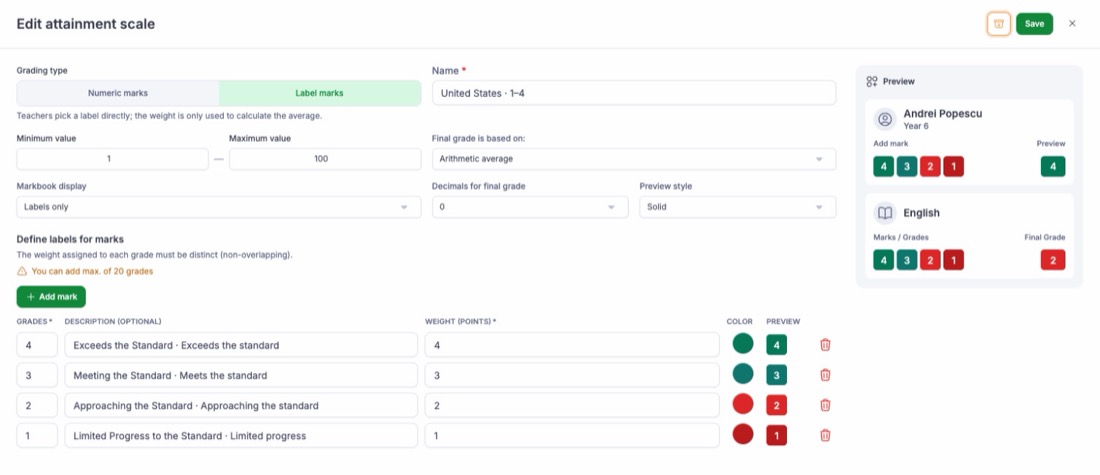
United States · 1–4
Attainment scale for years 1-5 (plus Kindergarten before year 1) (Elementary school (Kindergarten-Grade 5)). Build it in Configuration → Assessment → Attainment scales. Recipe: Whole-number marks.
| Grade | Description | Weight | Pass |
|---|---|---|---|
| 4 | Exceeds the Standard · Exceeds the standard | 4 | yes |
| 3 | Meeting the Standard · Meets the standard | 3 | yes |
| 2 | Approaching the Standard · Approaching the standard | 2 | no |
| 1 | Limited Progress to the Standard · Limited progress | 1 | no |
United States · A–F with + and −
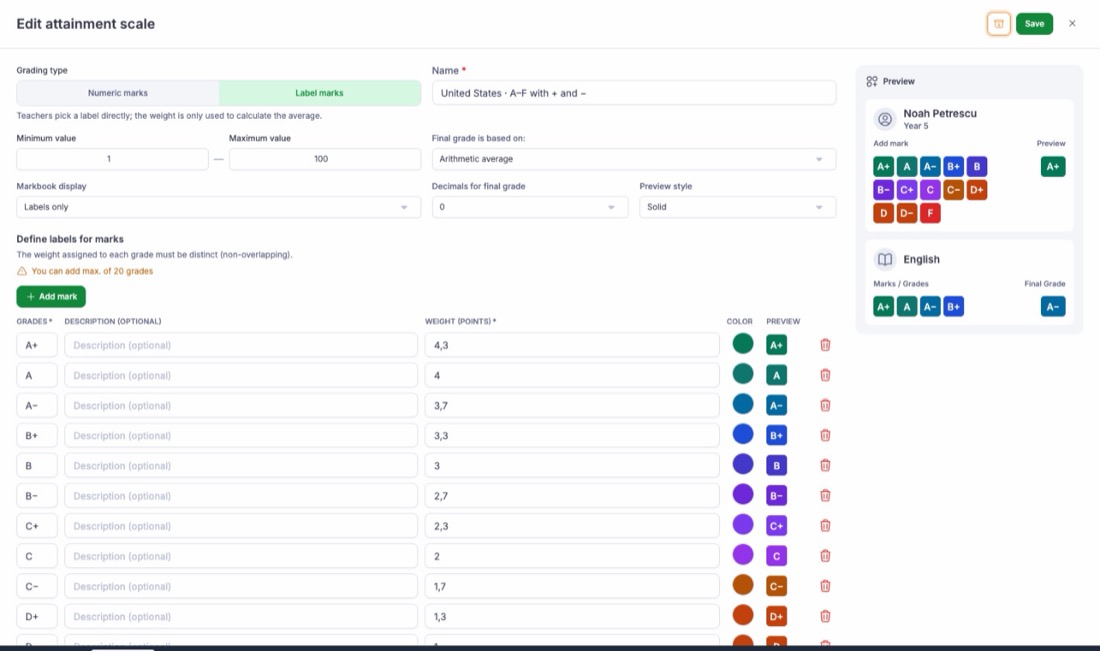
Attainment scale for years 6-12 (Middle and high school). Build it in Configuration → Assessment → Attainment scales. Recipe: Letters.
| Grade | Description | Weight | Pass |
|---|---|---|---|
| A+ | 4.3 | yes | |
| A | 4 | yes | |
| A− | 3.7 | yes | |
| B+ | 3.3 | yes | |
| B | 3 | yes | |
| B− | 2.7 | yes | |
| C+ | 2.3 | yes | |
| C | 2 | yes | |
| C− | 1.7 | yes | |
| D+ | 1.3 | yes | |
| D | 1 | yes | |
| D− | 0.7 | yes | |
| F | Fail | 0 | no |
Before you rely on this page
Confidence: medium
There is no federal rule. Each value is the most common pattern, and districts differ (standards-based 1-4, 50% floors, and so on). No federal rule exists, so every value is a 'most common' pattern, not law. The 90/80/70/60 cut-offs are the NCES research default; many districts differ. State test performance-level names and SAT/ACT scales are from general knowledge and the College Board page (AP 1-5 confirmed); state test labels were not checked state by state. Standards-based grading is spreading (post-2020 several districts adopted 'equitable grading' with 0-4 or 50% floors), so a given school may differ. Labels of other districts mentioned (Santa Monica-Malibu, Madison) were seen only in search snippets, not opened.
Sources (4)
- NCES High School Transcript Study: How GPA is calculated (grade conversion table) (official)
- NCES State Education Reforms, Table 3.3: State course credit requirements for high school graduation, 2018 (official)
- Dover Area School District: Elementary Assessment and Grading (standards-based 1-4, trimesters)
- College Board: About AP Scores