
🏴 United Kingdom - Scotland
This page describes how schools in United Kingdom - Scotland grade pupils, from the first year of primary school (year 1, about age 6–7) to the end of upper secondary, and how to build the same system in MarkBook. Back to Find Your Country.
Check the current rules
This description comes from public sources (ministry pages, national laws, Eurydice) read in October 2026. Rules change with reforms, and schools often have local rules. Check the current official text for anything your school reports to the ministry.
How pupils are graded
Before year 1: Early learning and childcare (age 3-5) is part of Early level but is not graded. P1 starts between 4.5 and 5.5, so Scotland has 13 school years (P1-P7, S1-S6); S5 or S6 is the last year before university, and S4-S6 are partly optional after age 16.
| Years | Stage | Scale | Pass | Recipe |
|---|---|---|---|---|
| 1-4 (P1-P4) | Primary - Early and First level (P1-P4) | CfE level achieved: Early level by end of P1, First level by end of P4 | Set by the school | Words |
| 5-7 (P5-P7) | Primary - Second level (P5-P7) | CfE level achieved: Second level by end of P7 | Set by the school | Words |
| 8-10 (S1-S3) | Secondary BGE - Third and Fourth level (S1-S3) | CfE Third or Fourth level achieved by end of S3 | Set by the school | Words |
| 11-13 (S4-S6) | Senior Phase - National Qualifications (S4-S6) | N5/Higher/Advanced Higher: A-D, No Award; N2-N4: pass/fail | C is the conventional pass; D means the course is awarded (government leaflets say A-C pass, D recognises achievement) | School decides |
The year. School year August to late June, usually four terms. Schools report to parents at least once a year in writing and hold parents' evenings; the format is set by the local authority or school. National Qualification results arrive in early August.
Averages and rounding. No averages of marks in the BGE. Teachers make a professional judgement on whether a learner has 'achieved' a CfE level in literacy and numeracy; this is collected nationally at the end of P1, P4, P7 and S3. National 5, Higher and Advanced Higher grades come from the course assessment (exam plus coursework) with boundaries set each year. Results also show a band 1-7 inside the grade.
Passing the year. Pupils move up by age each year. No year-level pass/fail. In the Senior Phase each course is passed or not on its own.
Conduct. No national conduct grade. Schools may report effort or behaviour on their own scale (not official).
Differences between regions or school types. The 32 local authorities set report formats and tracking tools. Independent schools may enter English GCSE/A level or IB instead of National Qualifications.
Common practice that is not official. Not official: percentage marks on unit tests; working-towards / predicted N5 or Higher grades A-D in S3-S6 tracking; 'developing / consolidating / secure' inside a CfE level; effort ratings.
National exams.
- Scottish National Standardised Assessments (SNSA) (year P1, P4, P7, S3): Diagnostic report; no pass or fail mark
- National 2, 3, 4 (year S4-S6): Pass / fail (ungraded)
- National 5, Higher, Advanced Higher (year S4 (N5), S5 (Higher), S6 (Advanced Higher)): A, B, C, D; below D = No Award; bands 1-7 (upper A = 1 ... D = 7)
Words you will meet
Curriculum for Excellence (CfE) level (Early, First, Second, Third, Fourth); Broad General Education (BGE); Senior Phase; National Qualifications (National 3, National 4, National 5, Higher, Advanced Higher); grade; 'No Award'; report; P1-P7 (primary), S1-S6 (secondary).
Set it up in MarkBook
BGE: a descriptor scale for each CfE level (for example 'Not yet / Developing / Consolidating / Secure / Level achieved', points 0-4, pass at 'Level achieved') with one column per term for literacy, numeracy and each curriculum area; no average, the teacher sets the end-of-year judgement. Senior Phase: a scale A, B, C, D, No Award (points 4,3,2,1,0) with pass flags on A-D, plus an optional band 1-7 column; columns per term: working grade, predicted grade, prelim (mock) percentage. A calculated column can map prelim percentages to A-D with editable boundaries (default D 40, C 50, B 60, A 70) and no rounding beyond whole percent.
The scales, ready to copy
These are the scales as MarkBook shows them in the scale editor. Build yours with the same grades, descriptions and weights. Each scale links to the recipe that explains it on Set Up Any Grading System.
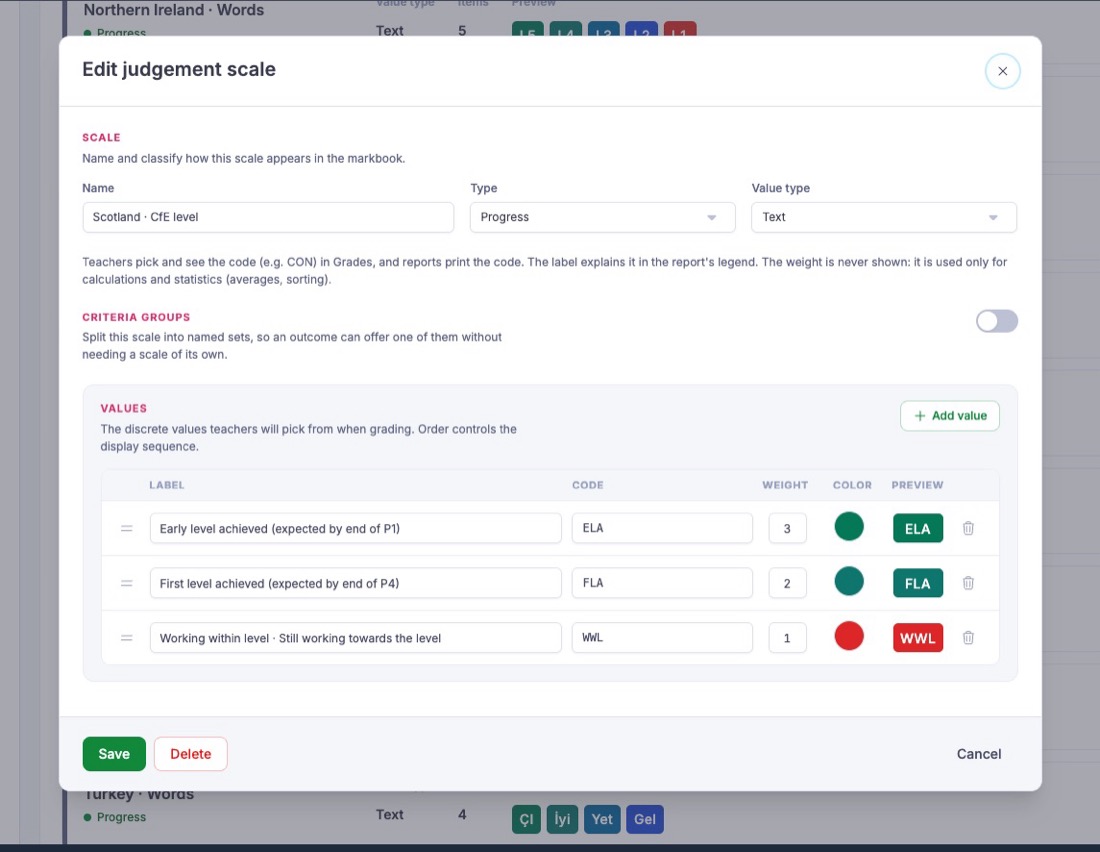
Scotland · CfE level
Judgement scale for years 1-4 (P1-P4) (Primary - Early and First level (P1-P4)). Build it in Configuration → Assessment → Judgement scales. Recipe: Words instead of marks.
| Grade | Description | Weight | Pass |
|---|---|---|---|
| Early level achieved | Early level achieved (expected by end of P1) | 3 | yes |
| First level achieved | First level achieved (expected by end of P4) | 2 | yes |
| Working within level | Still working towards the level | 1 | no |
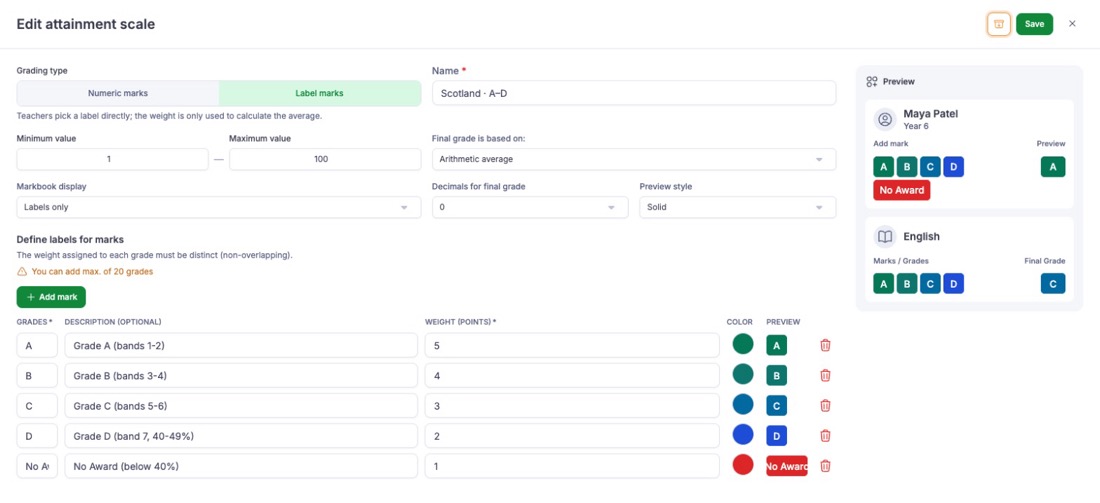
Scotland · A–D
Attainment scale for years 11-13 (S4-S6) (Senior Phase - National Qualifications (S4-S6)). Build it in Configuration → Assessment → Attainment scales. Recipe: Letters.
| Grade | Description | Weight | Pass |
|---|---|---|---|
| A | Grade A (bands 1-2) | 5 | yes |
| B | Grade B (bands 3-4) | 4 | yes |
| C | Grade C (bands 5-6) | 3 | yes |
| D | Grade D (band 7, 40-49%) | 2 | yes |
| No Award | No Award (below 40%) | 1 | no |
Before you rely on this page
Confidence: medium
SQA's page confirmed only the D band (40-49%) and the 1-7 bands; the A 70 / B 60 / C 50 percentage cut-offs are the commonly cited notional values, and real boundaries move each year. The Hayward review and the Education (Scotland) Act 2025 (Qualifications Scotland, operational early 2026) may change Senior Phase assessment; no grading change was in force for 2026 exams.
Sources (4)
- SQA - Grades and bands FAQ (official)
- Education Scotland Parentzone - Curriculum levels (official)
- SQA - Becoming Qualifications Scotland (official)
- Scottish Government - Achievement of CfE levels statistics (official)