
🇬🇧 United Kingdom - Northern Ireland
This page describes how schools in United Kingdom - Northern Ireland grade pupils, from the first year of primary school (year 1, about age 6–7) to the end of upper secondary, and how to build the same system in MarkBook. Back to Find Your Country.
Check the current rules
This description comes from public sources (ministry pages, national laws, Eurydice) read in October 2026. Rules change with reforms, and schools often have local rules. Check the current official text for anything your school reports to the ministry.
How pupils are graded
Before year 1: Pre-school is not graded. Compulsory school starts at age 4 (Year 1 = P1), so NI numbers 14 years (Years 1-14); the Foundation Stage (Years 1-2) uses written comments only.
| Years | Stage | Scale | Pass | Recipe |
|---|---|---|---|---|
| NI Years 1-2 (age 4-6; ~pre-primary and year 1) | Foundation Stage | No marks; written comments | Not applicable | Written description |
| NI Years 3-7 (~years 2-6) | Key Stage 1 and 2 (primary) | Levels of Progression 1-7 in Communication, Using Mathematics, Using ICT (end of Year 4 and Year 7) | Expected Level 2 at end of KS1, Level 4 at end of KS2 | Words |
| NI Years 8-10 (~years 7-9) | Key Stage 3 (lower secondary) | Levels of Progression; expected Level 5 at end of Year 10 | Level 5 | Words |
| NI Years 11-12 (~years 10-11) | Key Stage 4 (GCSE) | A*, A, B, C*, C, D, E, F, G, U (CCEA) | C (C* = 'strong pass' equivalent of 9-1 grade 5) | Letters |
| NI Years 13-14 (~years 12-13) | Post-16 (AS/A level) | A*-E, U | E | Letters |
The year. Three terms (Sept-June). Schools must give parents an annual written report by 30 June; it must state the Level of Progression in Communication, Using Mathematics and Using ICT at the end of each key stage. Many schools report more often.
Averages and rounding. No national average of marks. Levels of Progression are teacher judgements at the end of Years 4, 7 and 10. GCSE/A level grades are set by the awarding body with yearly boundaries.
Passing the year. Pupils move up by age. No year-level pass/fail.
Conduct. No national conduct grade.
Differences between regions or school types. Grammar schools select by transfer test; non-selective schools do not. Schools may enter CCEA (A*-G with C*) or English boards (9-1), so one school can hold both scales.
Common practice that is not official. Not official: percentage marks on tests and exams, target and predicted GCSE grades, effort grades, and school-made steps inside Levels of Progression.
National exams.
- End of key stage Levels of Progression (year NI Years 4, 7, 10): Levels 1-7; expected: KS1 Level 2, KS2 Level 4, KS3 Level 5
- Transfer tests (AQE / SEAG) (year NI Year 7): Standardised scores (set by the test bodies)
- GCSE (CCEA and other boards) (year NI Year 12): CCEA: A*-G including C* (9 letter grades), U; English boards' GCSEs: 9-1
- AS / A level (year NI Years 13-14): A level A*-E, U; AS A-E, U
Words you will meet
Levels of Progression (LoP); Communication, Using Mathematics, Using ICT; Foundation Stage; Key Stage; annual report; GCSE; transfer test (unregulated).
Set it up in MarkBook
Primary/KS3: a Level of Progression scale 1-7 (points 1-7) for Communication, Using Mathematics and Using ICT, one column per term with the end-of-key-stage judgement as the year result; other subjects get comment columns. GCSE: a CCEA scale A*, A, B, C*, C, D, E, F, G, U (points 9..1, U=0) and, if needed, a second 9-1 scale for English-board subjects linked by a conversion; columns per term: working-at, target, predicted. A level: A*-E, U. Calculated averages are optional and should round to the nearest whole level or grade point.
The scales, ready to copy
These are the scales as MarkBook shows them in the scale editor. Build yours with the same grades, descriptions and weights. Each scale links to the recipe that explains it on Set Up Any Grading System.
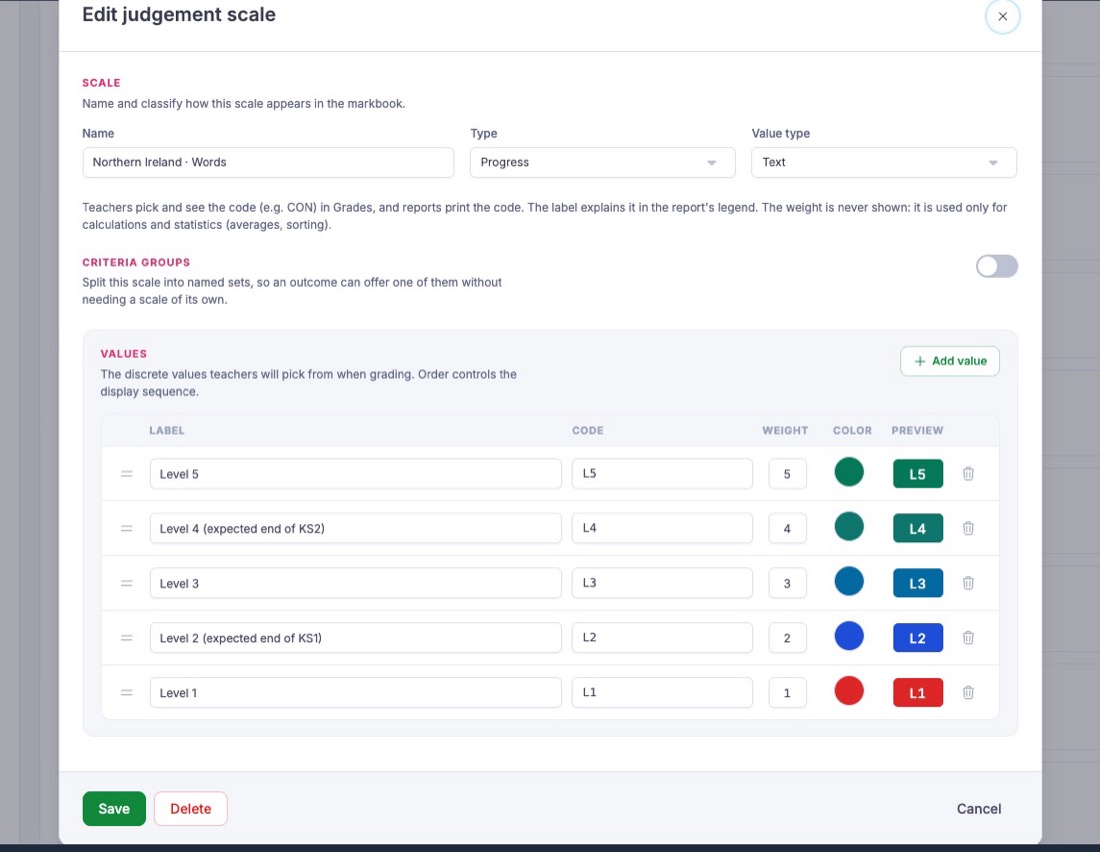
Northern Ireland · Words
Judgement scale for years NI Years 3-7 (~years 2-6) (Key Stage 1 and 2 (primary)). Build it in Configuration → Assessment → Judgement scales. Recipe: Words instead of marks.
| Grade | Description | Weight | Pass |
|---|---|---|---|
| Level 5 | 5 | yes | |
| Level 4 | Level 4 (expected end of KS2) | 4 | yes |
| Level 3 | 3 | yes | |
| Level 2 | Level 2 (expected end of KS1) | 2 | yes |
| Level 1 | 1 | no |
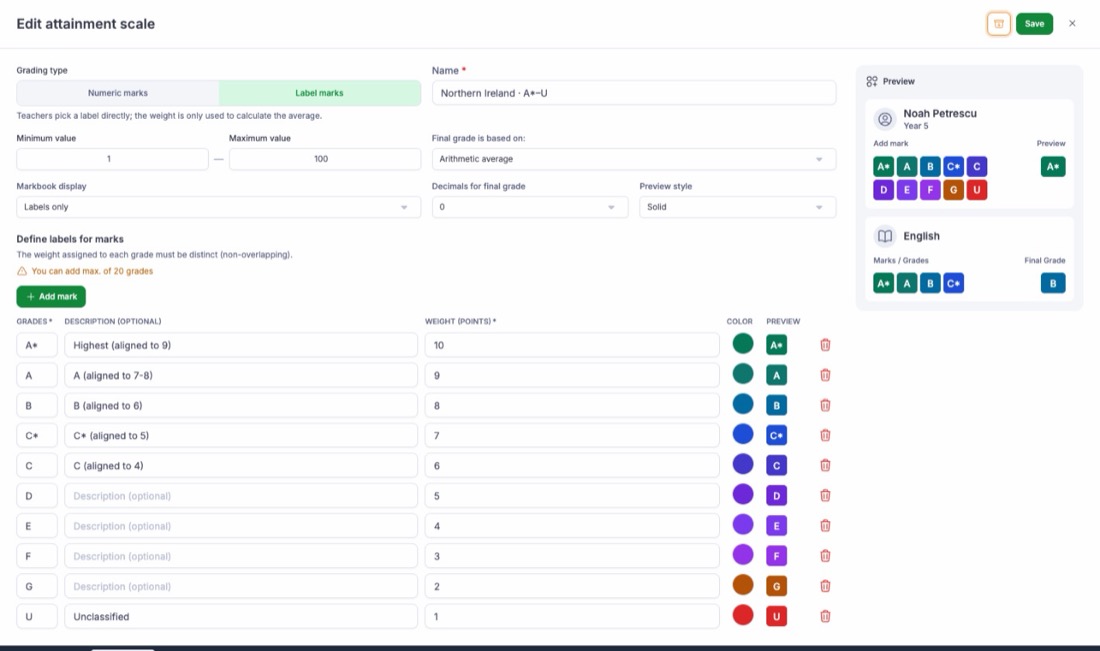
Northern Ireland · A*–U
Attainment scale for years NI Years 11-12 (~years 10-11) (Key Stage 4 (GCSE)). Build it in Configuration → Assessment → Attainment scales. Recipe: Letters.
| Grade | Description | Weight | Pass |
|---|---|---|---|
| A* | Highest (aligned to 9) | 10 | yes |
| A | A (aligned to 7-8) | 9 | yes |
| B | B (aligned to 6) | 8 | yes |
| C* | C* (aligned to 5) | 7 | yes |
| C | C (aligned to 4) | 6 | yes |
| D | 5 | yes | |
| E | 4 | yes | |
| F | 3 | yes | |
| G | 2 | yes | |
| U | Unclassified | 1 | no |
Before you rely on this page
Confidence: medium
Statutory key stage assessment is under review; nidirect says sample literacy/numeracy assessments stay until 2028-29, a new curriculum is phased in from 2028-29, and new statutory assessments start March 2030 (Year 4) and March 2031 (Years 7 and 10). CCEA's own pages returned 403, so the C* details and expected levels are from search summaries and nidirect. Transfer test scales not verified.