
🏴 United Kingdom - England
This page describes how schools in United Kingdom - England grade pupils, from the first year of primary school (year 1, about age 6–7) to the end of upper secondary, and how to build the same system in MarkBook. Back to Find Your Country.
Full step-by-step guide
There is a full guide for this country, with every click: England full guide.
Check the current rules
This description comes from public sources (ministry pages, national laws, Eurydice) read in October 2026. Rules change with reforms, and schools often have local rules. Check the current official text for anything your school reports to the ministry.
How pupils are graded
Before year 1: Reception (age 4-5) is not graded. The EYFS profile records 'expected' or 'emerging' for each early learning goal. England Year 1 starts at age 5, so England has 13 school years (Years 1-13) after Reception.
| Years | Stage | Scale | Pass | Recipe |
|---|---|---|---|---|
| 0 (Reception, age 4-5) | EYFS Reception (pre-primary) | Each early learning goal: 'expected' or 'emerging' | Set by the school | Words |
| 1-2 (England Years 1-2) | Key stage 1 (infant) | No official mark scale. Optional KS1 teacher assessment codes: PKS / WTS / EXS / GDS, HNM | EXS (expected standard) | Words |
| 3-6 (England Years 3-6) | Key stage 2 (junior) | Classroom: no national scale (school descriptors). End of KS2: scaled scores 80-120 (tests) and PKS/WTS/EXS/GDS (writing) | Scaled score 100 / EXS | School decides |
| 7-9 (England Years 7-9) | Key stage 3 (lower secondary) | No national scale. Schools choose: commonly GCSE-style 9-1 'working at' grades, percentages, or descriptors | Set by the school | School decides |
| 10-11 (England Years 10-11) | Key stage 4 (GCSE) | 9-1, 9 best, U below 1 | 4 = standard pass, 5 = strong pass (any grade 1-9 is an awarded grade) | Whole-number marks |
| 12-13 (England Years 12-13) | Key stage 5 (sixth form, A level) | A*-E, U (AS: A-E, U) | E | Letters |
The year. Three terms: autumn (Sept-Dec), spring (Jan-Easter), summer (Easter-July), each with a half-term break. The head teacher must send parents a written report on progress by the end of each summer term. The school may split it across the year, for example one report per term. Exam results that arrive after the term ends must reach parents within 15 days. Most secondary schools also send 2-3 short 'data drops' or interim reports per year (school practice).
Averages and rounding. There is no national rule for averages. No national mean of class marks exists. Teachers make a summative judgement (for example 'working at the expected standard', or a GCSE-style 'working at grade 5'). End-of-key-stage outcomes are national tests converted from raw marks to scaled scores by fixed annual conversion tables, or teacher assessment against national frameworks. GCSE and A level grades come from exam boards: raw marks are converted with grade boundaries set each year. Schools that average internally choose their own method.
Passing the year. Pupils move up by age every year. Repeating a year is rare and is not driven by marks. There is no pass/fail for a school year.
Conduct. No national conduct grade. Many schools report 'attitude to learning', effort or behaviour on their own 1-4 or 1-5 scale. This is school practice, not official.
Differences between regions or school types. Rules are for state schools in England. Academies and independent schools need not follow the national curriculum but most still enter GCSE/A level and (state schools) the KS2 tests. Internal KS3 and in-year scales differ from school to school. Wales, Scotland and Northern Ireland are separate systems.
Common practice that is not official. Not official: GCSE-style 9-1 'working at', 'target' and 'predicted' grades from Year 7; fine grades such as 5+ / 5- or 5.3; percentages on tests; effort or attitude-to-learning 1-4; flight paths; primary 'emerging / developing / secure / mastery' steps.
National exams.
- Phonics screening check (year Year 1 (age 5-6); retake in Year 2): 0-40 marks; pupils at or above the threshold reach the expected standard (threshold 32 in 2023 and 2024)
- Multiplication tables check (MTC) (year Year 4 (age 8-9)): Score out of 25
- End of key stage 2 national tests (SATs) (year Year 6 (age 10-11)): Scaled score 80-120; 100 or more = expected standard
- GCSE (year Year 11 (age 15-16)): 9-1 (9 best), U = unclassified
- A level / AS level (year Year 13 (age 17-18); AS often Year 12): A level A*-E, U; AS A-E, U
Words you will meet
grade, mark, score, 'scaled score', 'expected standard', 'working towards / working at / greater depth'; term (autumn, spring, summer); report / school report; key stage (KS); predicted grade, target grade (school practice).
Set it up in MarkBook
Primary: one descriptor scale GDS / EXS / WTS / PKS (points 4/3/2/1, pass at EXS) for reading, writing and maths per term; a numeric 80-120 column for KS2 scaled scores in Year 6. Secondary: a 9-1 + U grade scale (U=0, 1-9 = points 1-9; pass flag at 4) for working-at, target (TG) and predicted grade columns per term; an effort scale 1-4. Sixth form: A*-E, U scale (A*=6 ... E=1, U=0). Per term (autumn, spring, summer) add columns: working-at grade, effort, and a comment; a calculated value-added column = working-at minus target. No arithmetic year average is official: let the summer working-at grade be the year result, or average the term points and round to the nearest whole grade if the school wants a mean.
The scales, ready to copy
These are the scales as MarkBook shows them in the scale editor. Build yours with the same grades, descriptions and weights. Each scale links to the recipe that explains it on Set Up Any Grading System.
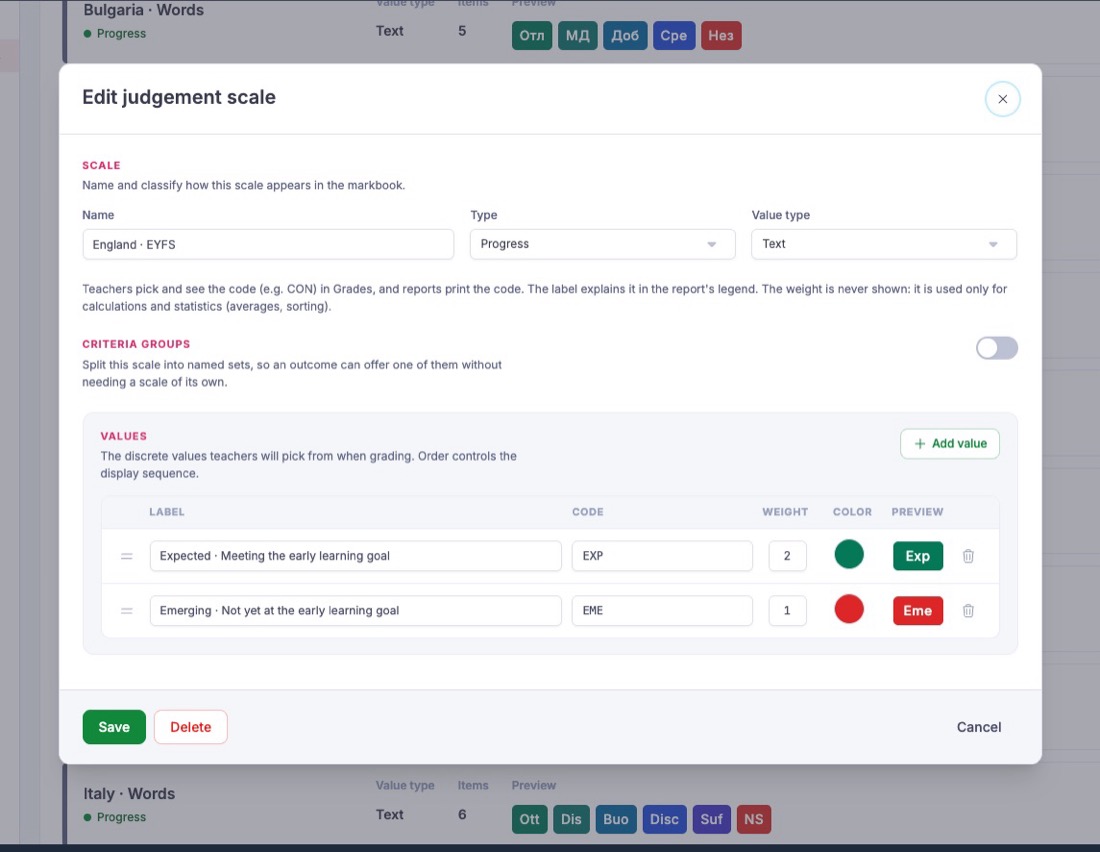
England · EYFS
Judgement scale for years 0 (Reception, age 4-5) (EYFS Reception (pre-primary)). Build it in Configuration → Assessment → Judgement scales. Recipe: Words instead of marks.
| Grade | Description | Weight | Pass |
|---|---|---|---|
| Expected | Meeting the early learning goal | 2 | yes |
| Emerging | Not yet at the early learning goal | 1 | no |
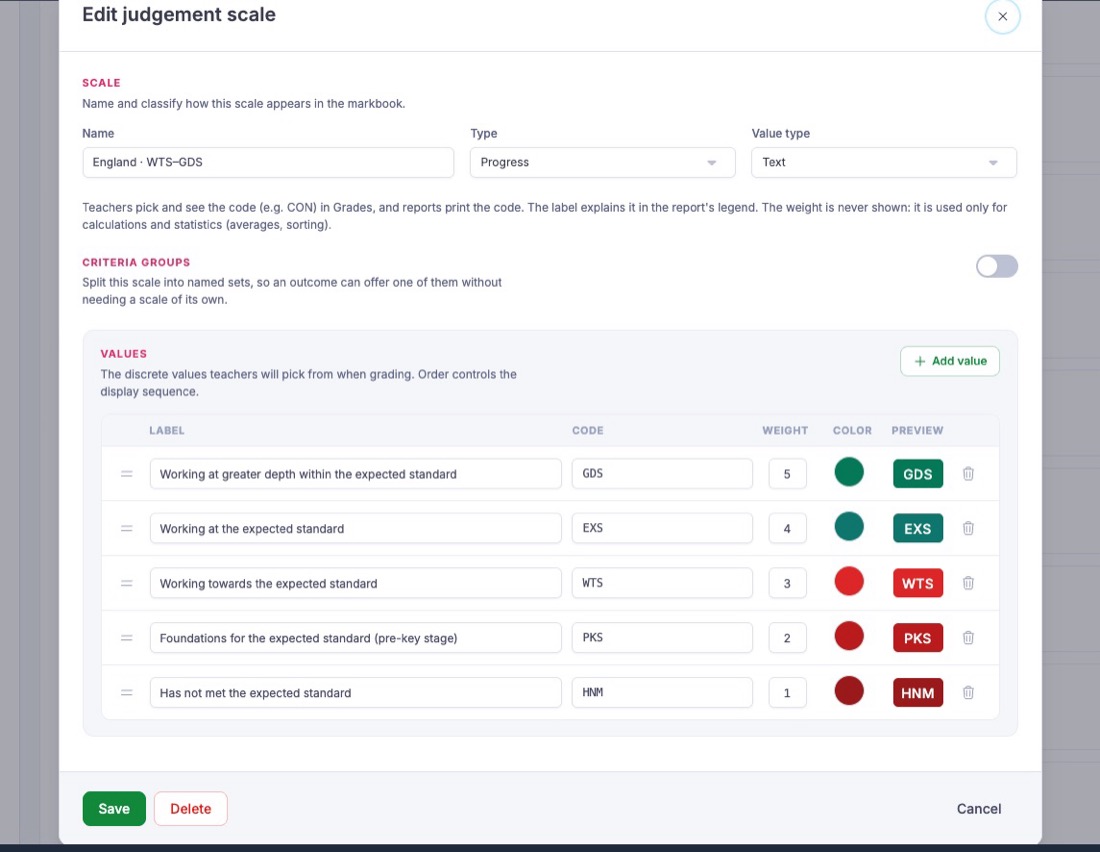
England · WTS–GDS
Judgement scale for years 1-2 (England Years 1-2) (Key stage 1 (infant)). Build it in Configuration → Assessment → Judgement scales. Recipe: Words instead of marks.
| Grade | Description | Weight | Pass |
|---|---|---|---|
| GDS | Working at greater depth within the expected standard | 5 | yes |
| EXS | Working at the expected standard | 4 | yes |
| WTS | Working towards the expected standard | 3 | no |
| PKS | Foundations for the expected standard (pre-key stage) | 2 | no |
| HNM | Has not met the expected standard | 1 | no |
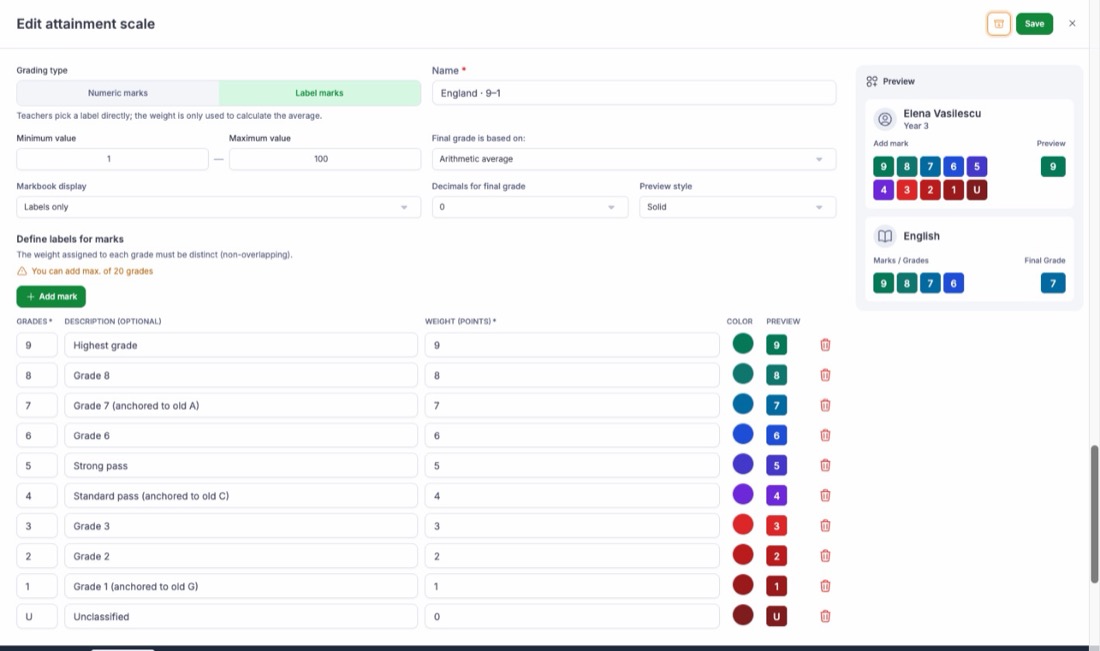
England · 9–1
Attainment scale for years 10-11 (England Years 10-11) (Key stage 4 (GCSE)). Build it in Configuration → Assessment → Attainment scales. Recipe: Whole-number marks.
| Grade | Description | Weight | Pass |
|---|---|---|---|
| 9 | Highest grade | 9 | yes |
| 8 | Grade 8 | 8 | yes |
| 7 | Grade 7 (anchored to old A) | 7 | yes |
| 6 | Grade 6 | 6 | yes |
| 5 | Strong pass | 5 | yes |
| 4 | Standard pass (anchored to old C) | 4 | yes |
| 3 | Grade 3 | 3 | no |
| 2 | Grade 2 | 2 | no |
| 1 | Grade 1 (anchored to old G) | 1 | no |
| U | Unclassified | 0 | no |
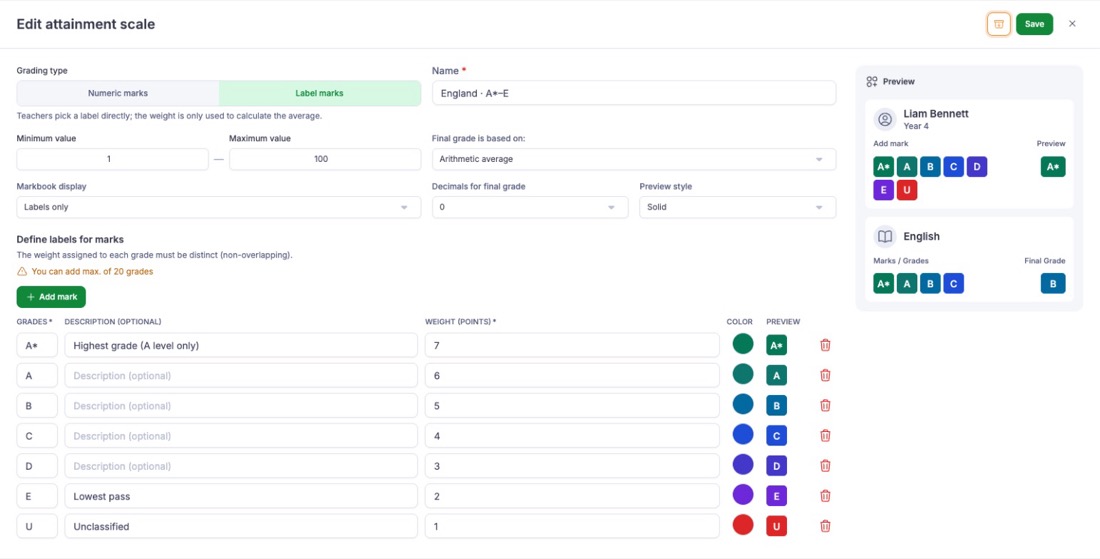
England · A*–E
Attainment scale for years 12-13 (England Years 12-13) (Key stage 5 (sixth form, A level)). Build it in Configuration → Assessment → Attainment scales. Recipe: Letters.
| Grade | Description | Weight | Pass |
|---|---|---|---|
| A* | Highest grade (A level only) | 7 | yes |
| A | 6 | yes | |
| B | 5 | yes | |
| C | 4 | yes | |
| D | 3 | yes | |
| E | Lowest pass | 2 | yes |
| U | Unclassified | 1 | no |
Before you rely on this page
Confidence: high
2026 phonics threshold (31 vs 32) not confirmed on gov.uk. The revised national curriculum (first teaching Sept 2028) and updated GCSEs (from 2029, about 10% less exam time) may change assessment; the Year 8 reading test is planned but not yet in force. Most KS1-KS3 classroom scales are school choices, not national rules.