
🇨🇭 Switzerland
This page describes how schools in Switzerland grade pupils, from the first year of primary school (year 1, about age 6–7) to the end of upper secondary, and how to build the same system in MarkBook. Back to Find Your Country.
Check the current rules
This description comes from public sources (ministry pages, national laws, Eurydice) read in October 2026. Rules change with reforms, and schools often have local rules. Check the current official text for anything your school reports to the ministry.
How pupils are graded
Before year 1: Two compulsory kindergarten years (HarmoS 1-2, from age 4) in most cantons; no marks. Zurich: also no marks in 1st class.
| Years | Stage | Scale | Pass | Recipe |
|---|---|---|---|---|
| 1 (and the 2 kindergarten years before it) | Kindergarten / Primarschule 1st year (HarmoS 1-3) | No marks. Parent meetings and/or a learning report | Not applicable | Written description |
| 2-6 | Primarschule / école primaire (primary, marked years) | 1-6, 6 best | 4 (genügend / suffisant); below 4 is insufficient | Whole-number marks |
| 7-9 | Sekundarstufe I / secondaire I / scuola media (lower secondary) | 1-6, 6 best | 4 | Whole-number marks |
| 10-12/13 | Gymnasium / gymnase / liceo (baccalaureate school, upper secondary) | 1-6, 6 best, with half marks | 4 per subject; Matura pass by compensation rule | Whole-number marks |
Values in Primarschule / école primaire (primary, marked years)
| Value | Local word | English |
|---|---|---|
| 6 | sehr gut / très bien | very good |
| 5.5 | good to very good | |
| 5 | gut / bien | good |
| 4.5 | satisfactory to good | |
| 4 | genügend / suffisant | sufficient (pass) |
| 3.5 | just below pass | |
| 3 | ungenügend / insuffisant | insufficient |
| 2 | schwach | weak |
| 1 | sehr schwach | very weak |
Values in Sekundarstufe I / secondaire I / scuola media (lower secondary)
| Value | Local word | English |
|---|---|---|
| 6 | sehr gut | very good |
| 5 | gut | good |
| 4 | genügend | sufficient |
| 3 | ungenügend | insufficient |
| 2 | schwach | weak |
| 1 | sehr schwach | very weak |
Values in Gymnasium / gymnase / liceo (baccalaureate school, upper secondary)
| Value | Local word | English |
|---|---|---|
| 6 | sehr gut | very good |
| 5.5 | ||
| 5 | gut | good |
| 4.5 | ||
| 4 | genügend | sufficient |
| 3.5 | ||
| 3 | ungenügend | insufficient |
| 2.5 | ||
| 2 | schwach | weak |
| 1.5 | ||
| 1 | sehr schwach | very weak |
The year. Two semesters. A graded report (Zeugnis / bulletin) or a learning report at the end of each semester (Zurich: end of January and end of school year). Eurydice: pupils generally receive a graded report or learning report twice a year.
Averages and rounding. Test marks in a subject are averaged (usually arithmetic mean, sometimes weighted by the teacher, e.g. big test x2) and the semester mark is rounded to the nearest half mark (e.g. 4.74 -> 4.5, 4.75 -> 5). Rounding and the role of teacher judgement are set by each canton; many cantons say the report mark is an overall judgement based on the marks, not only a mean. Matura: the final mark per subject combines the exam result and the report marks of the last year (often 50:50) and is rounded to a half mark.
Passing the year. Cantonal rules. Typical Gymnasium rule: promoted if the sum of shortfalls below 4, counted double, is not greater than the sum of marks above 4, and not more than a set number of marks below 4. Matura (MAR/MAV): twice the sum of all deviations below 4 must not exceed the sum of all deviations above 4, and not more than four marks below 4. In compulsory school, Zurich and others decide promotion at year end after hearing parents; repeating is rare and special education is an alternative.
Conduct. Not a numeric mark in most cantons. Zurich rates work, learning and social behaviour on a four-level scale: sehr gut / gut / genügend / ungenügend. Eurydice: teachers also assess learning behaviour, attitude to work and social conduct.
Differences between regions or school types. 26 cantons, three main language regions. Common: 1-6 scale, 6 best, 4 pass, half marks, two reports a year. Differences: the first year with marks (Zurich from 2nd class; other cantons from HarmoS 3, 4 or 5); learning reports without marks in early years; names and number of lower-secondary levels; rounding rules; promotion rules; Gymnasium length (4 years in most cantons, 3 in some, 6-year long track in some). Ticino has 5 years of primary and 4 years of scuola media. HarmoS numbering counts 2 kindergarten years, so HarmoS 3 = 1st primary class.
Common practice that is not official. Teachers score tests in points and convert to a mark with a linear formula, often mark = 5 x (points / max points) + 1, rounded to a half or tenth; this is common practice, not law. Some teachers use quarter marks or decimals on tests.
National exams.
- Gymnasiale Maturität / maturité gymnasiale (cantonal baccalaureate, federally recognised) (year 12 or 13): 1-6 with halves; pass by double-compensation rule, max 4 marks below 4
- Cantonal comparison / orientation tests (e.g. Stellwerk, Check S2/S3, épreuves cantonales de référence) (year various): Points or marks, canton-specific
Words you will meet
German: Note (mark), Zeugnis (report), Semester, Durchschnitt (average), Promotion (promotion), Matura / Maturität (school-leaving qualification). French: note, bulletin scolaire, semestre, moyenne, promotion, maturité. Italian: nota, pagella, semestre, media, maturità.
Set it up in MarkBook
Create a scale 'Note 1-6' with values 1, 1.5 ... 6 (points equal to the value, higher is better, pass at 4). For the first marked year use a comment column or a 4-level behaviour scale only. Per semester, add test columns (each with a weight, default 1) and a calculated weighted mean rounded to the nearest 0.5 for the report mark; allow a teacher override. Add a 'Verhalten' scale (sehr gut / gut / genügend / ungenügend) for work, learning and social behaviour. For the Gymnasium, add a Matura exam column and a final mark = mean of last-year report mark and exam mark, rounded to 0.5, plus a calculated pass check (double-compensation rule).
The scales, ready to copy
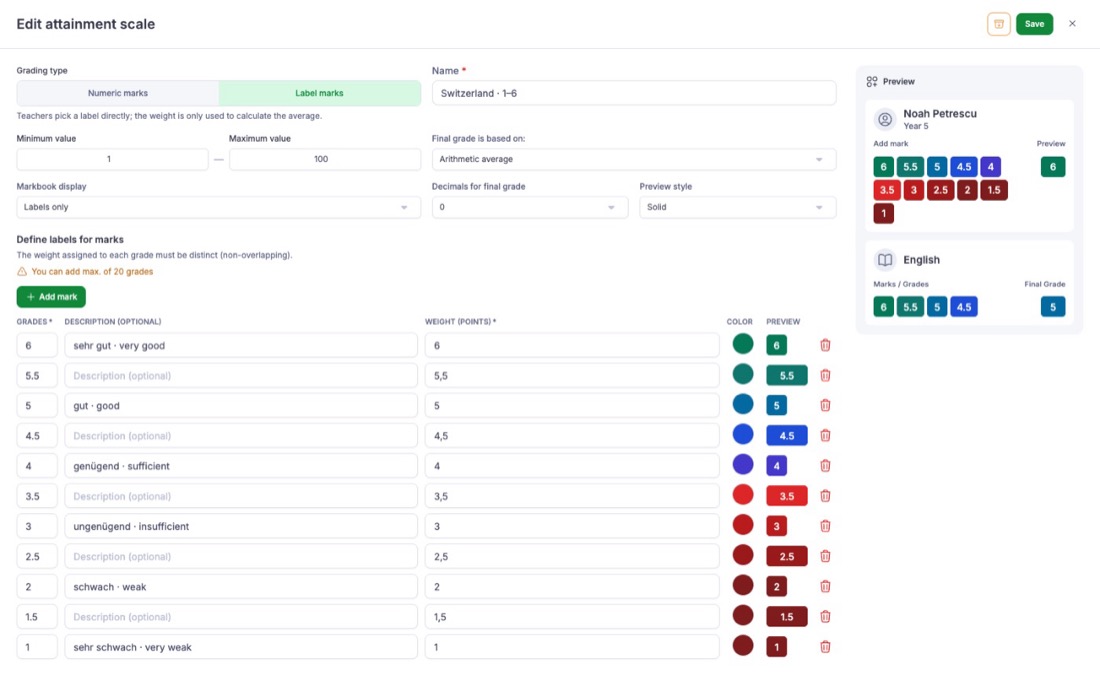
These are the scales as MarkBook shows them in the scale editor. Build yours with the same grades, descriptions and weights. Each scale links to the recipe that explains it on Set Up Any Grading System.
Switzerland · 1–6
Attainment scale for years 10-12/13 (Gymnasium / gymnase / liceo (baccalaureate school, upper secondary)). Build it in Configuration → Assessment → Attainment scales. Recipe: Whole-number marks.
| Grade | Description | Weight | Pass |
|---|---|---|---|
| 6 | sehr gut · very good | 6 | yes |
| 5.5 | 5.5 | yes | |
| 5 | gut · good | 5 | yes |
| 4.5 | 4.5 | yes | |
| 4 | genügend · sufficient | 4 | yes |
| 3.5 | 3.5 | no | |
| 3 | ungenügend · insufficient | 3 | no |
| 2.5 | 2.5 | no | |
| 2 | schwach · weak | 2 | no |
| 1.5 | 1.5 | no | |
| 1 | sehr schwach · very weak | 1 | no |
Before you rely on this page
Confidence: medium
The rules differ by canton. The verbal labels for marks 1-3, half marks in compulsory school, and the first marked year in Romandie and Ticino are not confirmed. The revised MAR/MAV (from 2024, with a transition) may change the Matura pass rule. Confirmed: 1-6 scale, 6 best, 4 pass, half marks at Gymnasium; two reports a year; Zurich marks from 2nd class and the four-level behaviour scale; Matura double-compensation rule and max four marks below 4 (MAR 2007 version). Not confirmed from a source I opened: the verbal labels for 3, 2 and 1 (they differ by canton); whether half marks are allowed on compulsory-school reports in every canton; the first marked year in Romandie and Ticino; rounding rules per canton; the linear point-to-mark formula (common teacher practice only). Reform: the revised MAR/MAV from the WEGM project (adopted 2023, in force from 2024 with a transition; new rules apply to cohorts from about 2027-2028) may change the Matura pass rules and subject list; I could not confirm the new pass rule text. Vaud simplified its Cadre général de l'évaluation in 2021.