
🇸🇪 Sweden
This page describes how schools in Sweden grade pupils, from the first year of primary school (year 1, about age 6–7) to the end of upper secondary, and how to build the same system in MarkBook. Back to Find Your Country.
Check the current rules
This description comes from public sources (ministry pages, national laws, Eurydice) read in October 2026. Rules change with reforms, and schools often have local rules. Check the current official text for anything your school reports to the ministry.
How pupils are graded
Before year 1: Förskoleklass (age 6) is compulsory but not graded.
| Years | Stage | Scale | Pass | Recipe |
|---|---|---|---|---|
| 0 (before year 1) | Förskoleklass (preschool class) | No grades | Not applicable | Written description |
| 1-5 | Grundskola, årskurs 1-5 (primary) | No grades; development talk each term and written individual development plan | Not applicable | Written description |
| 6-9 | Grundskola, årskurs 6-9 (upper primary / lower secondary) | A-F, A best; dash (–) when there is too little basis | E | Letters |
| 10-12 | Gymnasieskola (upper secondary, 3-year programmes) | A-F, A best; dash (–) | E | Letters |
Values in Grundskola, årskurs 6-9 (upper primary / lower secondary)
| Value | Local word | English |
|---|---|---|
| A | A | excellent (highest) |
| B | B | very good (between A and C) |
| C | C | good |
| D | D | satisfactory (between C and E) |
| E | E | sufficient (lowest pass) |
| F | F | fail (not passed) |
| – | streck | no grade: too little basis (absence) |
The year. Two terms: hösttermin (autumn, August-December) and vårtermin (spring, January-June). Development talk with pupil and parents at least once per term. From year 6, a grade per subject at the end of each term. Upper secondary: course or subject grades when the course/level ends.
Averages and rounding. A grade is a teacher's overall judgement against national grading criteria. It is not a mean of test results; for E all criteria for E must be met. Merit value (year 9): A=20, B=17.5, C=15, D=12.5, E=10, F=0; sum of the 16 best final grades (max 320), plus an optional 17th modern language (max 340). Upper secondary comparison number: grade values weighted by course points, divided by total points (max 20, plus extra merit points).
Passing the year. Pupils move up automatically. The head may hold back a pupil after consulting parents, which is unusual. A pupil with F gets support; for upper secondary eligibility a pass is needed in Swedish, English and mathematics plus further subjects. The gymnasieexamen needs grades in all courses and a passed diploma project, with a minimum share of passed points.
Conduct. No conduct grade.
Differences between regions or school types. National rules for municipal and independent (friskola) schools alike. Compulsory special schools (anpassad grundskola) give grades from year 7 and do not use F. Gymnasium programmes differ in courses, not in the scale.
Common practice that is not official. Teachers often mark tests with points, or with E/C/A-level ticks per task, and sometimes give 'E+' or 'C-' style indications during the term. These are not official grades.
National exams.
- Nationella prov, year 3 (year 3): Pass / not pass per part (not a grade)
- Nationella prov, year 6 (year 6): A-F test result
- Nationella prov, year 9 (year 9): A-F test result
- Nationella prov, gymnasieskola (year 10-12): A-F test result
- Högskoleprovet (university aptitude test) (year after 12 (optional)): 0.00-2.00
Words you will meet
betyg (grade), terminsbetyg (term grade), slutbetyg (final grade), meritvärde (merit value), jämförelsetal (comparison number, upper secondary), termin (term: hösttermin / vårtermin), utvecklingssamtal (development talk), individuell utvecklingsplan (IUP), nationella prov (national tests), kunskapskrav / betygskriterier (grading criteria)
Set it up in MarkBook
Create one letter scale 'Swedish A-F' with points A=20, B=17.5, C=15, D=12.5, E=10, F=0 and a non-grade value '–'; E and above pass. Years 1-5: comment/assessment columns only (one written assessment per term). Years 6-9: two periods (autumn, spring), one term-grade column per subject; year 9 spring = final grade. Calculated 'merit value' = sum of the 16 best final grades plus an optional modern language (max 340). Upper secondary: one grade per course/subject level, weighted by points; average to two decimals. Plan migration to a 1-10 scale from 1 July 2028.
The scales, ready to copy
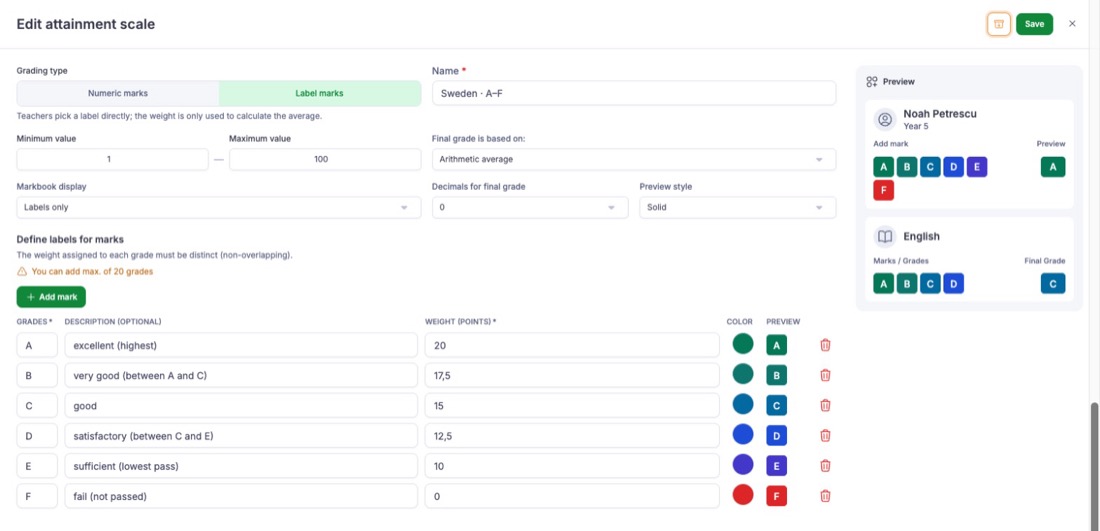
These are the scales as MarkBook shows them in the scale editor. Build yours with the same grades, descriptions and weights. Each scale links to the recipe that explains it on Set Up Any Grading System.
Sweden · A–F
Attainment scale for years 6-9 (Grundskola, årskurs 6-9 (upper primary / lower secondary)). Build it in Configuration → Assessment → Attainment scales. Recipe: Letters.
| Grade | Description | Weight | Pass |
|---|---|---|---|
| A | excellent (highest) | 20 | yes |
| B | very good (between A and C) | 17.5 | yes |
| C | good | 15 | yes |
| D | satisfactory (between C and E) | 12.5 | yes |
| E | sufficient (lowest pass) | 10 | yes |
| F | fail (not passed) | 0 | no |
Before you rely on this page
Confidence: medium
The scale is changing. The Riksdag approved a new 1-10 scale in June 2026, with most changes from 1 July 2028. Gy25 replaces course grades with subject grades from autumn 2025. Label A-F as the current scale and name the coming change. Merit-value points came from secondary guidance sites (skolkoll.se, ednia.se), not a Skolverket page I could open. Written assessment rules in years 1-5 were not confirmed. Reforms: Gy25 (from autumn 2025) replaces course grades with subject grades in upper secondary; course grades can be completed until 30 June 2030. In June 2026 the Riksdag approved a new grading scale 1-10 with no fixed pass figure, final national exams marked centrally, and a new merit model; most changes start 1 July 2028 (adult education 2031). Values and descriptors of the new scale were not confirmed.