
🇪🇸 Spain
This page describes how schools in Spain grade pupils, from the first year of primary school (year 1, about age 6–7) to the end of upper secondary, and how to build the same system in MarkBook. Back to Find Your Country.
Check the current rules
This description comes from public sources (ministry pages, national laws, Eurydice) read in October 2026. Rules change with reforms, and schools often have local rules. Check the current official text for anything your school reports to the ministry.
How pupils are graded
Before year 1: Educación Infantil (ages 0-6, second cycle 3-6) is not graded. Teachers write qualitative reports. Primary year 1 starts at age 6.
| Years | Stage | Scale | Pass | Recipe |
|---|---|---|---|---|
| 1-6 | Educación Primaria (primary) | IN / SU / BI / NT / SB (five words); national law sets no number | Suficiente (SU) | Words |
| 7-10 | Educación Secundaria Obligatoria – ESO (lower secondary) | Word + whole number 1-10, 10 best | 5 (Suficiente) | School decides |
| 11-12 | Bachillerato (upper secondary) | 0-10 whole numbers, 10 best | 5 | Whole-number marks |
Values in Educación Primaria (primary)
| Value | Local word | English |
|---|---|---|
| IN | Insuficiente | Fail / insufficient |
| SU | Suficiente | Pass / sufficient |
| BI | Bien | Good |
| NT | Notable | Very good |
| SB | Sobresaliente | Excellent |
Values in Educación Secundaria Obligatoria – ESO (lower secondary)
| Value | Local word | English |
|---|---|---|
| 1-4 | Insuficiente | Fail |
| 5 | Suficiente | Pass |
| 6 | Bien | Good |
| 7-8 | Notable | Very good |
| 9-10 | Sobresaliente | Excellent |
The year. Three terms ('evaluaciones' or 'trimestres', roughly Sept-Dec, Jan-Mar/Apr, Apr-Jun). Families receive a written report at least once per term. The third term report is the final ('evaluación final/ordinaria'). In Bachillerato there is also an extraordinary sitting for failed subjects (June/July, timing set by each community). Since LOMLOE the extraordinary sitting was removed in ESO.
Averages and rounding. Assessment is continuous, formative and integrative; the final mark is teacher judgement against evaluation criteria, not a fixed formula in national law. Schools set their own weights (exams, work, participation) in their 'criterios de calificación'. ESO and Bachillerato subject marks are whole numbers. Bachillerato stage average = arithmetic mean of all subjects, rounded to hundredths; a second standardised average excludes Religion. No national minimum number of marks.
Passing the year. Primary: collective team decision, giving special weight to the tutor; repetition only once in the stage, exceptional, with a support plan. ESO: promote with all subjects passed, or with one or two fails if the team judges recovery likely; repetition max once per year and twice in compulsory schooling. Bachillerato: move to year 2 with at most two failed subjects; the Bachiller title can be awarded with one failed subject if the stage average is at least 5.
Conduct. No official conduct grade in Spain. Behaviour is handled through the school's coexistence rules (plan de convivencia) and comments in reports.
Differences between regions or school types. 17 autonomous communities write their own curriculum and assessment orders on top of the state decrees (RD 157/2022 primary, RD 217/2022 ESO, RD 243/2022 Bachillerato). The word scale and 1-10 scale are national. Differences: report formats, Matrícula de Honor rules, extraordinary exam dates, PAU details. Many school documents (e.g. Madrid schools under Orden 130/2023) map primary words to 1-10 internally. Co-official language regions (Catalonia, Basque Country, Galicia, Valencia, Balearics) use translated labels (e.g. Catalan 'Assoliment excel·lent / notable / satisfactori / no assoliment' in Catalonia, which uses achievement levels rather than IN-SB in compulsory education). The description covers the state framework.
Common practice that is not official. Teachers commonly mark tests on 0-10 with decimals (6.75) and keep weighted percentages (e.g. exams 60%, work 30%, attitude 10%) in their own markbooks. Primary teachers often give numbers in the markbook and convert to words for the report. These decimals and weights are school/teacher practice, not official.
National exams.
- Evaluación de diagnóstico (diagnostic, census) (year 4 (primary) and 8 (2º ESO)): Competence levels, informative only
- Evaluación general del sistema (sample-based) (year 6 and end of ESO): Sample assessment, no pupil marks
- PAU (Prueba de Acceso a la Universidad, formerly EBAU/EvAU/Selectividad) (year after 12): Compulsory phase 0-10 (min 4 to count); access mark = 0.6 × Bachillerato average + 0.4 × compulsory phase, pass 5/10; specific phase adds weighted subjects (factors 0.1-0.2), up to 14 points
Words you will meet
Calificación / nota (mark); nota media (average); evaluación / trimestre (term); boletín de notas or informe de evaluación (report card); Insuficiente (IN), Suficiente (SU), Bien (BI), Notable (NT), Sobresaliente (SB); Matrícula de Honor (MH); NP = No Presentado (did not sit).
Set it up in MarkBook
Primary scale: IN=1 (fail), SU=2, BI=3, NT=4, SB=5 (pass from SU), words only on the report. ESO/Bachillerato scale: numeric 0-10 with word bands (1-4 IN, 5 SU, 6 BI, 7-8 NT, 9-10 SB), pass 5. Columns per term: assessment marks (decimals allowed in the markbook) and a 'Nota 1ª/2ª/3ª evaluación' term mark. Term mark = school-defined weighted mean, rounded to a whole number for the report. Final mark (ordinaria) = teacher judgement, usually the weighted mean of the three terms, rounded to whole number. Bachillerato: add a calculated stage average to two decimals. No conduct column.
The scales, ready to copy
These are the scales as MarkBook shows them in the scale editor. Build yours with the same grades, descriptions and weights. Each scale links to the recipe that explains it on Set Up Any Grading System.
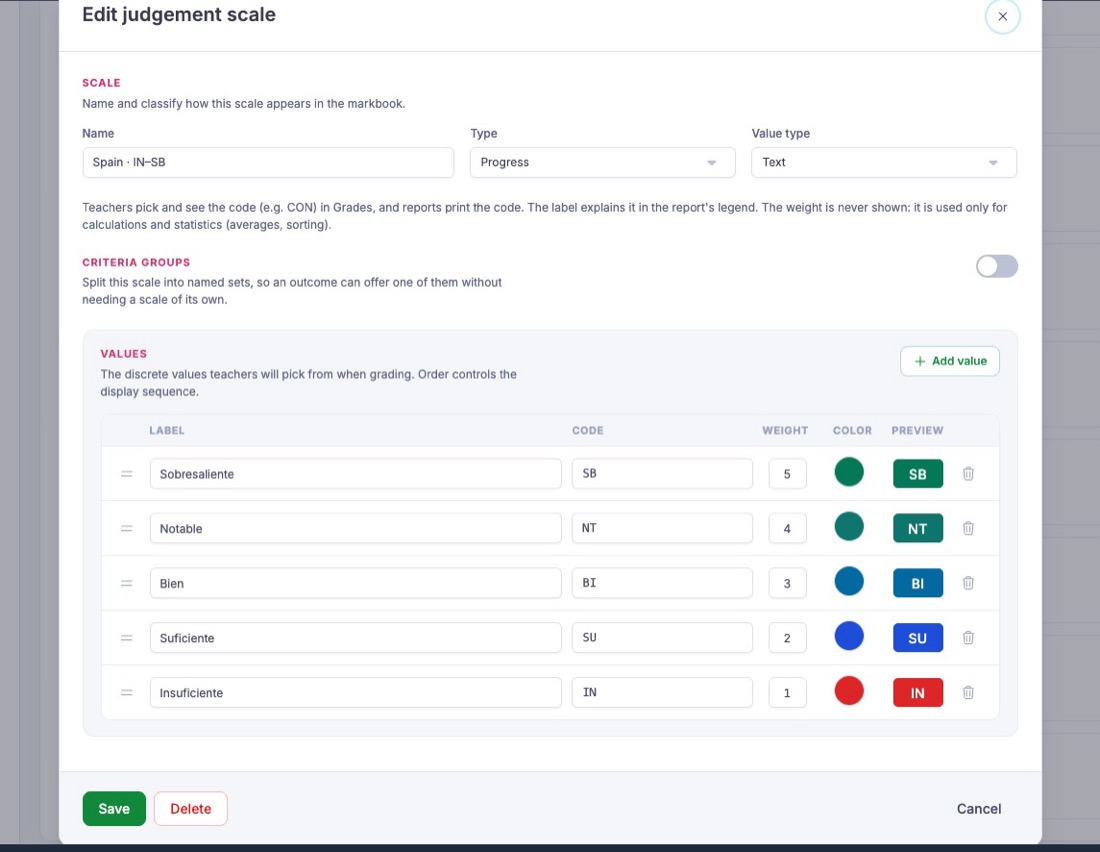
Spain · IN–SB
Judgement scale for years 1-6 (Educación Primaria (primary)). Build it in Configuration → Assessment → Judgement scales. Recipe: Words instead of marks.
| Grade | Description | Weight | Pass |
|---|---|---|---|
| SB | Sobresaliente · Excellent | 5 | yes |
| NT | Notable · Very good | 4 | yes |
| BI | Bien · Good | 3 | yes |
| SU | Suficiente · Pass / sufficient | 2 | yes |
| IN | Insuficiente · Fail / insufficient | 1 | no |
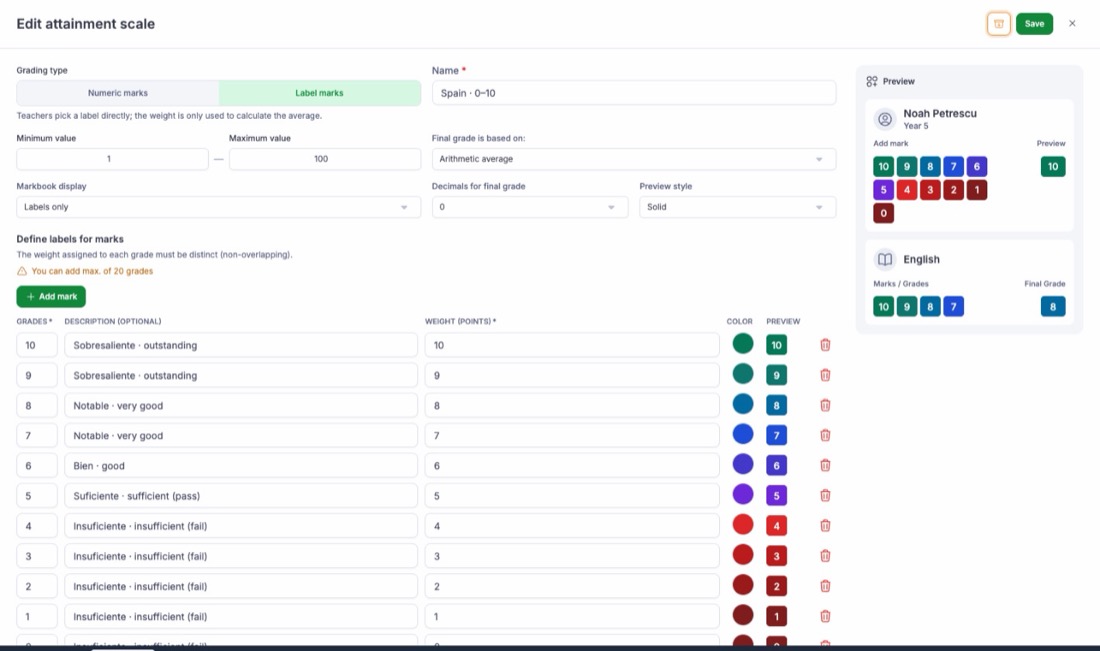
Spain · 0–10
Attainment scale for years 11-12 (Bachillerato (upper secondary)). Build it in Configuration → Assessment → Attainment scales. Recipe: Whole-number marks.
| Grade | Description | Weight | Pass |
|---|---|---|---|
| 10 | Sobresaliente · outstanding | 10 | yes |
| 9 | Sobresaliente · outstanding | 9 | yes |
| 8 | Notable · very good | 8 | yes |
| 7 | Notable · very good | 7 | yes |
| 6 | Bien · good | 6 | yes |
| 5 | Suficiente · sufficient (pass) | 5 | yes |
| 4 | Insuficiente · insufficient (fail) | 4 | no |
| 3 | Insuficiente · insufficient (fail) | 3 | no |
| 2 | Insuficiente · insufficient (fail) | 2 | no |
| 1 | Insuficiente · insufficient (fail) | 1 | no |
| 0 | Insuficiente · insufficient (fail) | 0 | no |
Before you rely on this page
Confidence: medium
LOMLOE (Law 3/2020) fully in force from 2023/24: removed numeric grades from primary at state level, removed the ESO extraordinary sitting, made promotion collective. Catalonia's exact achievement-level labels were not verified on an official page. The 14-point PAU ceiling is widely reported but its exact regulation was not opened. Regional extraordinary exam dates vary.
Sources (6)
- Eurydice – Spain: Assessment in primary education (official)
- Eurydice – Spain: Assessment in general lower secondary education (official)
- Eurydice – Spain: Assessment in general upper secondary education (official)
- BOE – Real Decreto 157/2022 (Educación Primaria) (official)
- ULPGC – Guía de estudiantes acceso 2025 (PAU) (official)
- CIUG Galicia – Convocatoria PAU 2025 (official)