
🇸🇮 Slovenia
This page describes how schools in Slovenia grade pupils, from the first year of primary school (year 1, about age 6–7) to the end of upper secondary, and how to build the same system in MarkBook. Back to Find Your Country.
Check the current rules
This description comes from public sources (ministry pages, national laws, Eurydice) read in October 2026. Rules change with reforms, and schools often have local rules. Check the current official text for anything your school reports to the ministry.
How pupils are graded
Before year 1: Vrtec (kindergarten) is not compulsory and has no marks. Basic school starts in the calendar year the child turns 6; grade 1 is part of basic school and is assessed descriptively, not with marks.
| Years | Stage | Scale | Pass | Recipe |
|---|---|---|---|---|
| 1-2 | Osnovna šola, 1. vzgojno-izobraževalno obdobje, 1.-2. razred (basic school, first two years) | Descriptive marks (opisne ocene) against the learning standards | Automatic progression | Written description |
| 3-6 | Osnovna šola, 3.-6. razred (basic school, primary part with numeric marks) | 1-5, 5 best | zadostno (2) | Whole-number marks |
| 7-9 | Osnovna šola, 7.-9. razred (basic school, lower secondary part) | 1-5, 5 best | zadostno (2) | Whole-number marks |
| 10-13 | Srednja šola – gimnazija (general upper secondary) and vocational/technical schools | 1-5, 5 best; some obligations opravil / ni opravil | zadostno (2) | Whole-number marks |
Values in Osnovna šola, 3.-6. razred (basic school, primary part with numeric marks)
| Value | Local word | English |
|---|---|---|
| 5 | odlično | excellent |
| 4 | prav dobro | very good |
| 3 | dobro | good |
| 2 | zadostno | sufficient |
| 1 | nezadostno | insufficient (fail) |
Values in Srednja šola – gimnazija (general upper secondary) and vocational/technical schools
| Value | Local word | English |
|---|---|---|
| 5 | odlično | excellent |
| 4 | prav dobro | very good |
| 3 | dobro | good |
| 2 | zadostno | sufficient |
| 1 | nezadostno | insufficient (fail) |
| opravil | opravil | passed (elective obligations, practical training) |
| ni opravil | ni opravil | not passed |
The year. Two assessment periods (ocenjevalni obdobji) in basic school. The first usually ends at the end of January; the second at the end of the school year (mid-June for grade 9, late June for others). Parents get a written report after the first period and an annual report (spričevalo) with final marks and a statement on progression. In upper secondary the school sets the periods (usually two); students get a transcript at the end of each period, except in the final year, and an annual report.
Averages and rounding. The teacher sets the final mark (zaključna ocena). Since the 2025 rulebook, the final mark 'is not necessarily the arithmetic mean of all marks'; the teacher has autonomy. There is no national rounding rule. Minimum marks per year (2025 rulebook, basic school): at least 2 for subjects with up to two lessons a week (was 3), at least 4 for subjects with more (was 6). Most marks in a subject must not come from written tests; at most two written tests a week; no written tests in the last three working days of a period; a test is repeated when half or more of the class fails. In upper secondary the teacher also sets the final mark; with two teachers, weights are agreed in advance.
Passing the year. Basic school grades 1-6: automatic progression. Grades 7-8: progression with positive marks in all subjects; with one or two negative marks the pupil takes repeat exams (popravni izpit) in the holidays; with three negative marks the pupil repeats the year. Grade 9: pupils with negative marks can retake those subjects during the following school year. Upper secondary: progression with positive marks in all subjects and all obligations done; up to three failed subjects can be retaken by popravni izpit; a year can be repeated once.
Conduct. No conduct mark in basic school or upper secondary in the sources I read. Behaviour is handled by educational measures (vzgojni ukrepi) and reprimands (opomini) under each school's rules, not graded.
Differences between regions or school types. Slovenia has one national system. In the ethnically mixed areas (Italian minority at the coast, Hungarian in Prekmurje) the language of instruction and the NPZ/matura language change, not the scale. Private schools (e.g. Waldorf, Catholic gimnazije) follow the national rules or their own approved programme.
Common practice that is not official. Not official: percentage thresholds on written tests (schools often use about 90/76/63/50% for 5/4/3/2, set in the school's own assessment rules), +/- signs and partial marks in the teacher's notebook, and computing the final mark as an average rounded at .5. Each school publishes its own 'šolska pravila ocenjevanja' (school assessment rules).
National exams.
- NPZ – nacionalno preverjanje znanja (national assessment) (year 3, 6, 9): Percentage points; no school mark
- Splošna matura (general matura) (year 13): Basic level subjects: 1-5 (nezadostno-odlično); higher level subjects: point grades 1-8; total 10-34 points for a pass
- Poklicna matura (vocational matura) (year 12 or 13): 1-5
Words you will meet
ocena (mark); opisna ocena (descriptive mark); številčna ocena (number mark); zaključna ocena (final mark of the year); povprečje (average); ocenjevalno obdobje (assessment period); spričevalo (annual report / certificate); obvestilo o uspehu (report after the first period); popravni izpit (repeat exam); splošni učni uspeh (overall success); NPZ – nacionalno preverjanje znanja (national assessment); matura.
Set it up in MarkBook
Create a 1-5 scale with values 5 odlično, 4 prav dobro, 3 dobro, 2 zadostno, 1 nezadostno; points = the number; pass from 2. Create a descriptive comment column for grades 1-2 (no scale). For upper secondary add a pass/fail scale opravil / ni opravil. Set two periods: 1. ocenjevalno obdobje (Sept-Jan) and 2. ocenjevalno obdobje (Feb-June). Per period, add mark columns tagged by method (written, oral, product, performance) so the school can check that written tests are not the majority. Add a calculated average (2 decimals) as a guide only, and a teacher-entered zaključna ocena (whole number) at year end. Show a warning when a subject has fewer than 2 or 4 marks in the year.
The scales, ready to copy
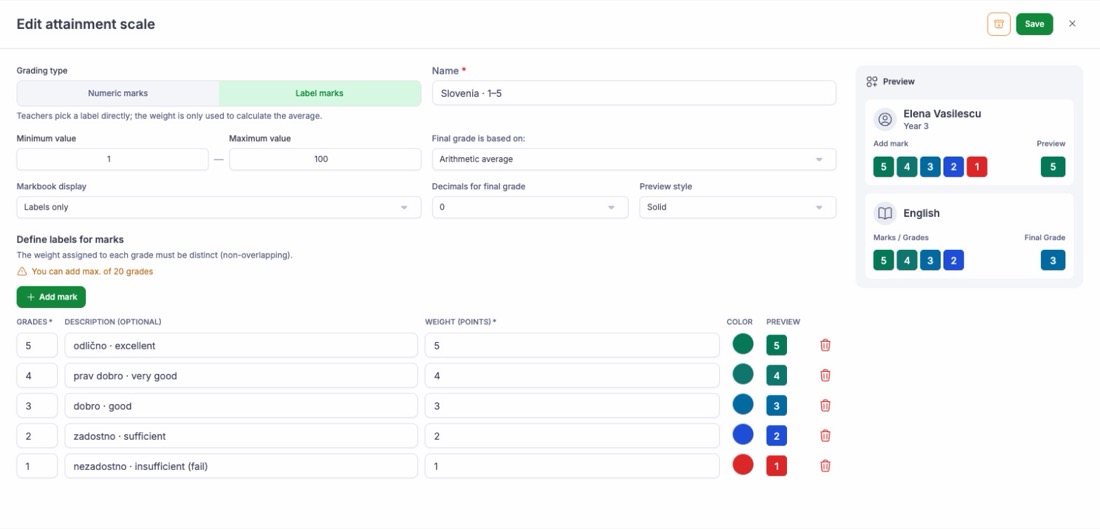
These are the scales as MarkBook shows them in the scale editor. Build yours with the same grades, descriptions and weights. Each scale links to the recipe that explains it on Set Up Any Grading System.
Slovenia · 1–5
Attainment scale for years 3-6 (Osnovna šola, 3.-6. razred (basic school, primary part with numeric marks)). Build it in Configuration → Assessment → Attainment scales. Recipe: Whole-number marks.
| Grade | Description | Weight | Pass |
|---|---|---|---|
| 5 | odlično · excellent | 5 | yes |
| 4 | prav dobro · very good | 4 | yes |
| 3 | dobro · good | 3 | yes |
| 2 | zadostno · sufficient | 2 | yes |
| 1 | nezadostno · insufficient (fail) | 1 | no |
Before you rely on this page
Confidence: medium
A new basic-school rulebook took effect in October 2025, and only Articles 1-10 were read. Which years get descriptive marks, the progression rules and whether a conduct mark exists are not confirmed under the new text. A new basic-school rulebook took effect on 18 October 2025 (school year 2025/26): fewer minimum marks, the final mark no longer has to be the mean, limits on written tests. I could read only Articles 1-10, so the exact grades with descriptive marks under the new rulebook (grades 1-2, per Eurydice and a consolidated text) and the progression rules (taken from Eurydice, which may describe the old rulebook) are not fully confirmed. The end date of the first assessment period (end of January) is from general knowledge of the school calendar, not read. The NPZ in grade 3 is per Eurydice; I did not check whether it is compulsory every year. I found no conduct mark; confirm that no 'vedenje' grade exists. Matura point details come from a ministry media document summary, not the matura law.
Sources (5)
- Eurydice: Slovenia – Assessment in single structure education (official)
- Eurydice (sl): Preverjanje in ocenjevanje v srednješolskem izobraževanju (official)
- GOV.SI: Objavljen je nov Pravilnik o ocenjevanju znanja in napredovanju učencev v osnovni šoli (17.10.2025) (official)
- Pravilnik o ocenjevanju znanja in napredovanju učencev v osnovni šoli – consolidated text 18.10.2025 (tax-fin-lex)
- N1: Že letos spremembe pri ocenjevanju v osnovnih šolah