
🇷🇸 Serbia
This page describes how schools in Serbia grade pupils, from the first year of primary school (year 1, about age 6–7) to the end of upper secondary, and how to build the same system in MarkBook. Back to Find Your Country.
Check the current rules
This description comes from public sources (ministry pages, national laws, Eurydice) read in October 2026. Rules change with reforms, and schools often have local rules. Check the current official text for anything your school reports to the ministry.
How pupils are graded
Before year 1: Pripremni predškolski program (preschool preparatory programme, compulsory, age 5.5-6.5) is not graded.
| Years | Stage | Scale | Pass | Recipe |
|---|---|---|---|---|
| 1 | Prvi razred osnovne škole (primary, year 1) | Descriptive marks only, during and at the end of each half-year, for subjects and conduct. The text states the pupil's progress towards outcomes, engagement and a recommendation. | Every pupil moves up to year 2. | Written description |
| 2-8 | Osnovna škola, od drugog do osmog razreda (primary 2-4 and lower secondary 5-8) | 1-5, 5 best. Marks are given both descriptively and numerically during the year; final marks are numerical. | 2 (dovoljan). 1 (nedovoljan) is the only failing mark. | Whole-number marks |
| 9-12 | Srednja škola - gimnazija i stručne škole (upper secondary) | 1-5, 5 best | 2 (dovoljan) | Whole-number marks |
Values in Osnovna škola, od drugog do osmog razreda (primary 2-4 and lower secondary 5-8)
| Value | Local word | English |
|---|---|---|
| 5 | odličan | Excellent |
| 4 | vrlo dobar | Very good |
| 3 | dobar | Good |
| 2 | dovoljan | Sufficient (pass) |
| 1 | nedovoljan | Insufficient (fail) |
The year. Two half-years (polugodišta): September to late December/January, and January/February to June. Each half-year has two classification periods (quarters); at the end of the 1st and 3rd quarter the class council reviews progress and informs parents. Final marks (zaključne ocene) are set at the end of the first and second half-year; a report (đačka knjižica) is issued at the half-year and the certificate (svedočanstvo) at the end of the year.
Averages and rounding. Minimum marks per half-year: primary - at least 4, or at least 2 when the subject has one lesson per week; secondary - at least 3, or at least 2 when the subject has fewer than 2 lessons per week. Otherwise no final mark can be set. Final mark per subject: proposed by the teacher, decided by the class council (odeljensko veće). It cannot be lower than the band of the arithmetic mean of ALL individual marks since the start of the school year: 5 if mean at least 4.50, 4 if 3.50-4.49, 3 if 2.50-3.49, 2 if 1.50-2.49, 1 if below 1.50. In primary it cannot be higher than the highest individual mark; in secondary it may exceptionally be the highest individual mark. The half-year final mark is NOT included in the mean at the end of the year (all individual marks are used). Overall success (opšti uspeh) in years 2-8: arithmetic mean of passing final marks in compulsory subjects, second foreign language and conduct: odličan at least 4.50, vrlo dobar 3.50-4.49, dobar 2.50-3.49, dovoljan up to 2.49; nedovoljan with fails. Not set when a subject is failed or ungraded.
Passing the year. Year 1: always moves up. Years 2-3: move up even with fails (prevođenje), per the law; repeat only by parents' decision per Eurydice. From year 4 (primary) and in secondary: a pupil with one or two final marks of 1 takes a make-up exam (popravni ispit) in June/August; more than two fails, or failing the make-up exam, means repeating the year (nedovoljan uspeh). Year 8 pupils cannot repeat and keep taking make-up exams.
Conduct. Changed by the 2024 rulebooks. Year 1: descriptive, does not count in the average. Years 2-8 and all of secondary: numerical conduct mark at least twice per half-year and at the end of each half-year: primerno (5), vrlo dobro (4), dobro (3), zadovoljavajuće (2), nezadovoljavajuće (1). It COUNTS in the overall success average. Disciplinary measures and unjustified absences fix the conduct mark (e.g. a head-teacher reprimand gives zadovoljavajuće (2) in secondary). Subject marks do not influence conduct.
Differences between regions or school types. One national system. Schools teaching in minority languages (Hungarian, Slovak, Romanian, Albanian, Bosniak, etc.) use the same scale and rules. Music and ballet schools have their own assessment additions. Kosovo is not covered.
Common practice that is not official. Teachers often add '+' and '-' signs or 'plus/minus' tallies for activity in their own notes, and score tests in points or percentages with a conversion table. eDnevnik shows the running mean with decimals. None of this is an official mark; only whole marks 1-5 enter the register as marks.
National exams.
- Završni ispit (final exam of basic education) (year 8): Points: native language max 14, mathematics max 14, one chosen subject (biology, geography, history, physics or chemistry) max 12 = 40 points
- Maturski ispit (school-based matura) / planned državna matura (year 12): 1-5 marks (school matura); state matura format not yet in force
Words you will meet
ocena (mark), opisna ocena (descriptive mark), brojčana ocena (numerical mark), zaključna ocena (final mark for a half-year or the year), opšti uspeh (overall success), srednja ocena / aritmetička sredina (average / arithmetic mean), polugodište (half-year), klasifikacioni period (classification period, quarter), vladanje (conduct), dnevnik (class register, now the electronic eDnevnik), đačka knjižica (report book), svedočanstvo (certificate).
Set it up in MarkBook
Scales: 'RS 1-5' (5 odličan ... 1 nedovoljan, points = number, pass at 2), 'RS descriptive electives' (ističe se, dobar, zadovoljava; no points, excluded from average), 'RS conduct' (primerno 5 ... nezadovoljavajuće 1, counts in average from year 2) and a free-text descriptive column type for year 1. Per half-year: mark columns (at least 4 in primary / 3 in secondary, 2 for one-lesson subjects), a calculated mean of all marks since September (two decimals) and a teacher-entered half-year final mark, checked against the mean band (4.50/3.50/2.50/1.50). At year end: final mark from the mean of all the year's individual marks (not of the two half-year marks). Overall success: calculated mean of final marks + conduct, two decimals, labelled with the bands.
The scales, ready to copy
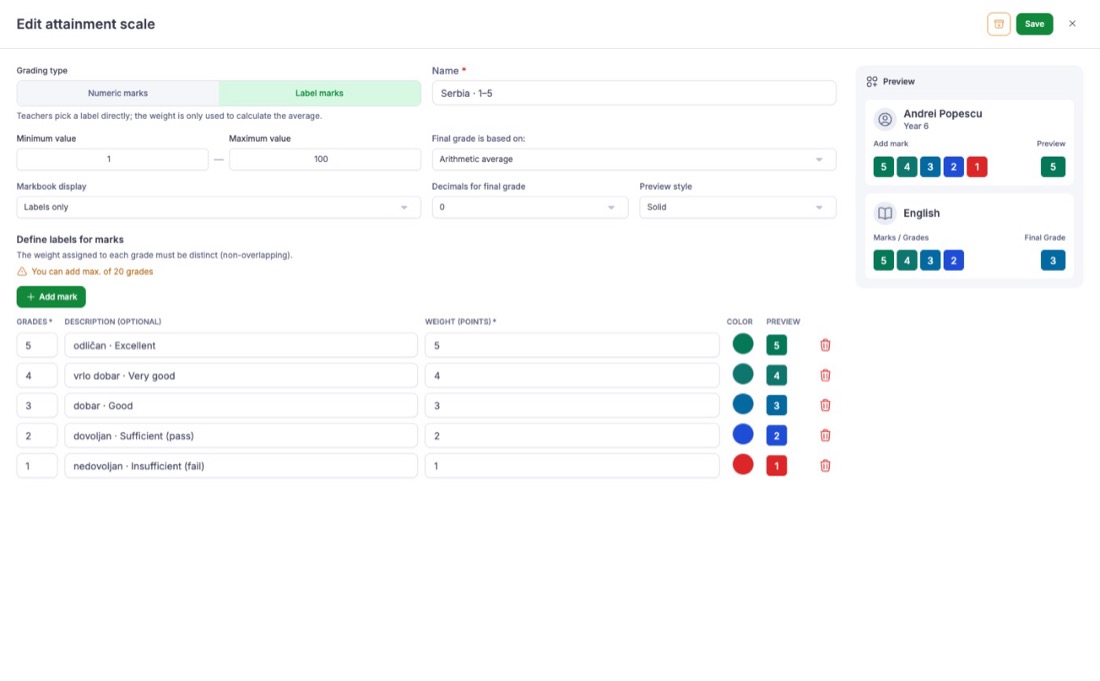
These are the scales as MarkBook shows them in the scale editor. Build yours with the same grades, descriptions and weights. Each scale links to the recipe that explains it on Set Up Any Grading System.
Serbia · 1–5
Attainment scale for years 2-8 (Osnovna škola, od drugog do osmog razreda (primary 2-4 and lower secondary 5-8)). Build it in Configuration → Assessment → Attainment scales. Recipe: Whole-number marks.
| Grade | Description | Weight | Pass |
|---|---|---|---|
| 5 | odličan · Excellent | 5 | yes |
| 4 | vrlo dobar · Very good | 4 | yes |
| 3 | dobar · Good | 3 | yes |
| 2 | dovoljan · Sufficient (pass) | 2 | yes |
| 1 | nedovoljan · Insufficient (fail) | 1 | no |
Before you rely on this page
Confidence: high
Eurydice text predates the 2024 rulebooks (it still says conduct is descriptive in years 1-5); I used the 2024 rulebooks, which make conduct numerical from year 2 and count it in the average. The exact rule for repeating in years 2-3 (automatic promotion vs parents' choice) differs between sources. The state matura date is still a draft (2028/29); verify before stating it. Secondary overall-success bands were read from the primary rulebook and Wikipedia; the secondary text refers to the Law for them.
Sources (5)
- Eurydice: Serbia - Assessment in single-structure education (official)
- Pravilnik o ocenjivanju učenika u osnovnom obrazovanju i vaspitanju (Sl. glasnik RS 10/2024), school copy (official)
- Pravilnik o ocenjivanju učenika u srednjem obrazovanju i vaspitanju (Sl. glasnik RS 10/2024), school copy (official)
- Wikipedia: Academic grading in Serbia
- 021.rs: Državna matura odlaže se za 2029. godinu