
🇷🇴 Romania
This page describes how schools in Romania grade pupils, from the first year of primary school (year 1, about age 6–7) to the end of upper secondary, and how to build the same system in MarkBook. Back to Find Your Country.
Full step-by-step guide
There is a full guide for this country, with every click: Romania full guide.
Check the current rules
This description comes from public sources (ministry pages, national laws, Eurydice) read in October 2026. Rules change with reforms, and schools often have local rules. Check the current official text for anything your school reports to the ministry.
How pupils are graded
Before year 1: Clasa pregătitoare (age 6) is part of primary school but is not graded: only a narrative evaluation report at year end. Kindergarten is not graded.
| Years | Stage | Scale | Pass | Recipe |
|---|---|---|---|---|
| 0 (before year 1) | Clasa pregătitoare (preparatory class, part of primary) | No marks or calificative; written end-of-year evaluation report | None; pupils cannot be held back at the end of the preparatory class or of year 1 | Written description |
| 1-4 | Învățământ primar, clasele I-IV (primary) | Calificative: FB, B, S, I (Foarte bine best, Insuficient fail) | Suficient (S) | Words |
| 5-8 | Gimnaziu (lower secondary) | 1-10, 10 best | 5 per subject (annual average); 6 for conduct | Whole-number marks |
| 9-12 | Liceu (upper secondary; theoretical, vocational, technological routes) | 1-10, 10 best | 5 per subject; conduct 6 (conduct below 8 in pedagogical, theological and military profiles forces a transfer; artistic and sport profiles need at least 6 in the main specialism subject) | Whole-number marks |
Values in Învățământ primar, clasele I-IV (primary)
| Value | Local word | English |
|---|---|---|
| FB | Foarte bine | Very good |
| B | Bine | Good |
| S | Suficient | Sufficient |
| I | Insuficient | Insufficient |
The year. Since 2022/23 the year is split into 5 learning modules (module de învățare) separated by holidays (2025/26: 8 Sept 2025 - 19 June 2026, OMEC 3463/2025). Under ROFUIP 2024 (OM 5726/2024, art. 109) only ONE annual average per subject is closed at the end of the year; there are no semester or module averages. Behaviour marks are given per learning interval and averaged. Results are communicated continuously (catalog, often electronic); the annual situation is closed at year end and recorded in the school record (foaie matricolă).
Averages and rounding. Secondary (years 5-12): subject annual average = arithmetic mean of all marks of the year, rounded to the nearest integer; an exact .50 is rounded in the pupil's favour (8.50 -> 9, 7.49 -> 7, 9.50 -> 10). Conduct annual average = mean of conduct marks per learning interval, minus 1 point for every 20 unjustified absences per year. Overall annual average (media anuală generală) = arithmetic mean of all subject annual averages AND the conduct average, to 2 decimals with rounding. Minimum marks per subject per year: weekly hours + 3, never fewer than 4 (subjects under 1 hour/week: at least 2). A pupil heading for corigență needs at least one extra mark, normally given in the last 3 weeks. Primary (years 1-4): no arithmetic; the teacher takes the two most frequent calificative of the year and, after the summative revision tests, chooses one of them by judgement (progress/regress, effort vs. result, motivation, remedial work) (art. 110). Minimum calificative per subject: same rule as above.
Passing the year. Preparatory class and year 1: no repeating. Years 1-4: promoted with at least 'Suficient' in every subject; 'Insuficient' in up to 2 subjects = corigent (one resit session, usually oral + written); more than 2 = repetent; conduct 'Insuficient' = repetent. Years 5-12: promoted with annual average >= 5 in every subject and >= 6 in conduct. Below 5 in at most 2 subjects = corigent: resit exam on the whole year's curriculum (written 90 min + oral), passed with >= 5 (mean of board members' marks, rounded). Below 5 in more than 2 subjects, conduct below 6, or failing a resit = repetent. Absence from 50% or more of a subject's classes = amânat (deferred), result closed in a later session.
Conduct. Primary: conduct calificativ (FB/B/S/I) recorded by the class teacher; below 'Bine' must be validated by the teachers' council; 'Insuficient' means repeating the year. Secondary: conduct mark (purtare) 1-10 proposed by the form teacher (diriginte), given per learning interval, annual = mean minus 1 point per 20 unjustified absences; below 6 means repeating the year; it is included in the overall annual average.
Differences between regions or school types. National system; no regional differences in the scale. Differences are by school type/profile: pedagogical, theological and military profiles demand conduct >= 8; artistic and sport profiles demand >= 6 in the main specialism; minority-language schools add mother-tongue papers at EN VIII and BAC; vocational/dual schools follow their own routes and certifications.
Common practice that is not official. Many teachers score written tests in points (often 90 points + 10 'din oficiu' = 100, then /10), copying the national exam marking schemes. The points and percentages are not official: only the resulting integer mark 1-10 goes into the register. Some teachers also use + / - or half marks in their own notes; these are not allowed in the official catalog.
National exams.
- Evaluarea Națională clasa a VIII-a (EN VIII) (year 8): 1-10 per paper (Romanian language and literature, Mathematics, mother tongue where applicable); EN average = arithmetic mean to 2 decimals without rounding
- Examenul de bacalaureat (BAC) (year 12): 1-10 per written paper (typically Romanian, compulsory profile subject, elective profile subject; plus competence assessments for language and digital skills, not marked 1-10)
- Evaluări naționale II, IV, VI (year 2, 4, 6): Diagnostic national tests; results reported per item, not as marks in the register
Words you will meet
notă (mark), note (marks), calificativ / calificative (descriptive grade, primary), medie (average), medie anuală (annual average), medie generală (overall average), purtare (conduct), modul de învățare (learning module, the 5 teaching periods), catalog (class register), foaie matricolă / registru matricol (official record), corigent (failed up to 2 subjects, resit), repetent (repeats year), amânat (result deferred), teză (written semester test, no longer mandatory).
Set it up in MarkBook
Create scale 'Calificative RO (I-IV)': FB=4, B=3, S=2, I=1 points, pass >= S. Create scale 'Note 1-10' (integers 1-10, pass >= 5) and 'Purtare 1-10' (pass >= 6). Preparatory class: no scale, one free-text 'Raport de evaluare' column at year end. Years 1-4: one column per assessment in the year (at least hours+3) plus an 'Annual qualifier' column the teacher selects (default suggestion = most frequent qualifier; not a mean). Years 5-12: one academic year period (optionally five module sub-periods for organising columns only, no averages per module), mark columns, and a calculated 'Media anuală' = mean of marks rounded to integer, half-up (.50 up). Conduct column per module, annual conduct = mean minus 1 per 20 unjustified absences, rounded to integer. Overall 'Media generală' = mean of all subject annual averages plus conduct, 2 decimals. Flag pass/fail: subject < 5, conduct < 6.
The scales, ready to copy
These are the scales as MarkBook shows them in the scale editor. Build yours with the same grades, descriptions and weights. Each scale links to the recipe that explains it on Set Up Any Grading System.
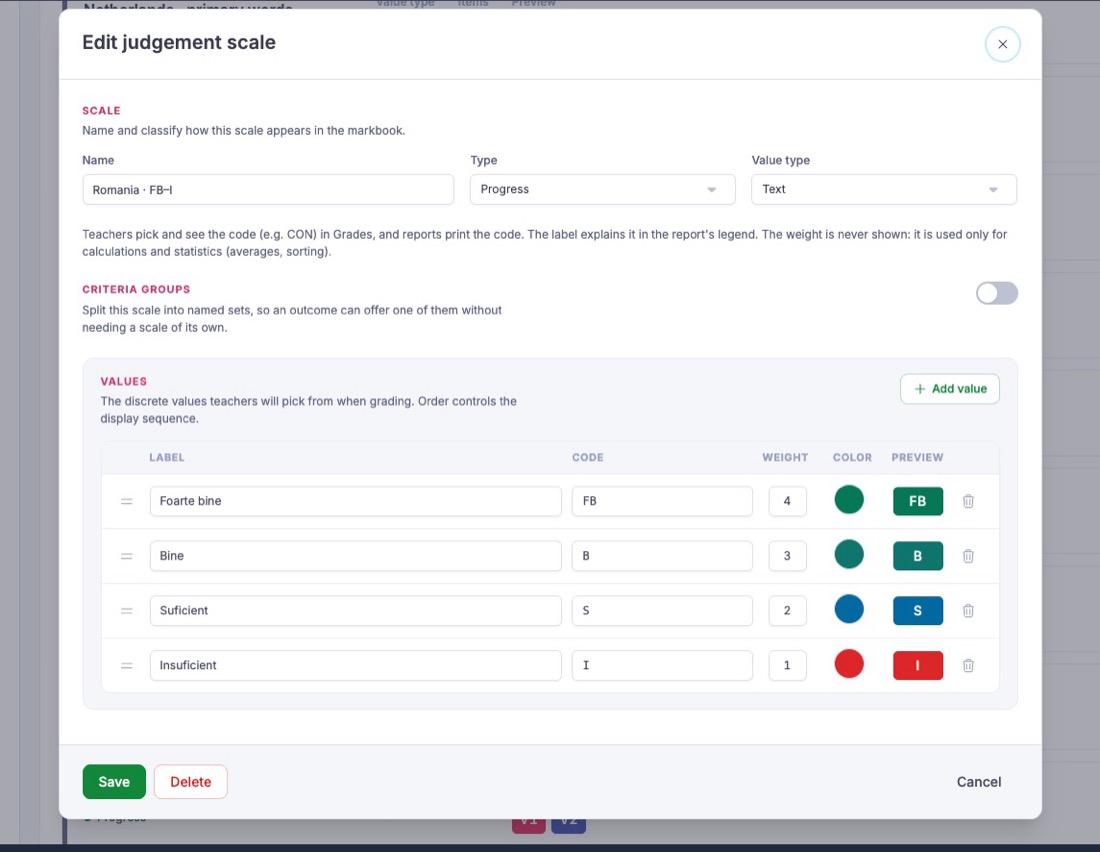
Romania · FB–I
Judgement scale for years 1-4 (Învățământ primar, clasele I-IV (primary)). Build it in Configuration → Assessment → Judgement scales. Recipe: Words instead of marks.
| Grade | Description | Weight | Pass |
|---|---|---|---|
| FB | Foarte bine · Very good | 4 | yes |
| B | Bine · Good | 3 | yes |
| S | Suficient · Sufficient | 2 | yes |
| I | Insuficient · Insufficient | 1 | no |
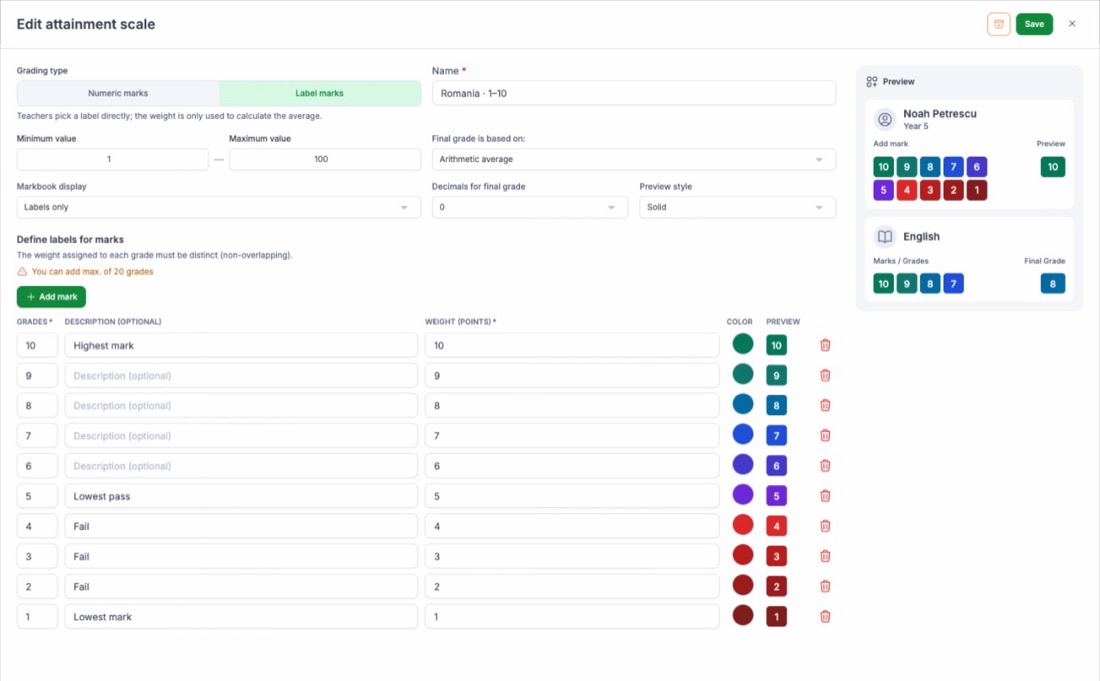
Romania · 1–10
Attainment scale for years 5-8 (Gimnaziu (lower secondary)). Build it in Configuration → Assessment → Attainment scales. Recipe: Whole-number marks.
| Grade | Description | Weight | Pass |
|---|---|---|---|
| 10 | Highest mark | 10 | yes |
| 9 | 9 | yes | |
| 8 | 8 | yes | |
| 7 | 7 | yes | |
| 6 | 6 | yes | |
| 5 | Lowest pass | 5 | yes |
| 4 | Fail | 4 | no |
| 3 | Fail | 3 | no |
| 2 | Fail | 2 | no |
| 1 | Lowest mark | 1 | no |
Before you rely on this page
Confidence: high
High confidence for the scales, but the status of the teză and the EN VIII 80/20 admission formula are not confirmed. Do not show them as current rules. Schooling is 13 years (preparatory + I-XII); upper secondary normally starts at year 9 (clasa a IX-a). Reforms: since 2022/23 the year has 5 learning modules and one annual average per subject (no semester averages); ROFUIP 2024 (OM 5726/2024) is the current text under Law 198/2023. The status of the teză (written semester test) could not be confirmed: it is no longer mandatory as far as I can tell, and the 2024 rules quoted say nothing about it. The EN VIII 80/20 admission formula comes from secondary sources for 2019-2025 and should be checked against the current admission order. EN II/IV/VI details were not verified from an opened source. Eurydice upper secondary page (updated 2023) cites older Law 1/2011 framework.
Sources (6)
- Eurydice - Romania: Assessment in primary education (official)
- Eurydice - Romania: Assessment in general lower secondary education (official)
- Eurydice - Romania: Assessment in general upper secondary education (official)
- Edupedu - Cum se încheie mediile la final de an școlar 2026 (quotes ROFUIP 2024 art. 107-111)
- Digi24 - Bacalaureat 2026: nota minimă pentru promovare
- Edupedu - Teze obligatorii eliminate, o singură medie la final de an (2022 reform report)