
🇵🇱 Poland
This page describes how schools in Poland grade pupils, from the first year of primary school (year 1, about age 6–7) to the end of upper secondary, and how to build the same system in MarkBook. Back to Find Your Country.
Full step-by-step guide
There is a full guide for this country, with every click: Poland full guide.
Check the current rules
This description comes from public sources (ministry pages, national laws, Eurydice) read in October 2026. Rules change with reforms, and schools often have local rules. Check the current official text for anything your school reports to the ministry.
How pupils are graded
Before year 1: The compulsory preparatory year (age 6, 'zerówka') gives no marks. It gives a written note on school readiness.
| Years | Stage | Scale | Pass | Recipe |
|---|---|---|---|---|
| 0 (age 6) | Oddział przedszkolny / zerówka (compulsory pre-primary year) | No marks | Not applicable | Written description |
| 1-3 | Edukacja wczesnoszkolna (early primary, first stage) | Mid-year and end-of-year results are descriptive. Current marks can be descriptive or 1-6 numbers, as the school statute decides. | There is no pass mark. Promotion is the normal outcome. Repeating a year is an exceptional decision of the teaching council. | Written description |
| 4-8 | Szkoła podstawowa, klasy IV-VIII (upper primary = lower secondary in function) | 1-6, 6 best | 2 (dopuszczający) | Whole-number marks |
| 9-12 (13 in technikum) | Szkoła ponadpodstawowa: liceum ogólnokształcące (4 years), technikum (5 years), szkoła branżowa I stopnia (3 years) (upper secondary) | 1-6, 6 best (the same scale as years 4-8) | 2 (dopuszczający) | Whole-number marks |
Values in Szkoła podstawowa, klasy IV-VIII (upper primary = lower secondary in function)
| Value | Local word | English |
|---|---|---|
| 6 | celujący | excellent |
| 5 | bardzo dobry | very good |
| 4 | dobry | good |
| 3 | dostateczny | satisfactory |
| 2 | dopuszczający | acceptable (lowest pass) |
| 1 | niedostateczny | unsatisfactory (fail) |
The year. The year has two terms (okresy, often called semesters). After the first term (January/February) the school gives a mid-year classification (klasyfikacja śródroczna), normally in the electronic register only. In late June it gives the annual classification and the report card (świadectwo). The final classification (końcowa) is given at the end of the school level.
Averages and rounding. The annual mark is a teacher judgement based on the current marks and the mid-year mark, using the criteria in the school statute. The law does not require an arithmetic mean. Many schools use a weighted mean (średnia ważona) in the e-register as a guide, with thresholds set in the statute (for example 4.75 and above gives 5). That is school practice, not national law. The annual average of all compulsory subjects is used for the report with distinction: average 4.75 or more and behaviour at least 'bardzo dobre'. No national minimum number of marks; the statute often sets one.
Passing the year. Years 1-3: promotion is based on the descriptive assessment. Repeating a year is exceptional. Years 4-8 and upper secondary: the pupil needs at least 2 (dopuszczający) in every compulsory subject. With one 1 (niedostateczny), the pupil can take a resit exam (egzamin poprawkowy) in August. The teaching council can promote a pupil conditionally with one 1, once per school cycle. A pupil with no basis for a mark (for example over 50% absence) gets 'nieklasyfikowany' and can take a qualifying exam (egzamin klasyfikacyjny).
Conduct. Years 1-3: descriptive. From year 4: wzorowe (exemplary), bardzo dobre (very good), dobre (good), poprawne (correct/acceptable), nieodpowiednie (unacceptable), naganne (reprehensible/inadmissible). The class tutor sets it after hearing teachers and pupils. Behaviour does not change subject marks. It can block promotion only in specific cases: for example, in upper secondary, 'naganne' at the end of two years in a row at the same school.
Differences between regions or school types. National rules apply in every voivodeship. Each school's statute (statut, section 'Wewnątrzszkolne Ocenianie' / WZO) sets current-mark rules: +/-, weights, the form of current marks in years 1-3, and how many marks are needed per term. These rules differ from school to school. Technikum lasts 5 years and branżowa 3 years, but they use the same 1-6 scale.
Common practice that is not official. Not official: + and - on current marks (for example 4+, 5-); weighted averages in the Librus or Vulcan e-registers, with weights by type of work (test 3, quiz 2, homework 1); percentage-to-mark tables for tests (for example 91-100% = 5, 100% + extra task = 6), set per school. In years 1-3, many schools use points, symbols or letters for current marks.
National exams.
- Egzamin ósmoklasisty (eighth-grade exam) (year 8): Percentage of points per subject (Polish, mathematics, modern foreign language), plus a centile. There is no pass mark.
- Egzamin maturalny (matura) (year 12 (13 in technikum)): Percentage of points per exam
- Egzamin zawodowy (vocational qualification exam) (year technikum / branżowa): Percentage; written part and practical part
Words you will meet
ocena (mark), stopień (grade on the scale), ocena bieżąca (current mark), ocena klasyfikacyjna śródroczna / roczna / końcowa (mid-year / end-of-year / final mark), ocena opisowa (descriptive assessment), średnia (average), okres / semestr (term), świadectwo (end-of-year report card), świadectwo z wyróżnieniem (report with distinction), dziennik (register), statut szkoły / WZO (school assessment rules)
Set it up in MarkBook
Make a scale 'Poland 1-6': 6 celujący, 5 bardzo dobry, 4 dobry, 3 dostateczny, 2 dopuszczający, 1 niedostateczny. Points equal the number, and 2 is the lowest pass. Add a current-mark variant with + and - if the school statute allows it (for example 4+ = 4.5, 4- = 3.75; the school decides the values). For years 1-3, use a text/comment column for mid-year and annual results, and optional 1-6 or symbol current marks. Use two periods (I okres, II okres). Each period gets current-mark columns with weights from the statute, a calculated weighted average (2 decimals, shown as a guide) and a teacher-entered mid-year mark. At year end, add a teacher-entered annual mark in whole steps. Add a calculated average of all compulsory annual marks, with a flag for 4.75 or more (and behaviour at least bardzo dobre) for the report with distinction. Make a behaviour scale with six words (wzorowe ... naganne) from year 4.
The scales, ready to copy
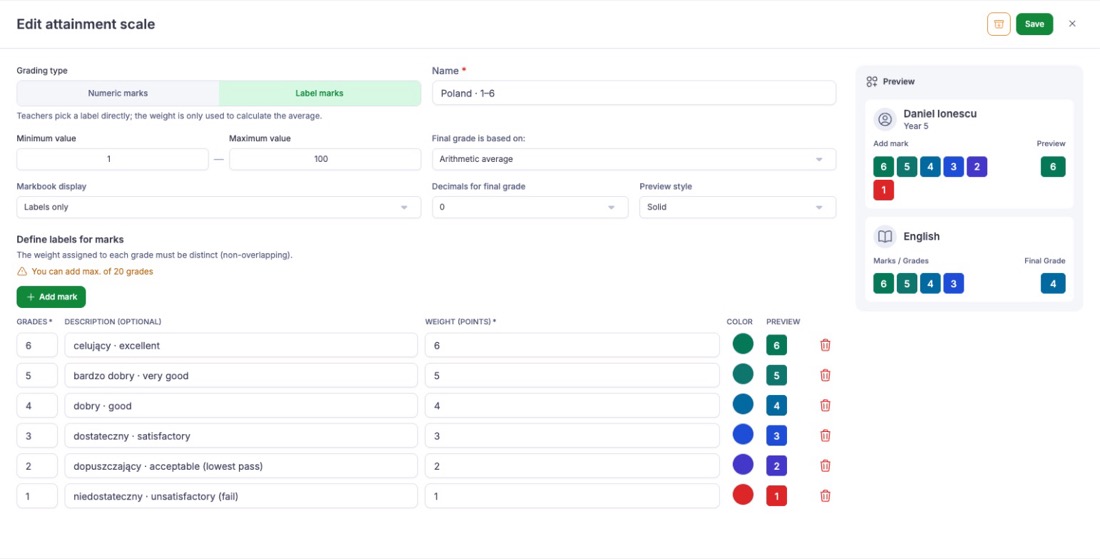
These are the scales as MarkBook shows them in the scale editor. Build yours with the same grades, descriptions and weights. Each scale links to the recipe that explains it on Set Up Any Grading System.
Poland · 1–6
Attainment scale for years 4-8 (Szkoła podstawowa, klasy IV-VIII (upper primary = lower secondary in function)). Build it in Configuration → Assessment → Attainment scales. Recipe: Whole-number marks.
| Grade | Description | Weight | Pass |
|---|---|---|---|
| 6 | celujący · excellent | 6 | yes |
| 5 | bardzo dobry · very good | 5 | yes |
| 4 | dobry · good | 4 | yes |
| 3 | dostateczny · satisfactory | 3 | yes |
| 2 | dopuszczający · acceptable (lowest pass) | 2 | yes |
| 1 | niedostateczny · unsatisfactory (fail) | 1 | no |
Before you rely on this page
Confidence: high
I could not open the current text of the Regulation of 22 February 2019 (Dz.U. 2023 poz. 2572) directly. The 6-step words and the six behaviour words are the widely used legal terms, but I did not quote them from the regulation itself. Eurydice gives English labels only. Reform: from April 2024, a ministry regulation removed compulsory homework in years 1-3 and made homework in years 4-8 not marked. Eurydice confirms that homework is 'generally not compulsory or assessed', but I did not open that regulation. The matura format changed in 2023 (new exam formula, 'Formula 2023'). I did not check its details. The resit (egzamin poprawkowy) month is normally August; I did not confirm it from a source here.
Sources (4)
- Eurydice - Poland: Assessment in single-structure education (official)
- Eurydice - Poland: Assessment in general upper secondary education (official)
- Ustawa o systemie oświaty, art. 44i (descriptive marks in years I-III; scale from year IV)
- Example school assessment rules (WZO) with a percentage-to-mark table using +/-