
🇳🇴 Norway
This page describes how schools in Norway grade pupils, from the first year of primary school (year 1, about age 6–7) to the end of upper secondary, and how to build the same system in MarkBook. Back to Find Your Country.
Check the current rules
This description comes from public sources (ministry pages, national laws, Eurydice) read in October 2026. Rules change with reforms, and schools often have local rules. Check the current official text for anything your school reports to the ministry.
How pupils are graded
Before year 1: No separate graded preparatory year; school starts at age 6 in year 1 (barnehage before is not school). Schooling runs 13 years (1-10 compulsory + Vg1-Vg3).
| Years | Stage | Scale | Pass | Recipe |
|---|---|---|---|---|
| 1-7 | Barneskole (primary, years 1-7) | No grades; written half-year assessment without grades | Not applicable | Written description |
| 8-10 | Ungdomsskole (lower secondary, years 8-10) | 1-6, 6 best; whole numbers only | No pass requirement in compulsory school; 2 is the lowest pass level in upper secondary | Whole-number marks |
| 11-13 | Videregående skole (upper secondary, Vg1-Vg3) | 1-6, 6 best | 2 (a 1 as standpunkt counts as passed if the exam grade is 2 or better) | Whole-number marks |
Values in Ungdomsskole (lower secondary, years 8-10)
| Value | Local word | English |
|---|---|---|
| 6 | framifrå kompetanse i faget | excellent competence |
| 5 | mykje god kompetanse i faget | very good competence |
| 4 | god kompetanse i faget | good competence |
| 3 | nokså god kompetanse i faget | fairly good competence |
| 2 | låg kompetanse i faget | low competence |
| 1 | svært låg kompetanse i faget | very low competence |
The year. School year mid-August to June, two half-years (autumn, spring). Half-year assessment (halvårsvurdering) twice a year: without grades in years 1-7, with grades from year 8. Final standpunkt grade when a subject ends (year 10, or the last year of the subject in upper secondary).
Averages and rounding. Grades are teacher judgement of overall competence on a broad basis, not a mean of test scores. Upper secondary: the certificate grade point average (all standpunkt and exam grades) is used for admission; it is commonly multiplied by 10 for points. In lower secondary the average of all grades on the certificate decides upper secondary admission. No rounding of single grades (whole numbers only).
Passing the year. Compulsory school: automatic progression every year, no pass/fail threshold. Upper secondary: a subject is passed with 2 or better; a failed subject must be retaken (privatist exam) for a full certificate.
Conduct. Separate grades for orden (order) and oppførsel (conduct) from year 8: G (God, good), Nokså god (fairly good, large negative deviations), Lite god (poor, particularly large deviations). A lower grade normally needs a prior warning. Standpunkt grades in order and conduct at the end of year 10 and of upper secondary.
Differences between regions or school types. National regulations (opplæringsforskrifta, from 2024 under the new Education Act) for all public schools. Private schools follow the privatskoleforskrift with the same scale. Steiner schools are exempt from the written year-10 exam. Counties organise upper secondary exams.
Common practice that is not official. Teachers often give grades with + or - (e.g. 5-, 4/5) or points on tests during the year. These are not allowed on half-year or final grades and are not official.
National exams.
- Eksamen 10. trinn (written) (year 10): 1-6
- Eksamen 10. trinn (oral) (year 10): 1-6
- Eksamen videregående (written and oral, drawn) (year 11-13): 1-6
- Nasjonale prøver (year 5, 8, 9): Mastery levels, not grades
Words you will meet
karakter (grade), halvårsvurdering (half-year assessment), standpunktkarakter (final overall achievement grade), eksamenskarakter (exam grade), vitnemål (certificate), karaktersnitt / gjennomsnitt (average), orden og oppførsel (order and conduct), termin (term)
Set it up in MarkBook
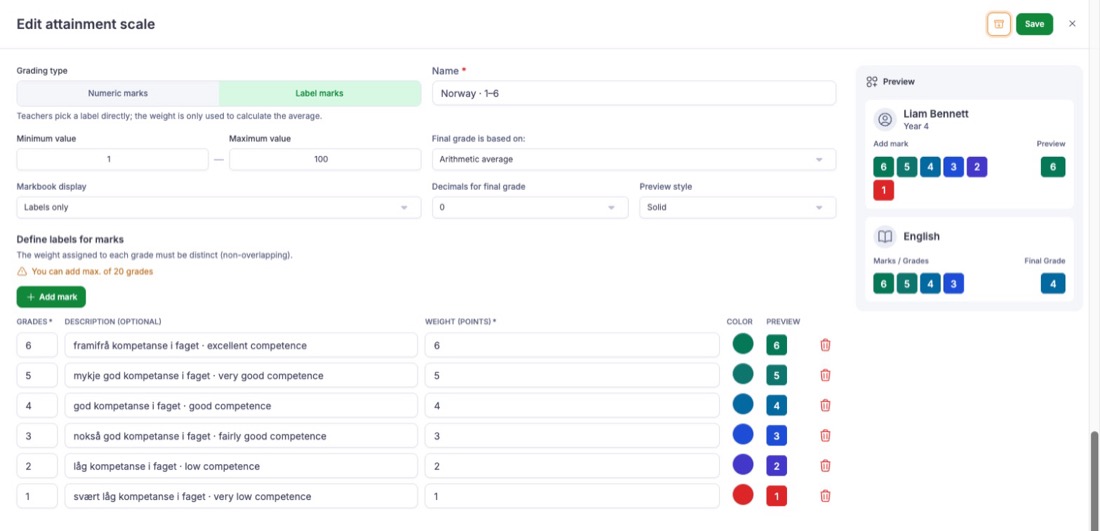
Create one scale 'Norwegian 1-6' with values 1-6 and points equal to the number; 2 and above pass (upper secondary). Create a 3-value conduct scale G / NG / LG for order and a separate one for conduct. Years 1-7: comment columns only, two periods. Years 8-10: two periods (autumn, spring), one half-year grade column per subject, a final standpunkt column in year 10, an exam column, and order/conduct columns. Calculated certificate average with two decimals (×10 for admission points). Allow test columns with +/- only as unofficial points.
The scales, ready to copy
These are the scales as MarkBook shows them in the scale editor. Build yours with the same grades, descriptions and weights. Each scale links to the recipe that explains it on Set Up Any Grading System.
Norway · 1–6
Attainment scale for years 8-10 (Ungdomsskole (lower secondary, years 8-10)). Build it in Configuration → Assessment → Attainment scales. Recipe: Whole-number marks.
| Grade | Description | Weight | Pass |
|---|---|---|---|
| 6 | framifrå kompetanse i faget · excellent competence | 6 | yes |
| 5 | mykje god kompetanse i faget · very good competence | 5 | yes |
| 4 | god kompetanse i faget · good competence | 4 | yes |
| 3 | nokså god kompetanse i faget · fairly good competence | 3 | yes |
| 2 | låg kompetanse i faget · low competence | 2 | yes |
| 1 | svært låg kompetanse i faget · very low competence | 1 | no |
Before you rely on this page
Confidence: high
The absence rule (fraværsgrense, about 10% in upper secondary) and its status under the new 2024 Education Act were not confirmed. The exact upper secondary exam selection rules and the admission-points formula were not opened from an official page. Reforms: LK20 curricula from 2020; new Education Act and regulation (opplæringsforskrifta) from August 2024, which kept the 1-6 scale and the G/NG/LG conduct scale.