
🇳🇱 Netherlands
This page describes how schools in Netherlands grade pupils, from the first year of primary school (year 1, about age 6–7) to the end of upper secondary, and how to build the same system in MarkBook. Back to Find Your Country.
Check the current rules
This description comes from public sources (ministry pages, national laws, Eurydice) read in October 2026. Rules change with reforms, and schools often have local rules. Check the current official text for anything your school reports to the ministry.
How pupils are graded
Before year 1: Groep 1-2 (ages 4-6, school from age 4, compulsory from 5) are part of primary school but are not graded with marks; observation systems and talks with parents are used.
| Years | Stage | Scale | Pass | Recipe |
|---|---|---|---|---|
| 1-6 | Basisschool groep 3-8 (primary) | School's own choice: marks 1-10, or words (o / m / v / rv / g), or descriptions | 6 / 'v' (voldoende), where marks are used | School decides |
| 7-8/9 (onderbouw) | Voortgezet onderwijs, onderbouw (lower secondary: vmbo, havo, vwo years 1-3) | 1-10, 10 best | 6 (5.5 when marks have one decimal) | Whole-number marks |
| bovenbouw: vmbo to 10, havo to 11, vwo to 12 | Voortgezet onderwijs, bovenbouw (upper secondary: vmbo years 3-4, havo 4-5, vwo 4-6) | 1-10 with one decimal, 10 best | 5.5 (rounded final mark 6); diploma by the pass rules | Number columns |
Values in Basisschool groep 3-8 (primary)
| Value | Local word | English |
|---|---|---|
| g | goed | good |
| rv | ruim voldoende | more than satisfactory |
| v | voldoende | satisfactory |
| m | matig | mediocre |
| o | onvoldoende | unsatisfactory |
Values in Voortgezet onderwijs, onderbouw (lower secondary: vmbo, havo, vwo years 1-3)
| Value | Local word | English |
|---|---|---|
| 10 | uitstekend | outstanding |
| 9 | zeer goed | very good |
| 8 | goed | good |
| 7 | ruim voldoende | more than satisfactory |
| 6 | voldoende | satisfactory (minimum pass) |
| 5 | bijna voldoende | almost satisfactory |
| 4 | onvoldoende | unsatisfactory |
| 3 | matig / zeer onvoldoende | very unsatisfactory |
| 2 | slecht | poor |
| 1 | zeer slecht | very poor |
Values in Voortgezet onderwijs, bovenbouw (upper secondary: vmbo years 3-4, havo 4-5, vwo 4-6)
| Value | Local word | English |
|---|---|---|
| 10 | uitstekend | outstanding |
| 6 | voldoende | satisfactory |
| 5 | bijna voldoende | almost satisfactory |
| 1 | zeer slecht | very poor |
The year. Schools decide. Secondary: usually 3 or 4 periods; parents get 3-4 progress reports a year, some schools also every six weeks (Eurydice). Primary: most schools issue a report each term, usually 2 or 3 a year, plus LVS test results (mid-year and end of year).
Averages and rounding. Report marks are weighted means of tests; the weights are set by the school (e.g. test x1, proefwerk x2) and kept with one decimal. Exams: the SE mark is the weighted mean of PTA tests (one decimal). The CE mark comes from the score with a national norm (N-term) on a 1.0-10.0 scale. The final mark per subject is the mean of SE and CE, rounded to a whole number (first decimal 5 or more rounds up). For subjects with only a school exam, the SE mark rounded is the final mark. Combined components (e.g. civics, culture, profile paper) are averaged and rounded the same way (Uitvoeringsbesluit WVO 2020, art. 3.34(4): first decimal 4 or lower down, 5 or higher up).
Passing the year. Promotion rules (overgangsnormen) are set by each school in its school plan, typically counting points below 6 (e.g. a 5 = 1 shortfall point, a 4 = 2) with a maximum. Most schools allow one repeat of a year. Diploma (havo/vwo): average of CE marks at least 5.5; all final marks 6 or higher, or one 5, or one 4 / two 5s / one 4 and one 5 with an overall average of at least 6; in Dutch, English and maths at most one 5 and none lower; no final mark below 4; physical education 'voldoende' or 'goed'. Vmbo has similar rules with the CE average of 5.5.
Conduct. No official conduct mark. Some schools note behaviour or effort on the report in words; this is school practice.
Differences between regions or school types. National system; no regions. Differences are between school types (vmbo 4 years, havo 5 years, vwo 6 years) and between schools, because each school sets its report weights, number of periods, promotion rules and primary report format. The Caribbean Netherlands (BES islands) have their own rules, not covered.
Common practice that is not official. Teachers score tests in points and convert to a mark, commonly with mark = 9 x (points / max) + 1, rounded to one decimal; the N-term is official only for the CE. Primary schools often use letters (o/m/v/rv/g) or + / +/- / - instead of marks; this is a school choice.
National exams.
- Doorstroomtoets (progression test, formerly eindtoets) (year 6 (groep 8)): Score per provider, reported as a level advice and reference levels (1F, 2F/1S) in reading, language and maths
- Centraal examen (CE), vmbo / havo / vwo (year 10 (vmbo), 11 (havo), 12 (vwo)): 1.0-10.0 (one decimal), from scores with the N-term
- Schoolexamen (SE) (year from the upper-secondary years): 1.0-10.0 (one decimal)
Words you will meet
cijfer (mark), gemiddelde (average), rapport (report card), periode / trimester (term), toets (test), proefwerk (larger test), schoolexamen SE (school exam), centraal examen CE (central exam), eindcijfer (final mark), voldoende / onvoldoende (pass / fail), overgaan / blijven zitten (promotion / repeating), schooladvies (school recommendation), doorstroomtoets (progression test).
Set it up in MarkBook
Create a scale 'Cijfer 1-10' (numeric, one decimal, higher is better, pass at 5.5). For primary, either the same scale or a descriptor scale o / m / v / rv / g (points 1-5, pass at v) chosen by the school. Per period (3 or 4), add test columns with weights (toets x1, proefwerk x2) and a calculated weighted average with one decimal; the year mark is the weighted mean of all periods (or of all tests), one decimal. For the upper years, add an SE column (weighted mean of PTA tests, one decimal), a CE column (entered, one decimal), and an eindcijfer = (SE + CE) / 2 rounded to a whole number (0.5 rounds up). Add a calculated diploma check (CE average >= 5.5, shortfall rules, core subjects).
The scales, ready to copy
These are the scales as MarkBook shows them in the scale editor. Build yours with the same grades, descriptions and weights. Each scale links to the recipe that explains it on Set Up Any Grading System.
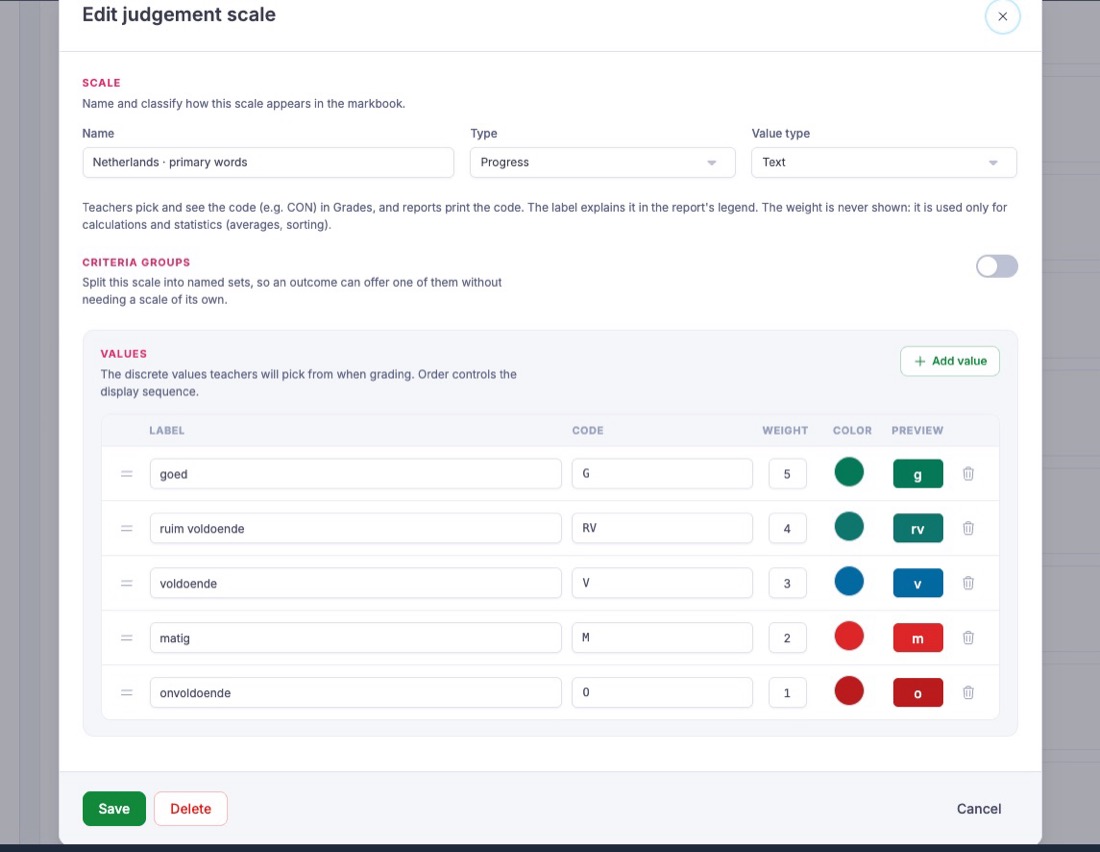
Netherlands · primary words
Judgement scale for years 1-6 (Basisschool groep 3-8 (primary)). Build it in Configuration → Assessment → Judgement scales. Recipe: Words instead of marks.
| Grade | Description | Weight | Pass |
|---|---|---|---|
| g | goed · good | 5 | yes |
| rv | ruim voldoende · more than satisfactory | 4 | yes |
| v | voldoende · satisfactory | 3 | yes |
| m | matig · mediocre | 2 | no |
| o | onvoldoende · unsatisfactory | 1 | no |
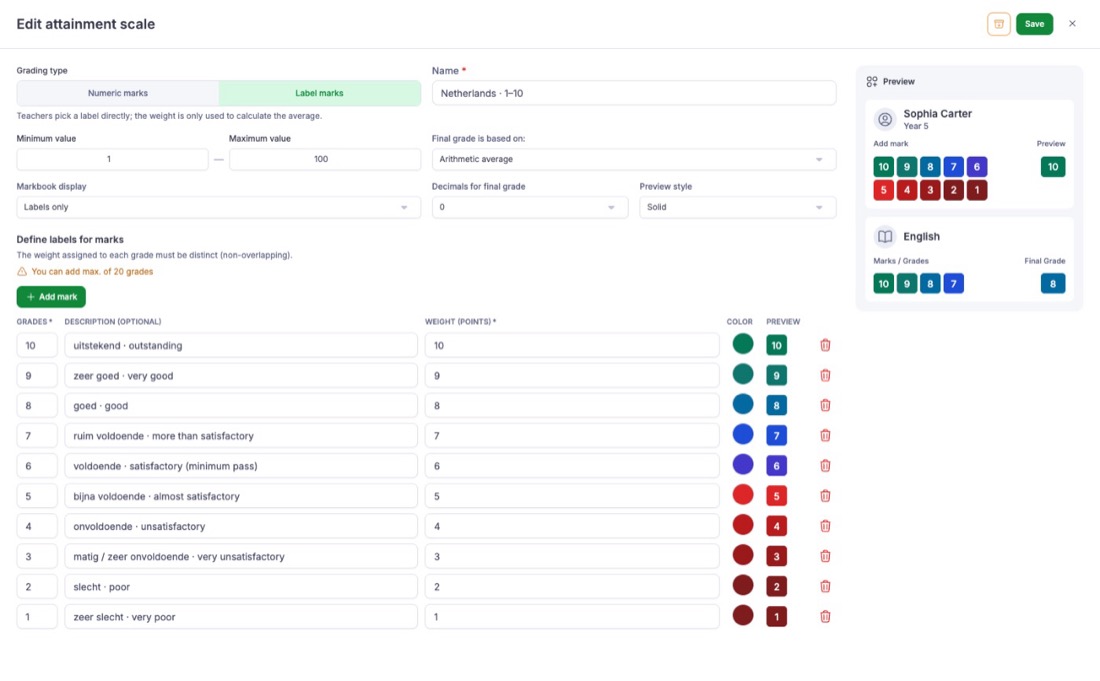
Netherlands · 1–10
Attainment scale for years 7-8/9 (onderbouw) (Voortgezet onderwijs, onderbouw (lower secondary: vmbo, havo, vwo years 1-3)). Build it in Configuration → Assessment → Attainment scales. Recipe: Whole-number marks.
| Grade | Description | Weight | Pass |
|---|---|---|---|
| 10 | uitstekend · outstanding | 10 | yes |
| 9 | zeer goed · very good | 9 | yes |
| 8 | goed · good | 8 | yes |
| 7 | ruim voldoende · more than satisfactory | 7 | yes |
| 6 | voldoende · satisfactory (minimum pass) | 6 | yes |
| 5 | bijna voldoende · almost satisfactory | 5 | no |
| 4 | onvoldoende · unsatisfactory | 4 | no |
| 3 | matig / zeer onvoldoende · very unsatisfactory | 3 | no |
| 2 | slecht · poor | 2 | no |
| 1 | zeer slecht · very poor | 1 | no |
Before you rely on this page
Confidence: medium
Confirmed: 1-10 scale in secondary, pass 5.5/6, SE/CE averaging, CE average >= 5.5, diploma pass rules (Eurydice and art. 3.34), no national primary scale. Not confirmed from an official source: the verbal labels for each mark (taken from Holland Expat Center; labels for 3-5 differ between sources); the rounding of SE and CE to one decimal before averaging (from school documents only); the doorstroomtoets result format. Reform: the Uitvoeringsbesluit WVO 2020 replaced the Eindexamenbesluit VO from 1 August 2022; a new version of art. 3.34 is in force from 1 August 2026 (Stb. 2026, 71) and I could not see what changed. The 'wegstreepregeling' (dropping one final mark, introduced in the COVID years) may or may not still apply; check examenblad.nl. The eindtoets was renamed doorstroomtoets in 2023-2024 and moved to February.