
🇲🇩 Republic of Moldova
This page describes how schools in Republic of Moldova grade pupils, from the first year of primary school (year 1, about age 6–7) to the end of upper secondary, and how to build the same system in MarkBook. Back to Find Your Country.
Check the current rules
This description comes from public sources (ministry pages, national laws, Eurydice) read in October 2026. Rules change with reforms, and schools often have local rules. Check the current official text for anything your school reports to the ministry.
How pupils are graded
Before year 1: The preparatory group (grupa pregătitoare, age 5-6) is in kindergarten, not school, and is not graded. Year I, semester 1 records no grades.
| Years | Stage | Scale | Pass | Recipe |
|---|---|---|---|---|
| 1-3 | Învățământ primar, clasele I-III (primary, criterion-referenced assessment by descriptors) | Calificative EX, FB, B, S (Excelent best); performance levels avansat / independent / ghidat / cu sprijin used in day-to-day formative assessment, not recorded as grades | No fail: all qualifiers count as promotion; work below Suficient triggers 'Recuperare' (remediation) | Words |
| 4 | Clasa a IV-a (last year of primary) | Marks 10-5 in Romanian language and literature, foreign language and mathematics; qualifiers EX/FB/B/S in other subjects | 5 (no lower marks are used; below 25% = Recuperare) | School decides |
| 5-9 | Gimnaziu (lower secondary) | 1-10, 10 best; qualifiers FB/B/S/A for Music, Art, Technology, PE; Admis/Respins for Personal Development (year IX); descriptors for Education for Society | 5 (annual average); years V-VIII promoted regardless | Whole-number marks |
| 10-12 | Liceu (upper secondary, lyceum) | 1-10, 10 best; qualifiers for PE, Education for Society, Personal Development | 5 per subject (annual average and thesis) | Whole-number marks |
Values in Învățământ primar, clasele I-III (primary, criterion-referenced assessment by descriptors)
| Value | Local word | English |
|---|---|---|
| EX | Excelent | Excellent |
| FB | Foarte bine | Very good |
| B | Bine | Good |
| S | Suficient | Sufficient |
| R | Recuperare | Remediation needed (not a grade) |
Values in Clasa a IV-a (last year of primary)
| Value | Local word | English |
|---|---|---|
| 10 | Zece | Ten (best) |
| 9 | Nouă | Nine |
| 8 | Opt | Eight |
| 7 | Șapte | Seven |
| 6 | Șase | Six |
| 5 | Cinci | Five |
Values in Gimnaziu (lower secondary)
| Value | Local word | English |
|---|---|---|
| 10 | zece | Ten (best) |
| 9 | nouă | Nine |
| 8 | opt | Eight |
| 7 | șapte | Seven |
| 6 | șase | Six |
| 5 | cinci | Five (lowest pass) |
| 4 | patru | Four (fail) |
| 3 | trei | Three (fail) |
| 2 | doi | Two (fail) |
| 1 | unu | One (lowest) |
The year. Two semesters. Semester and annual averages are closed in the last week of each semester / of the year; for year IX the annual average is closed by 25 May. In upper secondary, semester theses (teze semestriale) are held in the last month of each semester in Ministry-set subjects. Primary results go to parents through the 'tabelul performanțelor școlare' at the end of each year I-IV.
Averages and rounding. NO rounding anywhere: all averages to 2 decimals (hundredths) without rounding. Lower secondary (V-IX): semester average = arithmetic mean of current marks; annual = mean of the two semester averages; overall average for the cycle = mean of all annual averages (compulsory + optional subjects). Upper secondary (X-XII): semester average = mean of current marks; in thesis subjects = (mean of current marks + thesis mark) / 2, only if both are >= 5; curricular-extension subjects = mean of base-curriculum average, extension average and thesis. Minimum marks per semester: at least 2, at least one from a summative assessment (thesis excluded). Subjects graded by qualifiers (Music, Art, Technology, Physical Education, Education for Society, Personal Development) produce no numeric average and are excluded from the overall average. Primary (2025 methodology): convert results to points (EX=10, FB=9, B=8, S=6; marks at face value), take the mean to hundredths without rounding, then convert back: 10.00-9.50 EX, 9.49-8.50 FB, 8.49-6.50 B, 6.49-6.00 S; for year IV marks: 9.50+ =10, 8.50-9.49 =9, 7.50-8.49 =8, 6.50-7.49 =7, 5.50-6.49 =6, 5.00-5.49 =5. Annual = same procedure over the two semester results.
Passing the year. Primary (I-IV) and years V-VIII: automatic promotion, no repeating. Year IX: pupils with an annual average of 1-4 in one or more subjects are not admitted to the gymnasium graduation exams and receive a certificate instead (they may sit the exams later as external candidates). Years X-XI: an annual average of 1-4 in a subject (or thesis) makes the pupil 'corigent'; promotion only after passing the resit (at least 2 written tests on the whole semester/year material) before the next school year; not resitting in time leads to expulsion (exmatriculare). The teachers' council decides by 1 September. Absence from 50% or more of hours with only one mark = 'amânat'. Year XII: an annual average below 5 in any subject bars the pupil from the baccalaureate.
Conduct. No conduct grade. The 2025 regulation (pt. 135) forbids marks for behaviour in class, missing homework, missing materials or absence. Education for Society is assessed by observed behaviour descriptors over a school year, but that is a subject, not conduct.
Differences between regions or school types. National system, the same in all districts. The local education authority (OLSDÎ) may write the semester thesis papers or delegate them to the school. Minority-language schools (Russian, Gagauz, Bulgarian, Ukrainian) add Romanian as a separate exam subject. Transnistria (left bank) runs a separate system and is not described here. Schools may set their own assessment strategies within the regulation.
Common practice that is not official. In secondary, teachers commonly score tests in points and convert them with a conversion scheme (schema de convertire a punctajului în note); the conversion is required by the regulation, but the point scales themselves are the teacher's own. In primary, the percentage grids for summative tests are official; using points on formative tests is explicitly not allowed. Teachers may keep personal portfolios, tables or charts, but these are not official documents.
National exams.
- Testarea națională (national testing, end of primary) (year 4): Not confirmed from an opened source
- Examenele naționale de absolvire a gimnaziului (gymnasium graduation exams) (year 9): 1-10
- Examenul național de bacalaureat (BAC) (year 12): 1-10 per subject
Words you will meet
notă (mark), calificativ (descriptive grade), descriptor de performanță (performance descriptor), nivel de performanță (performance level: avansat, independent, ghidat, cu sprijin), medie semestrială / anuală / generală (semester / annual / overall average), semestru (semester), catalogul școlar / electronic (class register, SIME), tabelul performanțelor școlare (primary results table sent to parents), teză semestrială (semester thesis, upper secondary), corigent (has a subject below 5, must resit), amânat (deferred), lichidarea corigenței (resit), EFE / ES (evaluare formativă de etapă / evaluare sumativă).
Set it up in MarkBook
Primary (I-IV): scale 'Calificative MD' EX=10, FB=9, B=8, S=6 points (all pass; below S is not a grade but a 'Recuperare' remediation flag). Year I semester 1: no recorded grades. Year IV: Romanian, foreign language and maths use a '10-5' mark scale; other subjects stay on qualifiers. Calculated semester result = points mean to 2 decimals, no rounding, mapped back with the bands above; annual = same on the two semesters. Secondary: scale 'Note 1-10' (pass >= 5); qualifier scales 'FB/B/S/A' (Admis/Respins for Personal Development) for non-averaged subjects. Two periods (Semester I, Semester II), current-mark columns plus a summative column; in years X-XII add a 'Teză' column in thesis subjects. Calculated 'Media semestrială' = mean, truncated to 2 decimals (thesis subjects: (mean + thesis)/2); 'Media anuală' = mean of two semester averages, truncated to 2 decimals; 'Media generală' at cycle end. Add a 'Lichidarea corigenței' column after each average. Do not compute a conduct grade.
The scales, ready to copy
These are the scales as MarkBook shows them in the scale editor. Build yours with the same grades, descriptions and weights. Each scale links to the recipe that explains it on Set Up Any Grading System.
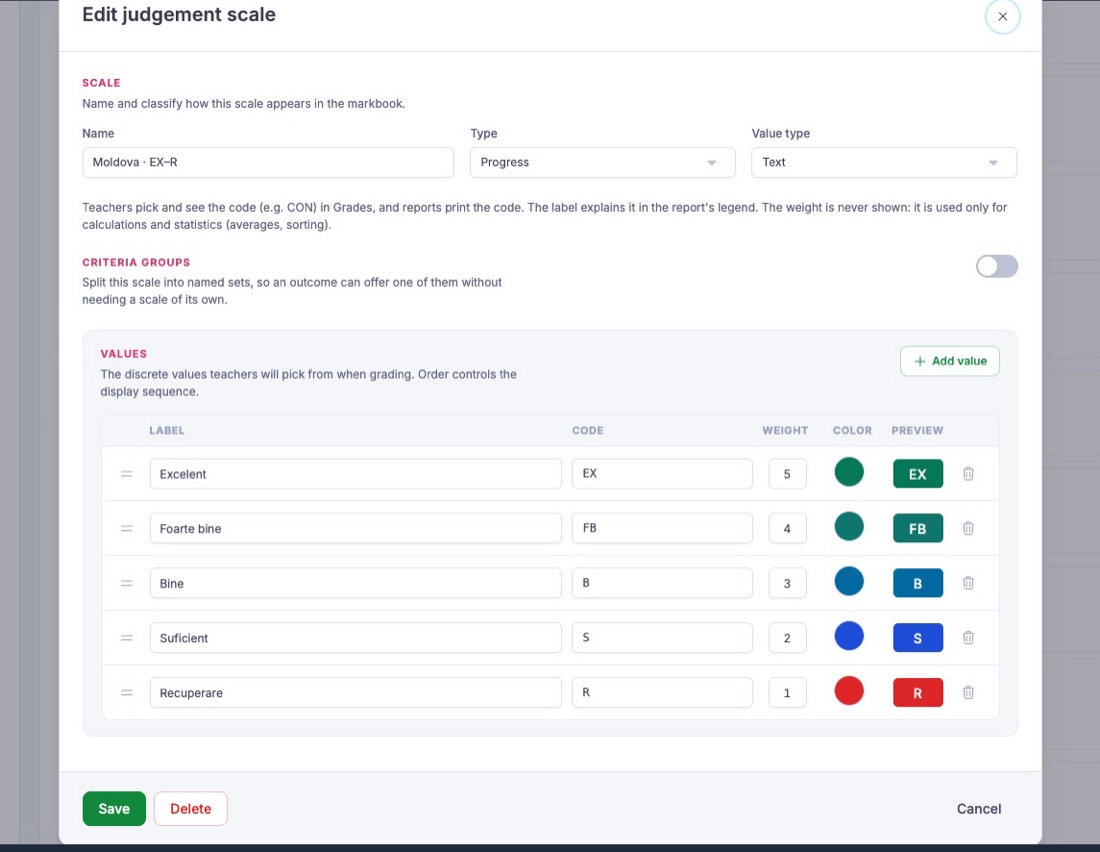
Moldova · EX–R
Judgement scale for years 1-3 (Învățământ primar, clasele I-III (primary, criterion-referenced assessment by descriptors)). Build it in Configuration → Assessment → Judgement scales. Recipe: Words instead of marks.
| Grade | Description | Weight | Pass |
|---|---|---|---|
| EX | Excelent · Excellent | 5 | yes |
| FB | Foarte bine · Very good | 4 | yes |
| B | Bine · Good | 3 | yes |
| S | Suficient · Sufficient | 2 | yes |
| R | Recuperare · Remediation needed (not a grade) | 1 | no |
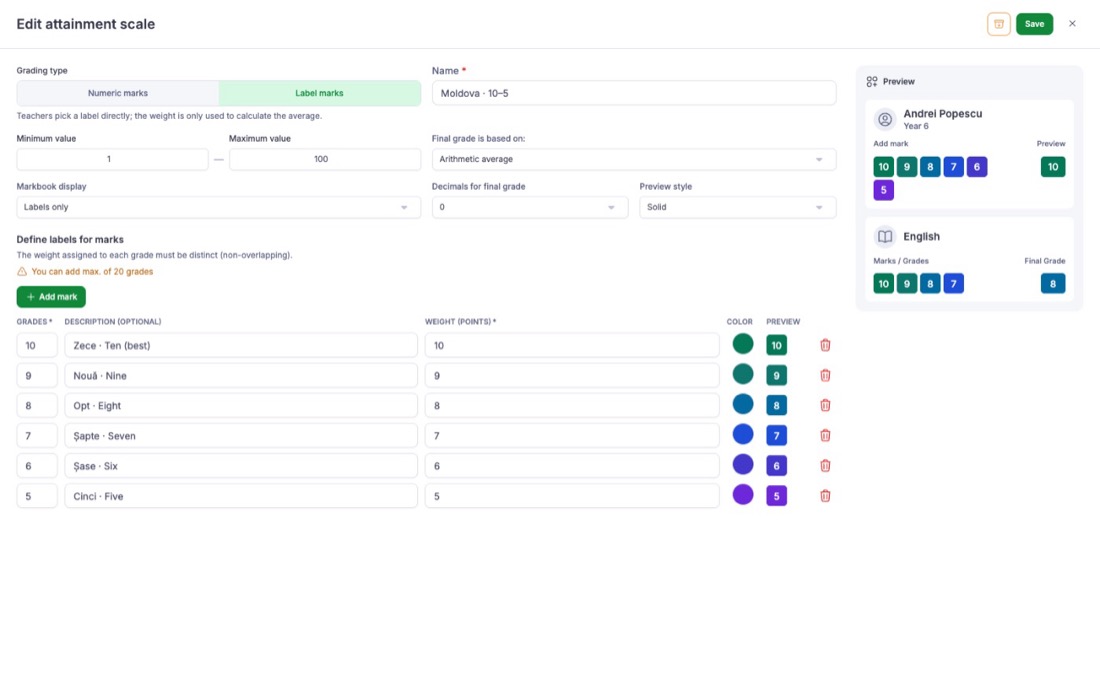
Moldova · 10–5
Attainment scale for years 4 (Clasa a IV-a (last year of primary)). Build it in Configuration → Assessment → Attainment scales. Recipe: Whole-number marks.
| Grade | Description | Weight | Pass |
|---|---|---|---|
| 10 | Zece · Ten (best) | 10 | yes |
| 9 | Nouă · Nine | 9 | yes |
| 8 | Opt · Eight | 8 | yes |
| 7 | Șapte · Seven | 7 | yes |
| 6 | Șase · Six | 6 | yes |
| 5 | Cinci · Five | 5 | yes |
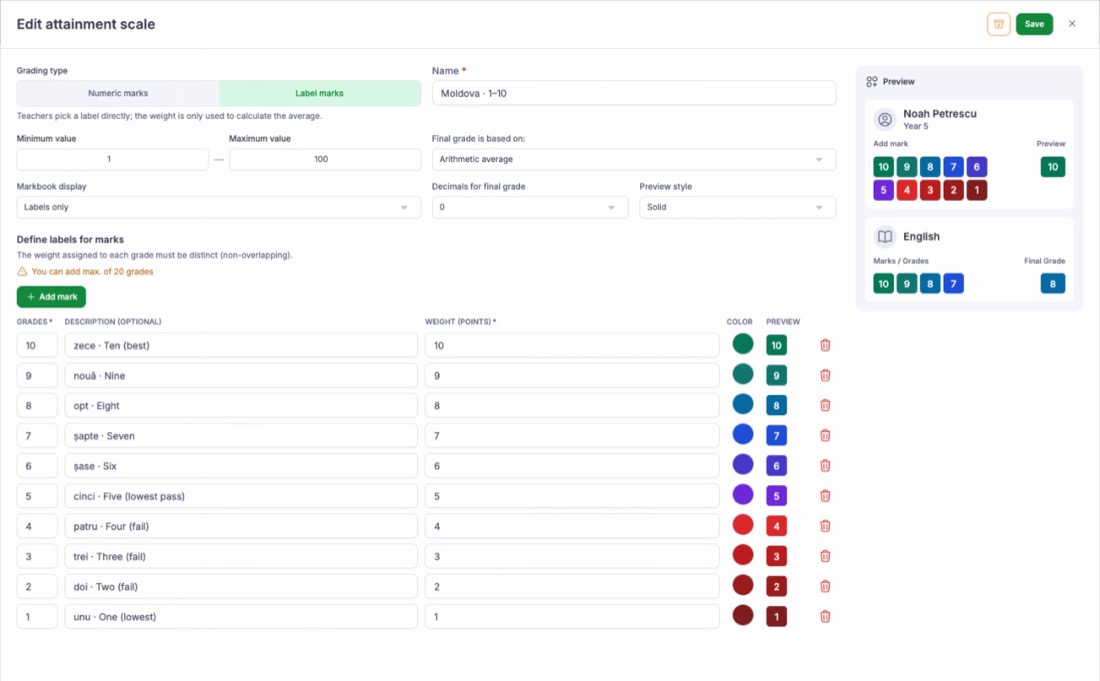
Moldova · 1–10
Attainment scale for years 5-9 (Gimnaziu (lower secondary)). Build it in Configuration → Assessment → Attainment scales. Recipe: Whole-number marks.
| Grade | Description | Weight | Pass |
|---|---|---|---|
| 10 | zece · Ten (best) | 10 | yes |
| 9 | nouă · Nine | 9 | yes |
| 8 | opt · Eight | 8 | yes |
| 7 | șapte · Seven | 7 | yes |
| 6 | șase · Six | 6 | yes |
| 5 | cinci · Five (lowest pass) | 5 | yes |
| 4 | patru · Four (fail) | 4 | no |
| 3 | trei · Three (fail) | 3 | no |
| 2 | doi · Two (fail) | 2 | no |
| 1 | unu · One (lowest) | 1 | no |
Before you rely on this page
Confidence: high
Two 2025 texts (Regulation 2290/2025 and order 1399/2025) disagree on the primary qualifiers (with or without 'Excelent') and on marks 10-5 in year IV. Say that the rules changed in 2025 and that schools must check which text applies. Schooling: 12 years (primary I-IV, gymnasium V-IX, lyceum X-XII), school entry at 6-7. Two 2025 texts disagree: Regulation 2290/2025 point 4.1 still names primary qualifiers FB/B/S and descriptors independent/ghidat/cu mai mult sprijin, while the 2025 primary methodology (order 1399/2025) adds 'Excelent', the 'avansat' level and marks 10-5 in year IV. I describe the methodology (more recent and specific); check which applies in the current year. Before 2025 primary used FB/B/S only (ECD since 2015, order 1468/2019). Regulation 2290/2025 says years V-VIII are promoted regardless, whereas the older Eurydice text describes resits for 1-3 failed subjects; I follow the 2025 regulation. Eurydice says repeating X-XI applies with 4+ failed subjects; the 2025 regulation instead speaks of corigență and expulsion. Gymnasium exam and BAC pass thresholds beyond 'each subject >= 5', their weighting, and the year-IV national test scale were not confirmed. A public consultation on amendments ran in December 2025.
Sources (4)
- MEC Moldova - Metodologia privind evaluarea rezultatelor învățării în clasele primare (Ordinul MEC nr. 1399 din 07.08.2025) (official)
- MEC Moldova - Regulamentul privind evaluarea și notarea rezultatelor învățării, promovarea și absolvirea (Ordinul MEC nr. 2290/2025) (official)
- Eurydice - Moldova: Assessment in general lower secondary education (official)
- Eurydice - Moldova: Assessment in general upper secondary education (official)