
🇱🇹 Lithuania
This page describes how schools in Lithuania grade pupils, from the first year of primary school (year 1, about age 6–7) to the end of upper secondary, and how to build the same system in MarkBook. Back to Find Your Country.
Check the current rules
This description comes from public sources (ministry pages, national laws, Eurydice) read in October 2026. Rules change with reforms, and schools often have local rules. Check the current official text for anything your school reports to the ministry.
How pupils are graded
Before year 1: Pre-primary education (priešmokyklinis ugdymas) is compulsory at 6 and not graded. School starts at 7. Grades 1-4 have no marks.
| Years | Stage | Scale | Pass | Recipe |
|---|---|---|---|---|
| 1-4 | Pradinis ugdymas (primary education) | No marks. Summary achievement levels: satisfactory / basic / advanced (unsatisfactory if not reached); moral education: progress made / not made | Satisfactory level | Words |
| 5-10 | Pagrindinis ugdymas (basic / lower secondary, incl. gymnasium classes I-II) | 1-10, 10 best; levels: threshold 4, satisfactory 5-6, basic 7-8, advanced 9-10; plus įskaityta / neįskaityta / atleista | 4 | Whole-number marks |
| 11-12 | Vidurinis ugdymas (upper secondary, gymnasium classes III-IV) | 1-10, 10 best (same levels); Matura exams 0-100 | 4 for year marks | Whole-number marks |
Values in Pradinis ugdymas (primary education)
| Value | Local word | English |
|---|---|---|
| nepatenkinamas | nepatenkinamas lygis | Unsatisfactory |
| patenkinamas | patenkinamas lygis | Satisfactory |
| pagrindinis | pagrindinis lygis | Basic |
| aukštesnysis | aukštesnysis lygis | Advanced |
| p.p. | padarė pažangą | Progress made (moral education) |
| n.p. | nepadarė pažangos | Progress not made (moral education) |
Values in Pagrindinis ugdymas (basic / lower secondary, incl. gymnasium classes I-II)
| Value | Local word | English |
|---|---|---|
| 10 | puikiai | Excellent |
| 9 | labai gerai | Very good |
| 8 | gerai | Good |
| 7 | pakankamai gerai | Fairly good |
| 6 | patenkinamai | Satisfactory |
| 5 | pakankamai patenkinamai | Fairly satisfactory |
| 4 | silpnai | Weak (threshold, pass) |
| 3 | labai silpnai | Very weak |
| 2 | blogai | Bad |
| 1 | labai blogai | Very bad |
| įsk. | įskaityta | Credited (pass) |
| neįsk. | neįskaityta | Not credited |
| atl. | atleista | Exempt |
Values in Vidurinis ugdymas (upper secondary, gymnasium classes III-IV)
| Value | Local word | English |
|---|---|---|
| 9-10 | aukštesnysis lygis | Advanced |
| 7-8 | pagrindinis lygis | Basic |
| 5-6 | patenkinamas lygis | Satisfactory |
| 4 | slenkstinis lygis | Threshold |
| 1-3 | nepatenkinamas | Unsatisfactory |
The year. The school chooses semesters (pusmečiai) or trimesters. Teachers summarise each period; period and annual grades are recorded in the electronic diary (e.g. TAMO, e-dienynas) and in progress summaries. Annual grade at the end of the year.
Averages and rounding. Set in each school's assessment procedure. Common rule (example: Vilnius Baltupiai pro-gymnasium, 2023): the annual grade is the arithmetic mean of the trimester grades rounded to a whole number; the teacher may instead use the mean of all marks of the year. The school sets a minimum number of marks per period by weekly lessons (e.g. 1 lesson/week → 3 marks per trimester, 2 → 5). Pupils without the minimum may sit a credit test (įskaita). Exempt in one period + credited in others gives 'įskaityta' for the year.
Passing the year. Satisfactory year-end marks (4+ or 'įskaityta') in all compulsory subjects mean promotion. Otherwise the teachers' council may give additional work (its mark becomes the annual mark), promote, or have the pupil repeat; the principal decides. Grades 1-3: pupils above the advanced level may skip a grade. Grade 10 with an unsatisfactory annual mark repeats only the failed subjects.
Conduct. No official conduct mark in the national rules found. Social civic activity (socialinė-pilietinė veikla) hours are recorded and required for completion.
Differences between regions or school types. National system. Schools choose semesters vs trimesters, the minimum number of marks, cumulative-point schemes and the exact words for low marks. School types (progimnazija, pagrindinė mokykla, gimnazija) differ in which grades they teach, not in the scale.
Common practice that is not official. Cumulative points (kaupiamieji balai) for homework and activity that turn into one mark; percent-to-mark tables on tests (e.g. 91-100% = 10). These are school rules, not national ones.
National exams.
- NMPP (national pupil achievement tests) (year 4, 6, 8): Percent / levels; the agency recommends no grade
- PUPP (basic education achievement assessment) (year 10): 10-point
- Brandos egzaminai (Matura exams, state and school) (year 11-12): 0-100 (state exam: part 1 40 pts taken in grade 11 + part 2 60 pts in grade 12; Lithuanian 30 + 70); certificate shows 40-100
Words you will meet
Mark: pažymys; score: balas; assessment: vertinimas; average: vidurkis. Term: pusmetis (semester) or trimestras (trimester). Annual grade: metinis įvertinimas. Report: pažangumo suvestinė / pasiekimų pažymėjimas. Credit: įskaityta / neįskaityta; exempt: atleista. Matura: brandos egzaminai. Achievement levels: slenkstinis, patenkinamas, pagrindinis, aukštesnysis.
Set it up in MarkBook
Create a level scale for grades 1-4 (nepatenkinamas, patenkinamas, pagrindinis, aukštesnysis; points 1-4) and a 'padarė pažangą / nepadarė pažangos' scale for moral education. For grades 5-12 create a 1-10 scale (10 puikiai ... 1 labai blogai), pass from 4, with level boundaries 4 / 5-6 / 7-8 / 9-10, and a pass-fail scale 'įskaityta / neįskaityta / atleista'. Use the school's periods (two semesters or three trimesters) and a year column. Calculate the period grade as the mean of the period's marks and the annual grade as the mean of period grades, both rounded half up to a whole number, with teacher override. Optionally add a Matura score column 0-100.
The scales, ready to copy
These are the scales as MarkBook shows them in the scale editor. Build yours with the same grades, descriptions and weights. Each scale links to the recipe that explains it on Set Up Any Grading System.
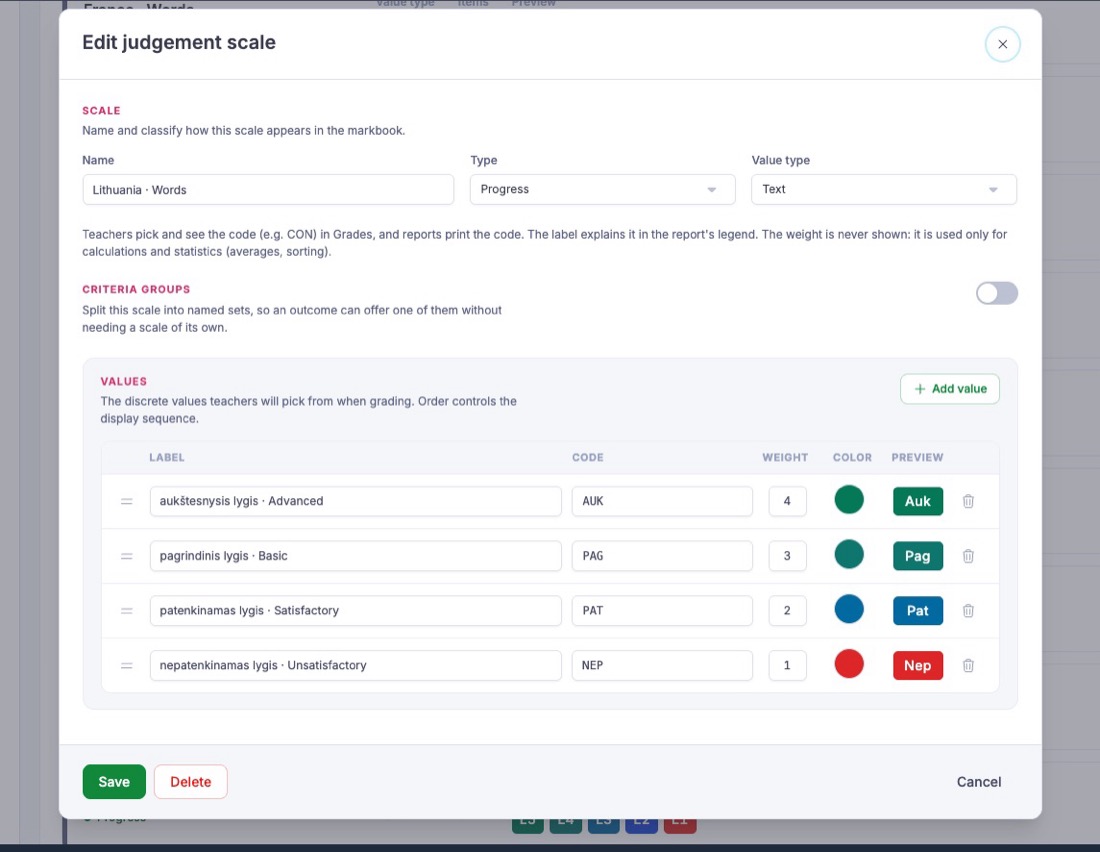
Lithuania · Words
Judgement scale for years 1-4 (Pradinis ugdymas (primary education)). Build it in Configuration → Assessment → Judgement scales. Recipe: Words instead of marks.
| Grade | Description | Weight | Pass |
|---|---|---|---|
| aukštesnysis | aukštesnysis lygis · Advanced | 4 | yes |
| pagrindinis | pagrindinis lygis · Basic | 3 | yes |
| patenkinamas | patenkinamas lygis · Satisfactory | 2 | yes |
| nepatenkinamas | nepatenkinamas lygis · Unsatisfactory | 1 | no |
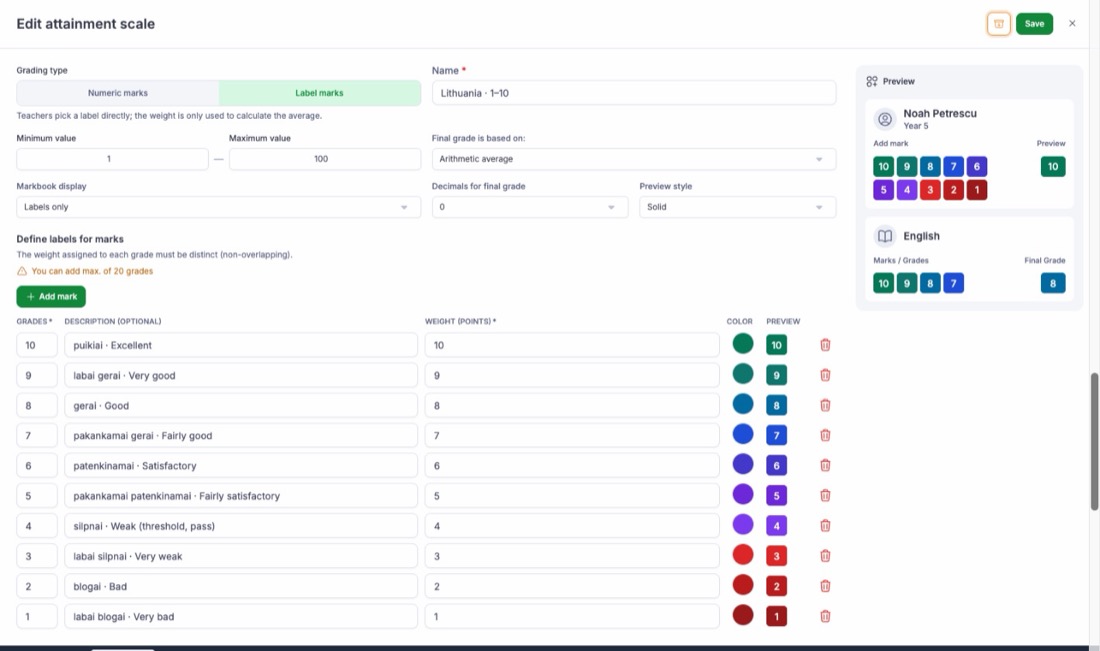
Lithuania · 1–10
Attainment scale for years 5-10 (Pagrindinis ugdymas (basic / lower secondary, incl. gymnasium classes I-II)). Build it in Configuration → Assessment → Attainment scales. Recipe: Whole-number marks.
| Grade | Description | Weight | Pass |
|---|---|---|---|
| 10 | puikiai · Excellent | 10 | yes |
| 9 | labai gerai · Very good | 9 | yes |
| 8 | gerai · Good | 8 | yes |
| 7 | pakankamai gerai · Fairly good | 7 | yes |
| 6 | patenkinamai · Satisfactory | 6 | yes |
| 5 | pakankamai patenkinamai · Fairly satisfactory | 5 | yes |
| 4 | silpnai · Weak (threshold, pass) | 4 | yes |
| 3 | labai silpnai · Very weak | 3 | no |
| 2 | blogai · Bad | 2 | no |
| 1 | labai blogai · Very bad | 1 | no |
Before you rely on this page
Confidence: medium
The Lithuanian words for 10-point marks come from school procedures; the words for 1-3 vary and I found no national ministry text listing them. Rounding and minimum-mark rules are school rules. Eurydice gives both 35 (pass) and 40 (threshold band) for Matura; check with NŠA. The updated general curriculum (from 2023/24) may change level descriptors; I did not confirm its effect on marks.
Sources (4)
- Eurydice - Lithuania: Assessment in primary education (official)
- Eurydice - Lithuania: Assessment in general lower secondary education (official)
- Eurydice - Lithuania: Assessment in general upper secondary education (official)
- Vilniaus Baltupių progimnazija - 5-8 klasių mokinių pažangos ir pasiekimų vertinimo tvarkos aprašas (2023)