
🇱🇻 Latvia
This page describes how schools in Latvia grade pupils, from the first year of primary school (year 1, about age 6–7) to the end of upper secondary, and how to build the same system in MarkBook. Back to Find Your Country.
Check the current rules
This description comes from public sources (ministry pages, national laws, Eurydice) read in October 2026. Rules change with reforms, and schools often have local rules. Check the current official text for anything your school reports to the ministry.
How pupils are graded
Before year 1: Pre-school education is compulsory at ages 5-6 and is not graded. School starts at 7.
| Years | Stage | Scale | Pass | Recipe |
|---|---|---|---|---|
| 1-3 | Pamatizglītība 1.-3. klase (basic education, first cycle) | Four mastery levels S / T / A / P (Regulation No. 747, Skola2030) | No formal pass; 'S' signals that support is needed | Words |
| 4-9 | Pamatizglītība 4.-9. klase (basic education, primary upper and lower secondary) | 1-10, 10 best | 4 (gandrīz viduvēji) | Whole-number marks |
| 10-12 | Vispārējā vidējā izglītība (general secondary) | 1-10, 10 best (same words as basic school) | 4 | Whole-number marks |
Values in Pamatizglītība 1.-3. klase (basic education, first cycle)
| Value | Local word | English |
|---|---|---|
| S | sācis apgūt | Started to learn |
| T | turpina apgūt | Continues to learn (partly achieved) |
| A | apguvis | Achieved (fully, stable) |
| P | apguvis padziļināti | Achieved in depth |
Values in Pamatizglītība 4.-9. klase (basic education, primary upper and lower secondary)
| Value | Local word | English |
|---|---|---|
| 10 | izcili | With distinction |
| 9 | teicami | Excellent |
| 8 | ļoti labi | Very good |
| 7 | labi | Good |
| 6 | gandrīz labi | Almost good |
| 5 | viduvēji | Satisfactory |
| 4 | gandrīz viduvēji | Almost satisfactory |
| 3 | vāji | Weak |
| 2 | ļoti vāji | Very weak |
| 1 | ļoti, ļoti vāji | Very, very weak |
| nv | nav vērtējuma | No assessment (work not done) |
Values in Vispārējā vidējā izglītība (general secondary)
| Value | Local word | English |
|---|---|---|
| 10 | izcili | With distinction |
| 4-9 | teicami ... gandrīz viduvēji | Excellent ... almost satisfactory |
| 1-3 | vāji ... ļoti, ļoti vāji | Weak ... very, very weak |
The year. Two semesters. A report (liecība) at the end of each semester; grade 9 and grade 12 pupils get it at the end of the first semester and then the final documents. Under Skola2030 the official result is the year grade (vērtējums gadā) per subject.
Averages and rounding. Set by each school's assessment procedure (vērtēšanas kārtība), not by a national formula. Typical rule (Madona secondary school 2024): the subject grade is the mean of the topic-end summative works, rounded half up (≥ .5 rounds up); a grade can only be given when all planned summative works have a mark (an 'nv' left at year end means no year grade). A combined final retest may weigh 70% against the earlier year grade. Formative marks do not count. Schools publish the number and weight of summative works by 20 September.
Passing the year. Promotion is usually automatic (head's decree on the report). Grades 5-9: a mark below 4 in more than one subject may lead to repeating the year after extra consultations and tests. Grade 9: certificate of basic education needs assessments in all subjects and the exams. Secondary: progression 10 → 11 is automatic since 2012/13; repeating only in exceptional cases.
Conduct. No official behaviour mark. Schools may record learning habits and social skills (often with S/T/A/P levels) in E-klase; these do not affect subject grades.
Differences between regions or school types. National standards apply everywhere. Each school sets its own assessment procedure: percentage cut-offs for S/T/A/P and for 1-10, number and weights of summative works, retake rules. Minority-language programmes add minority language and Latvian rules (being phased out by the move to Latvian-only teaching from 2023 onwards).
Common practice that is not official. Teachers usually score work in percent or points and convert to S/T/A/P or 1-10 with the school's table. Formative work is often shown as percent in E-klase. These percents are not the official grade.
National exams.
- Valsts diagnosticējošie darbi 3. un 6. klasē (national diagnostic tests) (year 3, 6): Percent
- Valsts pārbaudījumi 9. klasē (basic education exams) (year 9): Percent
- Centralizētie eksāmeni (centralised exams) (year 12): Percent (0-100%); foreign language also as CEFR level B1/B2/C1
Words you will meet
Mark/grade: vērtējums, atzīme; points: balles (10 ballu skala). Average: vidējais vērtējums. Term: semestris. Year grade: vērtējums gadā / gada vērtējums. Report card: liecība. Certificate: apliecība (basic), atestāts (secondary). No assessment: nv (nav vērtējuma). Pass/fail: ieskaitīts / neieskaitīts. Mastery levels: apguves līmeņi. E-diary: E-klase.
Set it up in MarkBook
Create a level scale S/T/A/P (points 1-4) for grades 1-3 and a 1-10 scale (izcili ... ļoti, ļoti vāji), pass from 4, for grades 4-12. Add 'nv' as a no-value marker and an 'ieskaitīts/neieskaitīts' pass-fail scale. Use two semesters plus a year column. Per period, add one summative column per topic (with a weight if the school sets one) and a percent formative column that does not count. Calculate the year grade as the weighted mean of summative columns, rounded half up to a whole point, empty if any summative column is 'nv'.
The scales, ready to copy
These are the scales as MarkBook shows them in the scale editor. Build yours with the same grades, descriptions and weights. Each scale links to the recipe that explains it on Set Up Any Grading System.
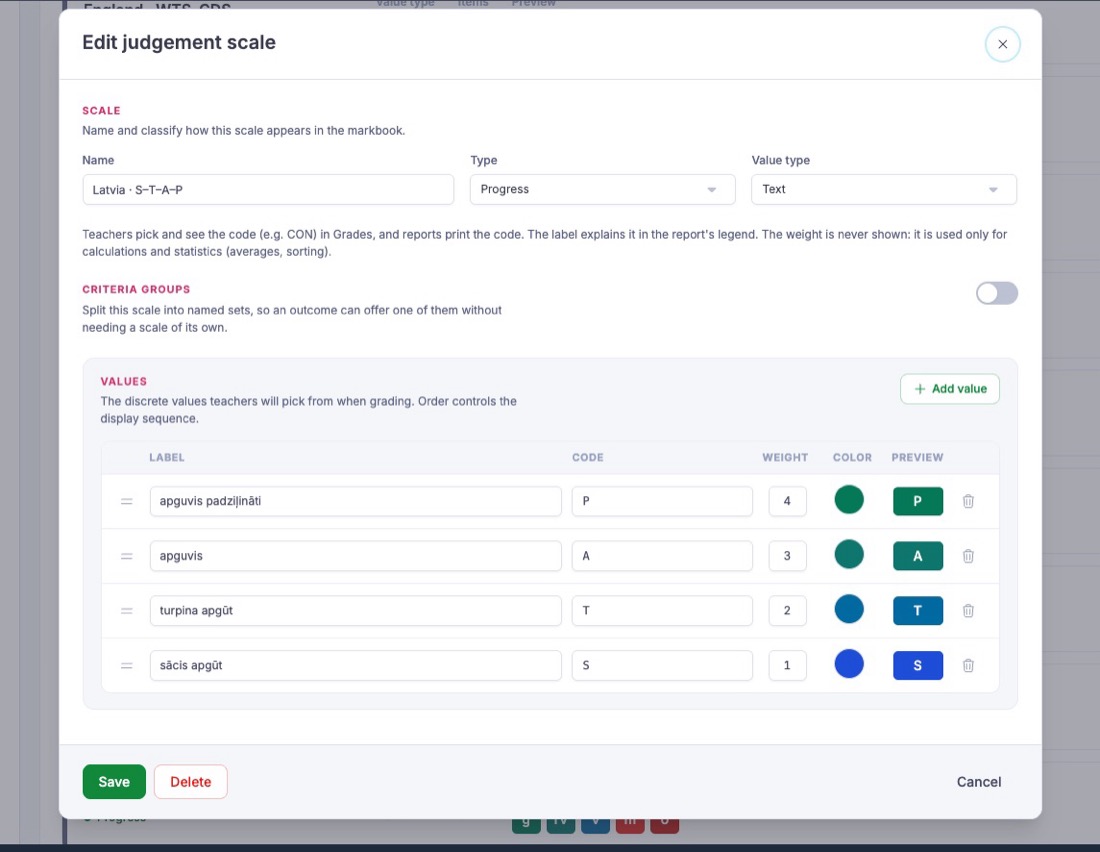
Latvia · S–T–A–P
Judgement scale for years 1-3 (Pamatizglītība 1.-3. klase (basic education, first cycle)). Build it in Configuration → Assessment → Judgement scales. Recipe: Words instead of marks.
| Grade | Description | Weight | Pass |
|---|---|---|---|
| P | apguvis padziļināti · Achieved in depth | 4 | yes |
| A | apguvis · Achieved (fully, stable) | 3 | yes |
| T | turpina apgūt · Continues to learn (partly achieved) | 2 | yes |
| S | sācis apgūt · Started to learn | 1 | yes |
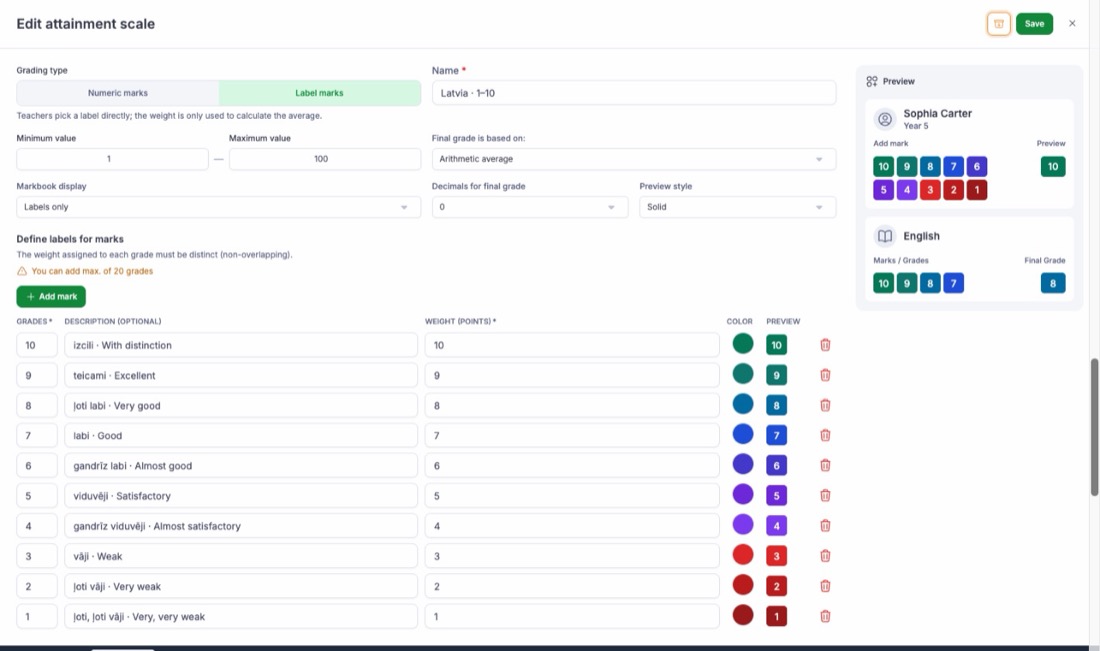
Latvia · 1–10
Attainment scale for years 4-9 (Pamatizglītība 4.-9. klase (basic education, primary upper and lower secondary)). Build it in Configuration → Assessment → Attainment scales. Recipe: Whole-number marks.
| Grade | Description | Weight | Pass |
|---|---|---|---|
| 10 | izcili · With distinction | 10 | yes |
| 9 | teicami · Excellent | 9 | yes |
| 8 | ļoti labi · Very good | 8 | yes |
| 7 | labi · Good | 7 | yes |
| 6 | gandrīz labi · Almost good | 6 | yes |
| 5 | viduvēji · Satisfactory | 5 | yes |
| 4 | gandrīz viduvēji · Almost satisfactory | 4 | yes |
| 3 | vāji · Weak | 3 | no |
| 2 | ļoti vāji · Very weak | 2 | no |
| 1 | ļoti, ļoti vāji · Very, very weak | 1 | no |
Before you rely on this page
Confidence: medium
Regulation 747 was not read. Eurydice still shows the older rule. Year 4 may be a transition year (10-point marks in some subjects, levels in others). Confirm that year 4 is fully numeric before you show it as 'numeric 1-10'. Eurydice still shows the older rule (grade 1 no marks, grades 2-3 partly numeric); school procedures under Regulation 747 use S/T/A/P in grades 1-3. I did not read the regulation text itself. Year-grade computation is from one school procedure, not a national rule. Current centralised-exam threshold (20%?) and the current grade-9 exam format were not confirmed.
Sources (4)
- Eurydice - Latvia: Assessment in single structure education (official)
- Eurydice - Latvia: Assessment in general upper secondary education (official)
- Madonas pilsētas vidusskola - Skolēnu mācību snieguma vērtēšanas kārtība (2024, under Reg. 747 and 416)
- LSM - School exam passing mark to rise substantially in Latvia (2022)