
🇮🇹 Italy
This page describes how schools in Italy grade pupils, from the first year of primary school (year 1, about age 6–7) to the end of upper secondary, and how to build the same system in MarkBook. Back to Find Your Country.
Check the current rules
This description comes from public sources (ministry pages, national laws, Eurydice) read in October 2026. Rules change with reforms, and schools often have local rules. Check the current official text for anything your school reports to the ministry.
How pupils are graded
Before year 1: Scuola dell'infanzia (ages 3-6) is not graded. Primary starts at age 6. Italy has 13 years before university (5 primary + 3 lower secondary + 5 upper secondary), ending at about age 19; compulsory schooling is 10 years (to 16).
| Years | Stage | Scale | Pass | Recipe |
|---|---|---|---|---|
| 1-5 | Scuola primaria (primary) | Six giudizi sintetici per subject, with a description of the level reached (from 2024/25) | Sufficiente | Words |
| 6-8 | Scuola secondaria di primo grado (lower secondary) | 0-10 (voti in decimi), 10 best; in practice 4-10 on reports | 6 | Whole-number marks |
| 9-13 | Scuola secondaria di secondo grado (upper secondary: licei, istituti tecnici, istituti professionali) | 0-10, 10 best (commonly 1/2/3-10 used) | 6 | Whole-number marks |
Values in Scuola primaria (primary)
| Value | Local word | English |
|---|---|---|
| Ottimo | Ottimo | Excellent |
| Distinto | Distinto | Distinguished / very good |
| Buono | Buono | Good |
| Discreto | Discreto | Fair |
| Sufficiente | Sufficiente | Sufficient |
| Non sufficiente | Non sufficiente | Not sufficient |
Values in Scuola secondaria di primo grado (lower secondary)
| Value | Local word | English |
|---|---|---|
| 10 | Dieci / ottimo | Excellent |
| 9 | Nove / distinto | Very good |
| 8 | Otto / buono | Good |
| 7 | Sette / discreto | Fair |
| 6 | Sei / sufficiente | Sufficient (pass) |
| 5 | Cinque / insufficiente | Insufficient |
| 4 | Quattro / gravemente insufficiente | Seriously insufficient |
The year. Each school chooses two quadrimestri (Sept-Jan, Feb-June) or three trimestri. A scrutinio (class council meeting) at the end of each period; the report card (pagella / documento di valutazione) is issued electronically after each one. The final (June) scrutinio decides promotion.
Averages and rounding. The period and final mark is proposed by the subject teacher and approved by the class council by majority vote (tie: school head decides). It is a judgement based on the marks collected, not a mandatory arithmetic mean; schools set a minimum number of assessments per period in their own rules (PTOF). Upper secondary credits are drawn from bands by the average of final marks including conduct (M), plus attendance and activities. Final State exam (upper secondary): credits (max 40) + three tests (max 20 each) = 100. Lower secondary exam: final mark = mean of the admission mark and the mean of the tests, rounded, in tenths.
Passing the year. Primary: pupils move up even with gaps; retention only by unanimous teacher decision with reasons. Lower secondary: 75% attendance required; the class council may refuse promotion by majority with reasons even if marks below 6 exist; conduct below 6 → not admitted. Upper secondary: all subjects and conduct at least 6; marks just below 6 → giudizio sospeso with a September check; conduct 6 → citizenship essay before admission; conduct below 6 → retained.
Conduct. Primary: collegial giudizio sintetico on behaviour (no number). Secondary (both levels): voto in condotta 0-10 (restored by Law 150/2024). Below 6 = not admitted to next year or exam. Exactly 6 (upper secondary) = assigned critical essay on active citizenship. Max credits in the final year need conduct 9 or 10.
Differences between regions or school types. National rules apply in all regions. Schools choose trimestri or quadrimestri and set assessment criteria in their PTOF. Bolzano/Trento and Valle d'Aosta have some autonomy (German- and Ladin-language schools in South Tyrol use their own provincial rules). Vocational training run by regions (IeFP) uses different certification.
Common practice that is not official. Daily marks with + and -, halves (6½) and fractional forms ('6/7', 'sei e mezzo') are very common in registers; schools publish grids mapping a percentage or points score to tenths. These are not official report values. Some registri elettronici compute weighted averages per type (written, oral, practical).
National exams.
- Prove INVALSI (year 2, 5, 8, 10, 13): Achievement levels (1-5 for Italian/Maths; A1/A2/B1/B2 for English); not school marks
- Esame di Stato conclusivo del primo ciclo (year 8): Marks in tenths; pass 6/10; 10 e lode possible
- Esame di Stato / Esame di maturità (year 13): 0-100; pass 60; 100 e lode
Words you will meet
Voto (mark, 'in decimi' = out of ten); giudizio sintetico (summary judgement); media (average); trimestre / quadrimestre (term); scrutinio (end-of-term class council); pagella / documento di valutazione (report card); voto in condotta / comportamento (conduct); credito scolastico (school credits); giudizio sospeso (suspended judgement); lode (honours).
Set it up in MarkBook
Primary scale: Ottimo=6, Distinto=5, Buono=4, Discreto=3, Sufficiente=2, Non sufficiente=1 (pass from Sufficiente) plus a level-description text; behaviour as a separate giudizio. Secondary scale: numeric 1-10, pass 6, allow 0.25/0.5 steps in daily marks (6+ = 6.25, 6½ = 6.5, 7- = 6.75) but round to whole numbers for the pagella. Columns per quadrimestre/trimestre: written, oral, practical marks; calculated mean; proposed period mark (whole number, teacher decides). Conduct column 0-10 per period. Final year average (with conduct) used for credit bands in years 9-13 (classes 3-5).
The scales, ready to copy
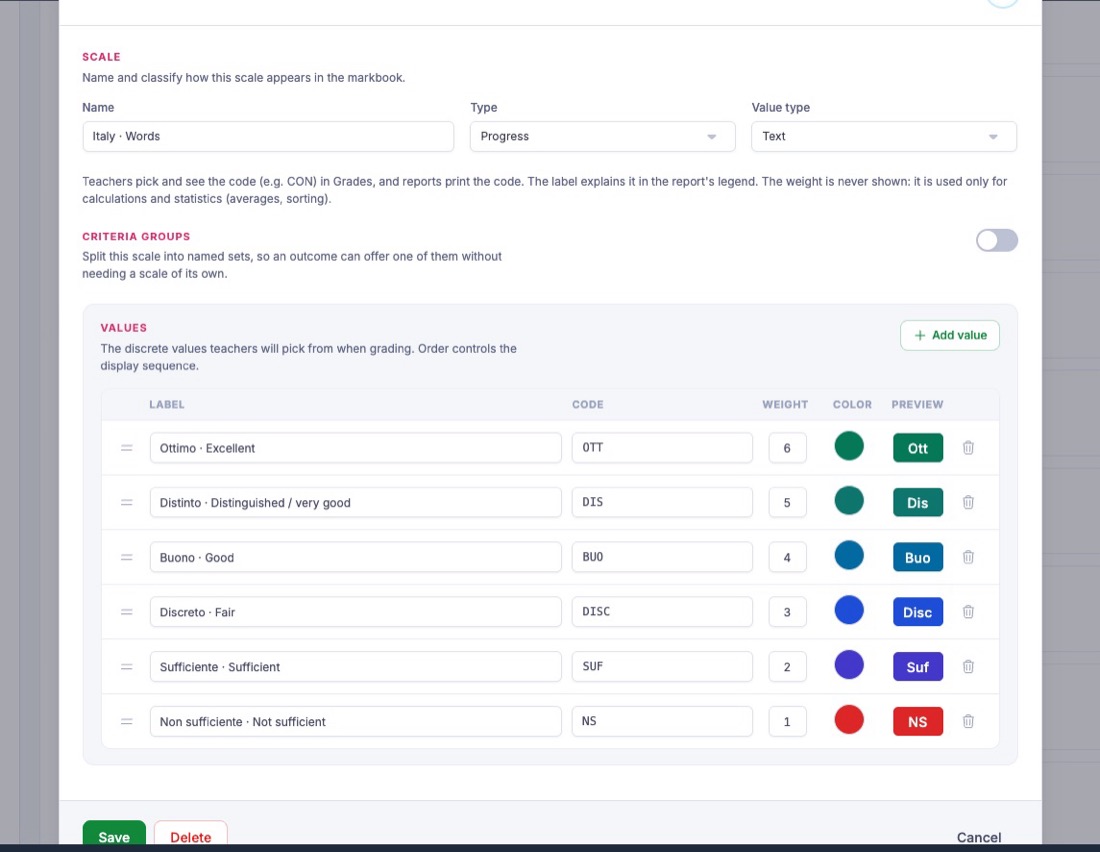
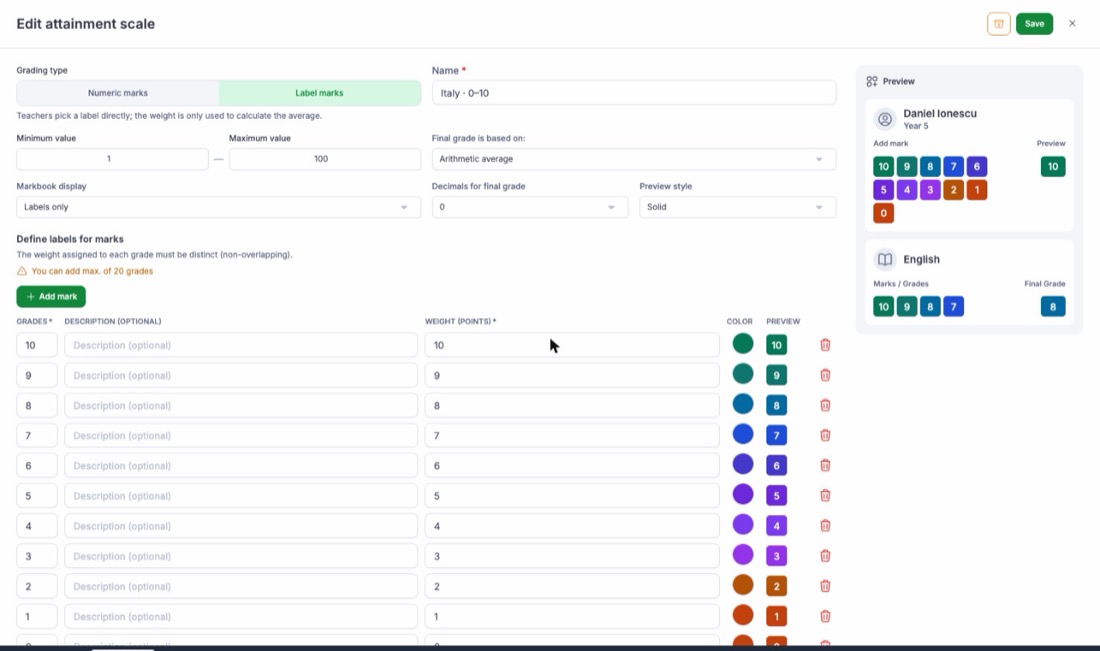
These are the scales as MarkBook shows them in the scale editor. Build yours with the same grades, descriptions and weights. Each scale links to the recipe that explains it on Set Up Any Grading System.
Italy · Words
Judgement scale for years 1-5 (Scuola primaria (primary)). Build it in Configuration → Assessment → Judgement scales. Recipe: Words instead of marks.
| Grade | Description | Weight | Pass |
|---|---|---|---|
| Ottimo | Excellent | 6 | yes |
| Distinto | Distinguished / very good | 5 | yes |
| Buono | Good | 4 | yes |
| Discreto | Fair | 3 | yes |
| Sufficiente | Sufficient | 2 | yes |
| Non sufficiente | Not sufficient | 1 | no |
Italy · 0–10
Attainment scale for years 9-13 (Scuola secondaria di secondo grado (upper secondary: licei, istituti tecnici, istituti professionali)). Build it in Configuration → Assessment → Attainment scales. Recipe: Whole-number marks.
| Grade | Description | Weight | Pass |
|---|---|---|---|
| 10 | 10 | yes | |
| 9 | 9 | yes | |
| 8 | 8 | yes | |
| 7 | 7 | yes | |
| 6 | 6 | yes | |
| 5 | 5 | yes | |
| 4 | 4 | yes | |
| 3 | 3 | yes | |
| 2 | 2 | yes | |
| 1 | 1 | yes | |
| 0 | 0 | yes |
Before you rely on this page
Confidence: medium
O.M. 3/2025 and its Allegato A were not opened. The six primary judgements are confirmed only through Eurydice and the press. The O.M. 3/2025 text and Allegato A were not opened directly (confirmed via Eurydice and press). Mapping of 4-10 to words (dieci/ottimo etc.) in lower/upper secondary is common practice, not a single national rule. Exact changes from the 2025 maturità reform (DL 127/2025, DPR 135/2025) were not confirmed. Lowest marks actually used (0, 1, 2, 3) vary by school policy.