
🌐 International Baccalaureate (PYP, MYP, DP)
This page describes how schools in International Baccalaureate (PYP, MYP, DP) grade pupils, from the first year of primary school (year 1, about age 6–7) to the end of upper secondary, and how to build the same system in MarkBook. Back to Find Your Country.
Check the current rules
This description comes from public sources (ministry pages, national laws, Eurydice) read in October 2026. Rules change with reforms, and schools often have local rules. Check the current official text for anything your school reports to the ministry.
How pupils are graded
Before year 1: PYP early years (ages 3-6) are not graded: observation, portfolios and narrative reports only.
| Years | Stage | Scale | Pass | Recipe |
|---|---|---|---|---|
| 1-5/6 (PYP covers ages 3-12, including early years) | Primary Years Programme (PYP) | No IB grading scale. The IB sets no exams and moderates no grades. Schools report with narrative comments and their own achievement descriptors. | None at IB level | Written description |
| 6-10 | Middle Years Programme (MYP years 1-5) | Each subject has four criteria (A-D), each marked 0-8 by best-fit level descriptors; the criteria total (0-32) converts to a final grade 1-7 (7 best) | For the MYP certificate: grade 3 or higher in every eAssessment component and 28 of 56 points. In-school, many schools treat 3 or 4 as the minimum satisfactory grade (school policy). | Whole-number marks |
| 11-12 | Diploma Programme (DP) and Career-related Programme | Each of six subjects graded 1-7 (7 best); Theory of Knowledge and Extended Essay graded A-E; up to 3 core points; maximum 45 | Diploma: at least 24 points and none of the failing conditions (see passing_the_year) | Whole-number marks |
The year. Not set by the IB. Schools use their own calendar: usually two semesters or three terms, with reports at the end of each. MYP schools report the four criteria levels plus the 1-7 grade per subject each reporting period. DP schools report predicted grades 1-7 (and TOK/EE letters) each term; final IB results come once, in July (May session) or January (November session).
Averages and rounding. MYP: not a mean. For each criterion the teacher gives the best-fit level 0-8 from the evidence in the period (most recent and consistent work weighs most); the four levels are summed and the sum is converted with the 1-32 boundary table. DP in school: teachers give a predicted 1-7 grade by judgement, often guided by percentage boundaries taken from past IB grade boundaries. IB final DP grades use component weights and published grade boundaries per session. TOK and EE combine to 0-3 core points through a matrix (from May 2015): A+A=3, A+B=3, A+C=2, A+D=2, B+B=2, B+C=2, B+D=1, C+C=1, C+D=0, D+D=0; any E = failing condition.
Passing the year. PYP and MYP: the IB has no rule for passing a year; promotion is school policy. MYP certificate (optional eAssessment): grade 3 or more in each required component (subjects, interdisciplinary exam, personal project) and at least 28 of 56 points. DP diploma failing conditions (from May 2015): CAS not met; fewer than 24 points; N in TOK, EE or a subject; grade E in TOK or EE; a grade 1 in any subject; grade 2 three or more times; grade 3 or below four or more times; fewer than 12 points at HL (top three count if four HL); fewer than 9 points at SL (at least 5 if only two SL).
Conduct. No IB conduct grade. Schools report approaches to learning (ATL) skills and learner profile attributes with descriptors (e.g. Consistently / Usually / Sometimes / Rarely). DP CAS is complete / not complete. Academic misconduct can cost the diploma.
Differences between regions or school types. The IB is a programme, not a country, so it sits on top of the host system. Many state schools (e.g. in the US, Spain, Poland) must also give the national grades on the official report and transcript, and convert IB levels to them (e.g. US district percentages, Spanish 0-10). Schools set their own report calendars, PYP descriptors and MYP in-school grade policies. Bilingual diploma and Career-related Programme (CP) variants exist.
Common practice that is not official. Many MYP teachers mark tasks as percentages or points and convert to criteria levels; this is not IB practice. DP teachers often record percentages on tests and convert to 1-7 with past-session boundaries. Some PYP schools add numeric or letter grades for parents; the IB does not require them.
National exams.
- MYP eAssessment (on-screen exams and ePortfolios, optional) (year 10 (MYP year 5)): 1-7 per component; certificate needs 28/56 and 3+ in each
- MYP Personal Project (year 10 (MYP year 5)): 1-7
- IB Diploma examinations (May or November session) (year 12): 1-7 per subject, TOK/EE A-E, total 0-45, diploma at 24+
Words you will meet
criterion / criteria, achievement level, criterion levels total, grade boundaries, final grade, predicted grade, internal assessment (IA), external assessment, HL (higher level), SL (standard level), core (TOK, EE, CAS), personal project, eAssessment, ePortfolio
Set it up in MarkBook
PYP: no numeric scale; one comment column per unit of inquiry per term, plus optional 4-level descriptor columns for ATL skills and learner profile. MYP: one 0-8 rating scale; per subject per period four criterion columns (A, B, C, D) each holding the best-fit level (teacher judgement, not a mean), a calculated sum 0-32, and a calculated final grade 1-7 using bands 1-5=1, 6-9=2, 10-14=3, 15-18=4, 19-23=5, 24-27=6, 28-32=7. DP: a 1-7 scale (7 points ... 1 point) per subject with a predicted-grade column per term; an A-E scale for TOK and EE; a calculated core-points column from the matrix (0-3) and a total out of 45. Optional raw percentage columns for tests, converted to 1-7 with school boundaries; no rounding of grades, which are whole numbers.
The scales, ready to copy
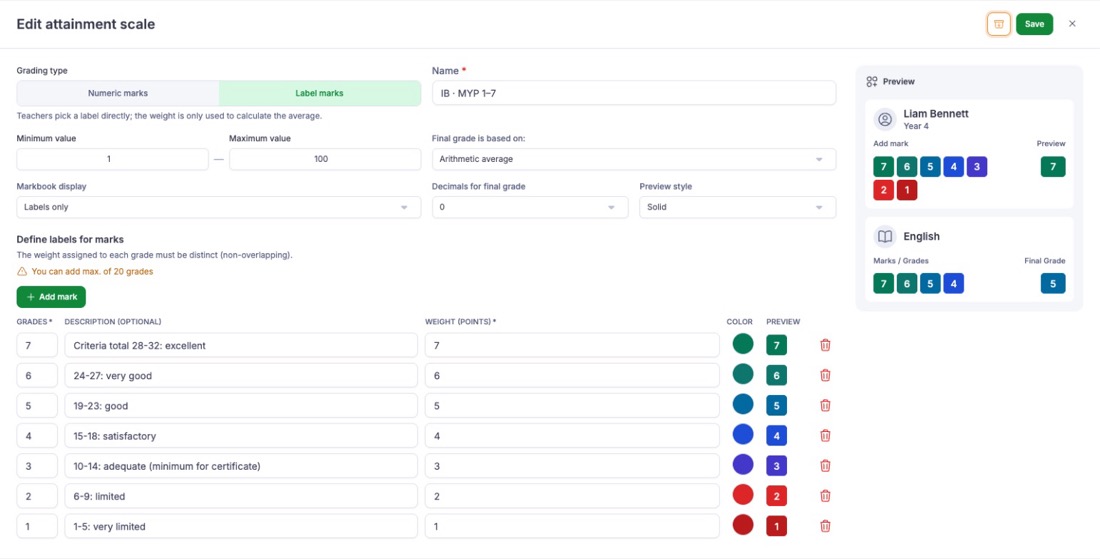
These are the scales as MarkBook shows them in the scale editor. Build yours with the same grades, descriptions and weights. Each scale links to the recipe that explains it on Set Up Any Grading System.
IB · MYP 1–7
Attainment scale for years 6-10 (Middle Years Programme (MYP years 1-5)). Build it in Configuration → Assessment → Attainment scales. Recipe: Whole-number marks.
| Grade | Description | Weight | Pass |
|---|---|---|---|
| 7 | Criteria total 28-32: excellent | 7 | yes |
| 6 | 24-27: very good | 6 | yes |
| 5 | 19-23: good | 5 | yes |
| 4 | 15-18: satisfactory | 4 | yes |
| 3 | 10-14: adequate (minimum for certificate) | 3 | yes |
| 2 | 6-9: limited | 2 | no |
| 1 | 1-5: very limited | 1 | no |
Before you rely on this page
Confidence: medium
ibo.org was not readable, and all facts come from school handbooks. The TOK/EE matrix version (2015) may be out of date. ibo.org returned HTTP 403 to every fetch, so no official IB page was read directly; the facts come from school handbooks and a study site that quote IB rules, and they agree with each other. The TOK/EE matrix is the May 2015 version; the IB may have changed details since (a Minnetonka document mentions a revision of B+C). The PYP 'no IB grades' statement comes from IB-linked research summaries seen in search results, not opened. The MYP descriptor words per grade are paraphrased. The DP '80% external / 20% internal' split varies by subject. The 2023+ DP assessment changes (e.g. new TOK, some subject reforms) were not checked in detail.
Sources (5)
- Struer Statsgymnasium: Introduction to the IBO Grading System (1-7 descriptors, failing conditions and TOK/EE matrix from May 2015)
- South Salem High School (Salem-Keizer): IB Diploma Requirements
- RevisionDojo: MYP grade boundary system (criteria 0-8, total out of 32, boundaries)
- Canadian International School of Guangzhou (CAIS): MYP (7-point scale, certificate 28/56, minimum 3)
- IB: MYP grading and awards (ibo.org blocked automated reading; seen in search results only) (official)