
🇭🇺 Hungary
This page describes how schools in Hungary grade pupils, from the first year of primary school (year 1, about age 6–7) to the end of upper secondary, and how to build the same system in MarkBook. Back to Find Your Country.
Check the current rules
This description comes from public sources (ministry pages, national laws, Eurydice) read in October 2026. Rules change with reforms, and schools often have local rules. Check the current official text for anything your school reports to the ministry.
How pupils are graded
Before year 1: Óvoda (kindergarten) is compulsory from age 3 and has no marks. School starts at about 6-7; the school-readiness decision is made by the Oktatási Hivatal on parental request. There is no graded preparatory year inside the school.
| Years | Stage | Scale | Pass | Recipe |
|---|---|---|---|---|
| 1 | Alsó tagozat, 1. évfolyam (lower primary, first year) | Written verbal assessment at half-year and year end; no number marks | Advancement: the pupil must meet the year's requirements; parents may ask to repeat grade 1 once | Written description |
| 2 | Alsó tagozat, 2. évfolyam (lower primary, second year) | Half-year: verbal wording; end of year: marks 1-5, 5 best | elégséges (2) | School decides |
| 3-8 | Alsó és felső tagozat (primary grades 3-4 and lower secondary grades 5-8 of the 8-year általános iskola) | 1-5, 5 best | elégséges (2) | Whole-number marks |
| 9-12 (13) | Középiskola (upper secondary: gimnázium, technikum, szakképző iskola) | 1-5, 5 best | elégséges (2) | Whole-number marks |
Values in Alsó tagozat, 1. évfolyam (lower primary, first year)
| Value | Local word | English |
|---|---|---|
| kiválóan teljesített | kiválóan teljesített | performed excellently |
| jól teljesített | jól teljesített | performed well |
| megfelelően teljesített | megfelelően teljesített | performed satisfactorily |
| felzárkóztatásra szorul | felzárkóztatásra szorul | needs to catch up |
Values in Alsó és felső tagozat (primary grades 3-4 and lower secondary grades 5-8 of the 8-year általános iskola)
| Value | Local word | English |
|---|---|---|
| 5 | jeles | excellent |
| 4 | jó | good |
| 3 | közepes | satisfactory / average |
| 2 | elégséges | pass / sufficient |
| 1 | elégtelen | fail |
The year. Two halves (félév). The first half ends in late January; pupils get a half-year mark per subject in the félévi értesítő (now usually in the KRÉTA e-register). The school year ends in mid-June with the év végi bizonyítvány (end-of-year certificate). The class teacher issues the certificate; the teachers' conference (nevelőtestület) approves year-end marks and promotion.
Averages and rounding. In-year marks (érdemjegyek) are recorded during the year; the teacher sets the half-year and year-end mark (osztályzat). The law does not prescribe an arithmetic mean or a rounding rule. Nkt § 54(6): if a year-end mark differs significantly, to the pupil's disadvantage, from the in-year average, the teachers' conference asks the teacher to explain and may change it in the pupil's favour. In practice, KRÉTA computes a weighted average (teachers set weights, e.g. 100% for an ordinary mark and 200% for a témazáró), and many schools round at .5 (some at .6 or higher). Schools set the minimum number of marks in their pedagogical programme; it is often tied to weekly lesson count. These practices are local, not national.
Passing the year. A pupil moves up when every subject is at least elégséges (2). With a fail (1), the pupil may take a javítóvizsga (repeat exam) in August before the next year; passing it means promotion. Common practice and the EMMI decree limit the repeat exam to at most three failed subjects; with more, the pupil repeats the year (not confirmed in the text I read). Absences above the legal maximum mean repeating the year unless the staff allow a classifying exam. Grade 1 may be repeated once at parents' request.
Conduct. Two separate marks every half-year and year end, set by the class teacher after consulting the other teachers. Magatartás (conduct): példás (5) exemplary, jó (4) good, változó (3) varying, rossz (2) bad. Szorgalom (diligence): példás (5) exemplary, jó (4) good, változó (3) varying, hanyag (2) indolent. There is no 1 on these scales. Criteria are set in each school's pedagogical programme and house rules.
Differences between regions or school types. Hungary has one national system; there are no regional grading rules. Differences come from school type and programme: a school can, with ministerial approval, use written assessment instead of marks after grade 2 (common in alternative schools such as Waldorf); church and foundation schools follow the same law. Vocational schools (technikum, szakképző iskola) since the 2020 vocational reform are under a separate vocational law but keep the 1-5 scale. Described here: the ordinary state általános iskola and gimnázium.
Common practice that is not official. Not official: in-between marks such as 5/4 or 4/5, plus and minus signs (often three pluses = a 5), percentage scores on tests converted to marks with a teacher's own table (often 90/75/60/40%), KRÉTA weights (100%/200%/50%), and red marks for témazáró. Rounding thresholds (.5 or .6) are school or teacher choices.
National exams.
- Érettségi vizsga (school-leaving exam), középszint (standard level) (year 12 (or final year)): 1-5 from percentage: 80-100% jeles (5), 60-79% jó (4), 40-59% közepes (3), 25-39% elégséges (2), 0-24% elégtelen (1)
- Érettségi vizsga, emelt szint (advanced level) (year 12): 1-5 from percentage: 60-100% jeles (5), 47-59% jó (4), 33-46% közepes (3), 25-32% elégséges (2), 0-24% elégtelen (1)
- Központi írásbeli felvételi (central written entrance exam) (year 8 (also 4 and 6 for 8- and 6-year gimnázium)): Points: Hungarian 0-50, mathematics 0-50
- Országos mérések (national measurements, bemeneti / kimeneti mérés) (year 4-11 (4-8 in primary schools)): Scaled scores, no marks
Words you will meet
érdemjegy (mark given during the year); osztályzat (period/year mark); átlag (average); félév (half-year); tanév (school year); félévi értesítő (half-year report); év végi bizonyítvány (end-of-year certificate); szöveges értékelés / szöveges minősítés (written/verbal assessment); magatartás (conduct); szorgalom (diligence); javítóvizsga (repeat exam); érettségi (school-leaving exam); témazáró (end-of-topic test); KRÉTA (national e-register).
Set it up in MarkBook
Create a 1-5 scale 'Osztályzat' with values 5 jeles, 4 jó, 3 közepes, 2 elégséges, 1 elégtelen; points = the number; pass from 2. Create a verbal scale for grade 1 (and grade 2 half-year) with four levels: kiválóan / jól / megfelelően teljesített / felzárkóztatásra szorul, plus a comment column. Create conduct and diligence scales 5-2 (példás, jó, változó, rossz / hanyag). Split the year into two periods: 1. félév (Sept-Jan) and 2. félév (Feb-June). Per period, add in-year mark columns with a weight (ordinary mark 1, témazáró 2) and a calculated weighted average shown with 2 decimals. Add a teacher-set half-year mark and a year-end mark (whole number), suggested from the average with the school's rounding rule (default .5), and flag when the year-end mark is much lower than the average.
The scales, ready to copy
These are the scales as MarkBook shows them in the scale editor. Build yours with the same grades, descriptions and weights. Each scale links to the recipe that explains it on Set Up Any Grading System.
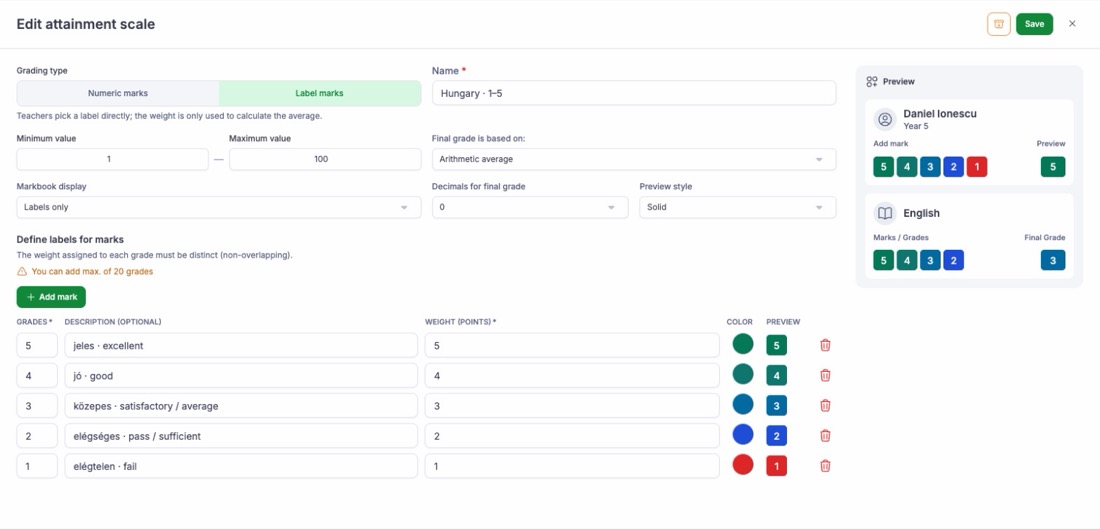
Hungary · 1–5
Attainment scale for years 3-8 (Alsó és felső tagozat (primary grades 3-4 and lower secondary grades 5-8 of the 8-year általános iskola)). Build it in Configuration → Assessment → Attainment scales. Recipe: Whole-number marks.
| Grade | Description | Weight | Pass |
|---|---|---|---|
| 5 | jeles · excellent | 5 | yes |
| 4 | jó · good | 4 | yes |
| 3 | közepes · satisfactory / average | 3 | yes |
| 2 | elégséges · pass / sufficient | 2 | yes |
| 1 | elégtelen · fail | 1 | no |
Before you rely on this page
Confidence: high
I read the scales, conduct/diligence and verbal-assessment rules in the law itself. I did not open the 20/2012 EMMI decree, so the limit of three subjects for the javítóvizsga and the exact Hungarian verbal phrases for grade 1 are from memory and Eurydice's English text. The érettségi percentage thresholds come from a 2019-2020 news source, not the decree; the exam was restructured from 2024 and thresholds may have changed. I did not confirm whether a pupil in grades 2-4 can be held back for a fail (older rules limited this). KRÉTA weighting and rounding are practice, not law.