
🇬🇷 Greece
This page describes how schools in Greece grade pupils, from the first year of primary school (year 1, about age 6–7) to the end of upper secondary, and how to build the same system in MarkBook. Back to Find Your Country.
Check the current rules
This description comes from public sources (ministry pages, national laws, Eurydice) read in October 2026. Rules change with reforms, and schools often have local rules. Check the current official text for anything your school reports to the ministry.
How pupils are graded
Before year 1: Nipiagogeio (kindergarten) is compulsory for two years (ages 4-6). No marks.
| Years | Stage | Scale | Pass | Recipe |
|---|---|---|---|---|
| 1-2 | Dimotiko, years A-B (primary, first two years) | No marks; oral/written descriptive assessment | Teacher judgement (can the pupil keep up) | Written description |
| 3-4 | Dimotiko, years C-D (primary, middle years) | A-D, A best (with descriptive comments) | A-C pass; D counts as fail. Promoted if most final subject grades are not D. | Letters |
| 5-6 | Dimotiko, years E-ΣΤ (primary, last two years) | Verbal grade plus number 1-10, 10 best | General annual average at least 4.5/10 | School decides |
| 7-9 | Gymnasio (lower secondary) | 0-20, 20 best | 10 per subject (or overall average 13 compensates) | Number columns |
| 10-12 | Geniko Lykeio (general upper secondary) | 0-20, 20 best (exam papers marked 0-100, then divided by 5) | General average at least 10 | Number columns |
Values in Dimotiko, years C-D (primary, middle years)
| Value | Local word | English |
|---|---|---|
| A | Άριστα | Excellent |
| B | Πολύ καλά | Very good |
| Γ (C) | Καλά | Good |
| Δ (D) | Σχεδόν καλά | Almost good |
Values in Dimotiko, years E-ΣΤ (primary, last two years)
| Value | Local word | English |
|---|---|---|
| 9-10 | Άριστα | Excellent |
| 7-8 | Πολύ καλά | Very good |
| 5-6 | Καλά | Good |
| 1-4 | Σχεδόν καλά | Almost good |
Values in Gymnasio (lower secondary)
| Value | Local word | English |
|---|---|---|
| 18.5-20 | Άριστα | Excellent |
| 15.5-18.5 | Πολύ καλά | Very good |
| 12.5-15.5 | Καλά | Good |
| 10-12.5 | Σχεδόν καλά | Fair |
| 0-9 | Ανεπαρκώς | Insufficient |
The year. Primary: three terms (τρίμηνα); parents get a written 'Performance Assessment' within 10 days of each term end. Secondary: two four-month terms (τετράμηνα): 11 Sept-20 Jan and 21 Jan-end of lessons (late May in lyceum, end of June incl. exams in gymnasio). End-of-year written exams in June (gymnasio) or May-June (lyceum), re-sits in September/June.
Averages and rounding. Primary years 5-6: subject annual mark = mean of the three term marks; general average >= 4.5. Gymnasio: Group A (exam) subjects = (term1 + term2 + written exam)/3; Group B/C = mean of the two terms; subject marks in whole numbers. Lyceum years 1-2: exam-subject annual mark = mean of oral (term) average and written exam mark; year 3: oral 60% + written 40%; non-exam subjects = mean of the two terms; general average over all subjects incl. optional ones.
Passing the year. Primary: promotion almost automatic (repetition <1%); years 3-4 promoted unless most grades are D; years 5-6 need general average 4.5; attendance at least half the year. Gymnasio: at least 10 in each subject or overall average 13, plus attendance (max 114 absence hours, repeat above 130); September re-sit in up to four failed subjects; more than four failed and average below 10 = repeat. Lyceum: general average at least 10 and attendance (max 114 absences); June/September re-sits; year 3 can re-sit later years.
Conduct. Conduct (διαγωγή) decided by majority vote of the Teachers' Council before certificates; a 'good' or 'reproachable' rating must be justified in writing. Commonly the three values Εξαιρετική (excellent) / Καλή (good) / Επιλήψιμη (reproachable). Recorded on the lyceum certificate again since Law 4692/2020.
Differences between regions or school types. National system, no regional variation. Vocational lyceum (EPAL), music, art and evening schools have their own rules (e.g. extra absence allowance, different subject groups). Described: general Gymnasio and Geniko Lykeio.
Common practice that is not official. Teachers often mark individual tests out of 100 or out of 20 with halves, or use +/- in notes, then convert to the official whole-number term mark. Private frontistiria use percentages. None of this is official.
National exams.
- Panhellenic Examinations (Πανελλαδικές Εξετάσεις) (year 12): Papers 0-100, converted to 0-20; subject grades weighted into admission points (μόρια, up to about 20,000)
- School progression / leaving exams with Bank of Topics (Τράπεζα Θεμάτων) (year 10-12): 0-100 converted to 0-20
Words you will meet
βαθμός (vathmos) = mark; μέσος όρος (mesos oros) = average; Γενικός Μέσος Όρος / Γενικός Βαθμός = general average; τρίμηνο (primary term), τετράμηνο (secondary four-month term); Έλεγχος Προόδου / Περιγραφική αξιολόγηση = report / descriptive assessment; Τίτλος Προόδου (primary progress certificate); Απολυτήριο (leaving certificate); διαγωγή = conduct.
Set it up in MarkBook
Create three scales: (1) Primary years 3-4 letters A/B/Γ/Δ with points 4/3/2/1, Δ = fail; (2) Primary years 5-6 numbers 1-10 with verbal bands; (3) Secondary 0-20, pass 10, bands as above. Years 1-2: comment columns only. Secondary: two term columns (oral/continuous term mark, whole number 0-20) plus one end-of-year written exam column (0-100 converted to 0-20). Calculated annual mark: gymnasio Group A = (T1+T2+Exam)/3, else (T1+T2)/2; lyceum years 1-2 = mean(oral mean, exam), year 3 = 0.6 oral + 0.4 exam. General average to one decimal; promotion check at 10. Add a conduct column with Εξαιρετική/Καλή/Επιλήψιμη.
The scales, ready to copy
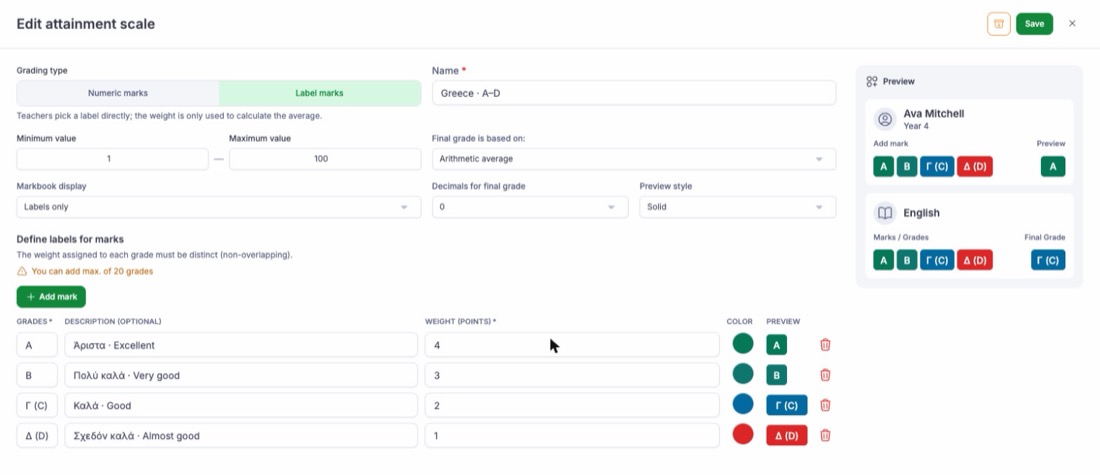
These are the scales as MarkBook shows them in the scale editor. Build yours with the same grades, descriptions and weights. Each scale links to the recipe that explains it on Set Up Any Grading System.
Greece · A–D
Attainment scale for years 3-4 (Dimotiko, years C-D (primary, middle years)). Build it in Configuration → Assessment → Attainment scales. Recipe: Letters.
| Grade | Description | Weight | Pass |
|---|---|---|---|
| A | Άριστα · Excellent | 4 | yes |
| B | Πολύ καλά · Very good | 3 | yes |
| Γ (C) | Καλά · Good | 2 | yes |
| Δ (D) | Σχεδόν καλά · Almost good | 1 | no |
Before you rely on this page
Confidence: medium
The gymnasio band edges overlap (12.5, 15.5, 18.5), and the Greek labels for the lower bands are not confirmed. Exact conduct value list and wording not confirmed from an opened official source. Gymnasio band boundaries (12.5, 15.5, 18.5) are taken from Eurydice and overlap at their edges; band labels in Greek for the gymnasio/lyceum lower bands are not confirmed word for word. Panhellenic points formula (weights, 20,000 max) not verified from an opened source. Possible reforms after 2025 (e.g. new lyceum/Bank of Topics changes, a proposed 'national baccalaureate') not checked.