
🇩🇪 Germany
This page describes how schools in Germany grade pupils, from the first year of primary school (year 1, about age 6–7) to the end of upper secondary, and how to build the same system in MarkBook. Back to Find Your Country.
Check the current rules
This description comes from public sources (ministry pages, national laws, Eurydice) read in October 2026. Rules change with reforms, and schools often have local rules. Check the current official text for anything your school reports to the ministry.
How pupils are graded
Before year 1: Kindergarten is not part of school and is not graded. Where a school-entry phase exists (grades 1-2 mixed, 1-3 years), it gets written reports, not marks.
| Years | Stage | Scale | Pass | Recipe |
|---|---|---|---|---|
| 1-2 (year 2 depends on the Land) | Grundschule, Schuleingangsphase (primary, first years) | Written report (Lernentwicklungsbericht / verbal report), no marks | Not applicable | Written description |
| 2 or 3 to 4 (to 6 in Berlin, Brandenburg) | Grundschule (primary, from mark years) | 1-6, 1 best | 4 (ausreichend); 5 and 6 are fail marks | 1 is the best |
| 5-9/10 | Sekundarstufe I (lower secondary: Gymnasium, Realschule, Hauptschule, Gesamtschule, Oberschule etc.) | 1-6, 1 best | 4 (ausreichend) | 1 is the best |
| 10/11-12/13 | Gymnasiale Oberstufe (upper secondary: Einführungsphase + Qualifikationsphase) | 0-15 points, 15 best | 5 points (= mark 4) per course; for the Abitur at least 300 of 900 points overall | Whole-number marks |
Values in Grundschule (primary, from mark years)
| Value | Local word | English |
|---|---|---|
| 1 | sehr gut | very good - meets the requirements to an especially high degree |
| 2 | gut | good - fully meets the requirements |
| 3 | befriedigend | satisfactory - generally meets the requirements |
| 4 | ausreichend | sufficient - has flaws but still meets the requirements overall |
| 5 | mangelhaft | deficient - does not meet requirements, basic knowledge present, gaps can be closed |
| 6 | ungenügend | insufficient - does not meet requirements, gaps cannot be closed soon |
Values in Gymnasiale Oberstufe (upper secondary: Einführungsphase + Qualifikationsphase)
| Value | Local word | English |
|---|---|---|
| 15 | sehr gut (1+) | very good, top |
| 14 | sehr gut (1) | very good |
| 13 | sehr gut (1-) | very good, low |
| 12 | gut (2+) | good, top |
| 11 | gut (2) | good |
| 10 | gut (2-) | good, low |
| 9 | befriedigend (3+) | satisfactory, top |
| 8 | befriedigend (3) | satisfactory |
| 7 | befriedigend (3-) | satisfactory, low |
| 6 | ausreichend (4+) | sufficient, top |
| 5 | ausreichend (4) | sufficient |
| 4 | ausreichend (4-) | sufficient, low (counts as an under-course in most Länder) |
| 3 | mangelhaft (5+) | deficient |
| 2 | mangelhaft (5) | deficient |
| 1 | mangelhaft (5-) | deficient |
| 0 | ungenügend (6) | insufficient |
The year. Two half-years (Halbjahre). Mid-year report (Halbjahreszeugnis, around end of January / start of February) and end-of-year report (Jahreszeugnis, June/July). In the Oberstufe every half-year is a separate course result (e.g. Q1.1, Q1.2, Q2.1, Q2.2). Some Länder (e.g. Bavaria) let primary schools replace the mid-year report with a learning-development talk with parents.
Averages and rounding. There is no national arithmetic formula. The report mark is a teacher judgement (pädagogische Gesamtbewertung) over two areas: written work (Klassenarbeiten / Schulaufgaben) and other work in class (mündliche / sonstige Leistungen). Both must be 'appropriately' considered (NRW). Schools or subject conferences often agree weights such as 50:50 or 2:1, but the result is not a mechanical rounding. The year mark is not the average of the two half-year marks; it is a judgement over the whole year. Abitur: the point total E (300-900) converts to a grade with the KMK formula N = 17/3 - E/180, truncated to one decimal; 823 points or more gives 1.0, 300 points gives 4.0.
Passing the year. Grade 1 to 2 is normally automatic. From grade 3 (some Länder grade 2 or 4) promotion (Versetzung) depends on the year report. Typical rule in Sek I: a pupil is promoted with no mark 5/6, or with one 5 in one subject; two 5s or one 6 can be compensated by good marks (usually 3 or better) in other subjects; core subjects (German, maths, first foreign language) have stricter rules. The exact compensation rules are in each Land's ordinance. Some Länder (e.g. Hamburg) have largely replaced repeating with extra support. Eurydice: 0.9% of primary pupils repeated a grade in 2024/25.
Conduct. Not uniform. Several Länder print conduct marks (Kopfnoten) on the report, e.g. Saxony (Betragen, Fleiß, Mitarbeit, Ordnung on a 1-5 scale). Other Länder use written remarks on working and social behaviour, or nothing. Primary reports may include remarks on participation, work habits and social conduct (Eurydice).
Differences between regions or school types. Education is a Land matter (16 Länder). The 1-6 scale and its six words are the same everywhere (KMK 1968). Differences: (1) when marks start (end of grade 2 in most Länder, grade 3 or later in some; verbal reports can continue by school choice in some Länder); (2) primary lasts 4 years, but 6 years in Berlin and Brandenburg; (3) Abitur after 12 years (e.g. Saxony, Thuringia, Saxony-Anhalt, Mecklenburg-Vorpommern, Saarland, Hamburg, Berlin, Brandenburg) or 13 years (e.g. Bavaria, NRW, Lower Saxony, Schleswig-Holstein, Baden-Württemberg returning to G9); (4) promotion and compensation rules; (5) conduct marks (Kopfnoten) only in some Länder. This entry describes the common case.
Common practice that is not official. Teachers mark tests with points and convert them to marks with a percentage key (Notenschlüssel), e.g. 87% = 1, 73% = 2, 59% = 3, 45% = 4, 18% = 5; the key is set by the teacher or subject conference, not by national law. Tendencies (2+, 3-) and intermediate marks (2-3) are widely used on single tests but not allowed on report cards in most Länder. Decimal averages (e.g. 2.4) are calculated for information only.
National exams.
- Abitur (Allgemeine Hochschulreife) (year 12 or 13): 0-15 points per exam; total 300-900 points; final grade 1.0-4.0 (one decimal)
- Erster Schulabschluss / Hauptschulabschluss, Mittlerer Schulabschluss (MSA / Realschulabschluss) (year 9 or 10): 1-6 marks (Land exams in German, maths, first foreign language in most Länder)
- VERA 3 / VERA 8 (comparison tests) (year 3 and 8): Competence levels; not graded
Words you will meet
Note (mark), Zensur (mark, older word), Notendurchschnitt / Durchschnitt (average), Halbjahr (half-year term), Halbjahreszeugnis / Zwischenzeugnis (mid-year report), Jahreszeugnis (end-of-year report), Klassenarbeit / Schulaufgabe (class test), Punkte (points, upper secondary), Kopfnoten (conduct marks), Versetzung (promotion), Abitur / Allgemeine Hochschulreife (school-leaving qualification).
Set it up in MarkBook
Create a scale 'Note 1-6' with values 1-6 (points 1..6, lower is better, pass at 4). Optional: a 'Tendenz' scale for tests (1+, 1, 1-, ... 6) mapped to decimals (1+ = 0.7, 1 = 1.0, 1- = 1.3 etc.) for internal averages only. For grades 1-2 use a comment column (verbal report) and no mark scale. Per half-year, add columns: Klassenarbeit 1..n (written), Sonstige Leistungen / mündlich (oral and class work), then a calculated weighted average (e.g. written 50% / oral 50%, as the school agrees) with 1 decimal, and a teacher-entered Zeugnisnote (whole 1-6) that the teacher may set against the average. Year: Jahresnote is teacher-entered, not a mean of the halves. For the Oberstufe, create a 'Punkte 0-15' scale (higher is better, pass 5) with one column per half-year course (Q1.1-Q2.2) and an Abitur total calculated in points, converted with N = 17/3 - E/180 (truncate to 1 decimal, minimum 1.0).
The scales, ready to copy
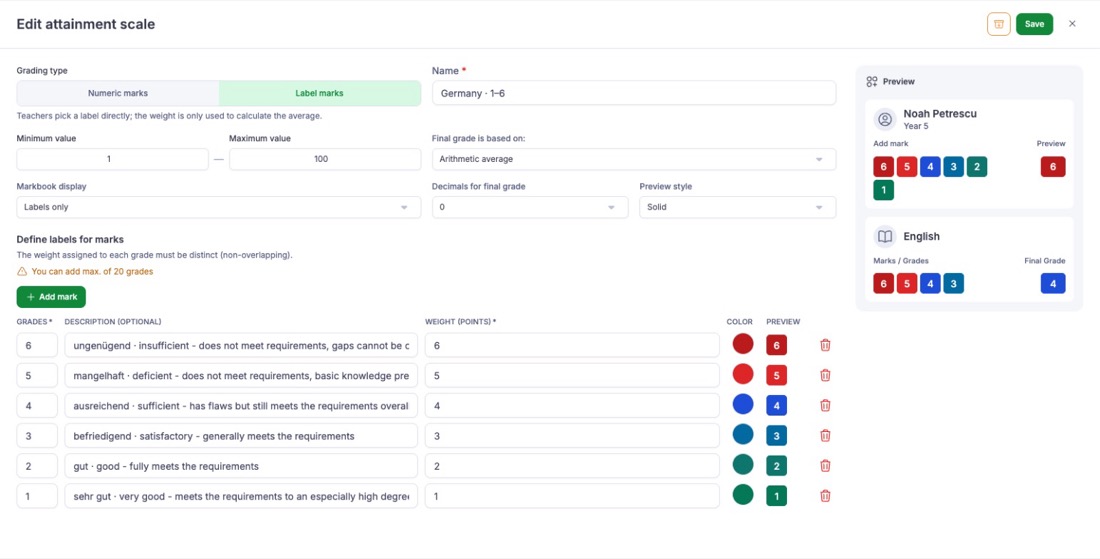
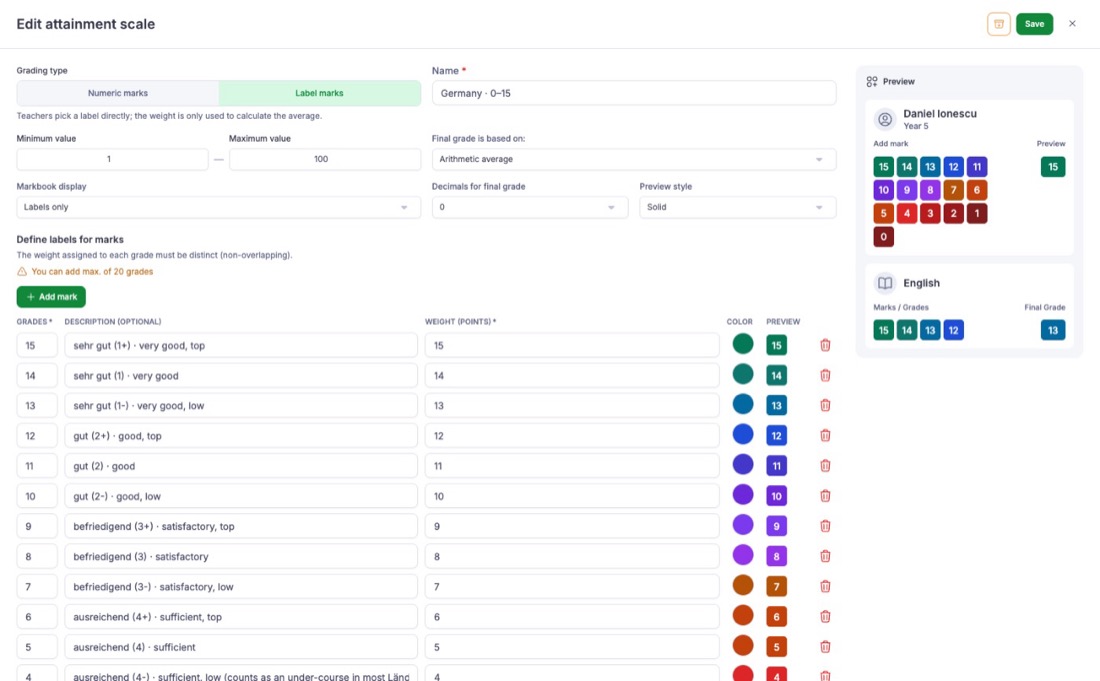
These are the scales as MarkBook shows them in the scale editor. Build yours with the same grades, descriptions and weights. Each scale links to the recipe that explains it on Set Up Any Grading System.
Germany · 1–6
Attainment scale for years 2 or 3 to 4 (to 6 in Berlin, Brandenburg) (Grundschule (primary, from mark years)). Build it in Configuration → Assessment → Attainment scales. Recipe: A scale where 1 is the best mark.
| Grade | Description | Weight | Pass |
|---|---|---|---|
| 1 | sehr gut · very good - meets the requirements to an especially high degree | 1 | yes |
| 2 | gut · good - fully meets the requirements | 2 | yes |
| 3 | befriedigend · satisfactory - generally meets the requirements | 3 | yes |
| 4 | ausreichend · sufficient - has flaws but still meets the requirements overall | 4 | yes |
| 5 | mangelhaft · deficient - does not meet requirements, basic knowledge present, gaps can be closed | 5 | no |
| 6 | ungenügend · insufficient - does not meet requirements, gaps cannot be closed soon | 6 | no |
Germany · 0–15
Attainment scale for years 10/11-12/13 (Gymnasiale Oberstufe (upper secondary: Einführungsphase + Qualifikationsphase)). Build it in Configuration → Assessment → Attainment scales. Recipe: Whole-number marks.
| Grade | Description | Weight | Pass |
|---|---|---|---|
| 15 | sehr gut (1+) · very good, top | 15 | yes |
| 14 | sehr gut (1) · very good | 14 | yes |
| 13 | sehr gut (1-) · very good, low | 13 | yes |
| 12 | gut (2+) · good, top | 12 | yes |
| 11 | gut (2) · good | 11 | yes |
| 10 | gut (2-) · good, low | 10 | yes |
| 9 | befriedigend (3+) · satisfactory, top | 9 | yes |
| 8 | befriedigend (3) · satisfactory | 8 | yes |
| 7 | befriedigend (3-) · satisfactory, low | 7 | yes |
| 6 | ausreichend (4+) · sufficient, top | 6 | yes |
| 5 | ausreichend (4) · sufficient | 5 | yes |
| 4 | ausreichend (4-) · sufficient, low (counts as an under-course in most Länder) | 4 | no |
| 3 | mangelhaft (5+) · deficient | 3 | no |
| 2 | mangelhaft (5) · deficient | 2 | no |
| 1 | mangelhaft (5-) · deficient | 1 | no |
| 0 | ungenügend (6) · insufficient | 0 | no |
Before you rely on this page
Confidence: high
The 1-6 definitions and the 0-15 point table are confirmed (KMK, NRW, Eurydice). Not confirmed from a source I opened: the exact Abitur conversion formula (N = 17/3 - E/180, 823+ = 1.0) - it is widely used but I did not open the KMK text; the list of Länder with 12 vs 13 years (Baden-Württemberg and others are moving back to G9 between 2025 and 2032); the exact Sek I promotion/compensation rules (they differ per Land); Saxony's Kopfnoten scale. The Notenschlüssel percentages are an example, not a rule. Reform note: the KMK Ländervereinbarung of October 2020 harmonises the Oberstufe and Abitur (common exam pool, number of courses counted); Länder are implementing it through the late 2020s. Some Länder (e.g. Bavaria) changed primary mid-year reports into talks with parents.