
🇫🇮 Finland
This page describes how schools in Finland grade pupils, from the first year of primary school (year 1, about age 6–7) to the end of upper secondary, and how to build the same system in MarkBook. Back to Find Your Country.
Check the current rules
This description comes from public sources (ministry pages, national laws, Eurydice) read in October 2026. Rules change with reforms, and schools often have local rules. Check the current official text for anything your school reports to the ministry.
How pupils are graded
Before year 1: Esiopetus (age 6) is compulsory and not graded. Basic education starts at age 7, so 'year 1' is age 7-8; years 1-12 end at about 19.
| Years | Stage | Scale | Pass | Recipe |
|---|---|---|---|---|
| 0 (before year 1) | Esiopetus (pre-primary) | No grades | Not applicable | Written description |
| 1-3 | Perusopetus vuosiluokat 1-3 (basic education, early years) | Verbal assessment, numerical 4-10, or both (local choice) | Set by the school | School decides |
| 4-9 | Perusopetus vuosiluokat 4-9 (basic education) | 4-10, 10 best | 5 | Whole-number marks |
| 10-12 | Lukio (general upper secondary) | 4-10, 10 best; some study units pass/fail (S/H) | 5 | Whole-number marks |
Values in Perusopetus vuosiluokat 4-9 (basic education)
| Value | Local word | English |
|---|---|---|
| 10 | erinomainen | excellent |
| 9 | kiitettävä | very good |
| 8 | hyvä | good |
| 7 | tyydyttävä | satisfactory |
| 6 | kohtalainen | moderate |
| 5 | välttävä | adequate |
| 4 | hylätty | fail |
The year. School year August-early June, autumn and spring terms. Basic education: lukuvuositodistus at end of each year; the provider may add one or more välitodistus (interim reports, often in December/January). Lukio: usually 5 periods (or 4-6) per year, each study unit graded when completed.
Averages and rounding. Basic education: the grade is teacher judgement against objectives; the final grade is not an average of earlier grades. Lukio: the subject grade is basically the mathematical average of the study-unit grades (in practice weighted by credits), rounded to a whole number; students can sit a separate exam to raise it.
Passing the year. A pupil with at least 5 in all assessed subjects moves up. A pupil with 4 may be retained but must first get a chance to show an acceptable level (separate test). Retention is rare. Leaving certificate needs every subject at 5 or verbal pass.
Conduct. Behaviour (käyttäytyminen) is assessed separately and does not affect subject grades. Years 1-3: verbal or numerical (verbal given as an annex). Years 4-8: numerical grade on the year report. Not on the year 9 leaving certificate (can be an annex).
Differences between regions or school types. National core curricula for Finnish- and Swedish-language schools alike; local curricula decide verbal vs numerical in years 1-3, interim reports, and some details of behaviour assessment. Åland has its own legislation.
Common practice that is not official. Teachers widely use +, -, ½ and point totals or percentages on tests (e.g. 8½, 9-). These are not official and do not appear on certificates.
National exams.
- Ylioppilastutkinto (matriculation examination) (year 12): L (laudatur, 7 pts), E (eximia cum laude approbatur, 6), M (magna cum laude approbatur, 5), C (cum laude approbatur, 4), B (lubenter approbatur, 3), A (approbatur, 2), I (improbatur, fail, 0)
- National sample-based evaluations (Karvi) (year various): Not pupil grades
Words you will meet
arvosana (grade), arviointi (assessment), sanallinen arvio (verbal assessment), lukuvuositodistus (end-of-year report), välitodistus (interim report), päättötodistus (leaving certificate), keskiarvo (average), käyttäytyminen (behaviour), ylioppilastutkinto (matriculation exam); Swedish: vitsord, betyg
Set it up in MarkBook
Create one scale 'Finnish 4-10' with values 4-10 and points equal to the number; 5 and above pass; add pass/fail 'hyväksytty/hylätty' for optional subjects. Years 1-3: verbal comment columns, optionally numeric. Years 4-9: optional interim period (winter) and the year-end period, one grade column per subject plus a behaviour column (4-8). Test columns may allow 8+, 8½, 9- with points 8.25, 8.5, 8.75; the report grade is a teacher-set whole number. Lukio: one column per study unit, subject grade = credit-weighted average rounded to whole number.
The scales, ready to copy
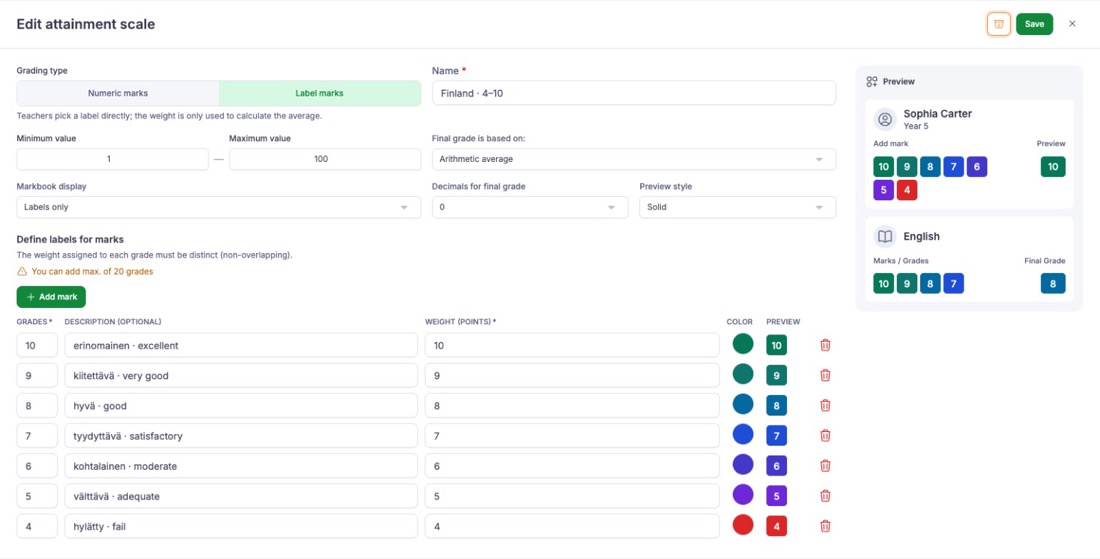
These are the scales as MarkBook shows them in the scale editor. Build yours with the same grades, descriptions and weights. Each scale links to the recipe that explains it on Set Up Any Grading System.
Finland · 4–10
Attainment scale for years 4-9 (Perusopetus vuosiluokat 4-9 (basic education)). Build it in Configuration → Assessment → Attainment scales. Recipe: Whole-number marks.
| Grade | Description | Weight | Pass |
|---|---|---|---|
| 10 | erinomainen · excellent | 10 | yes |
| 9 | kiitettävä · very good | 9 | yes |
| 8 | hyvä · good | 8 | yes |
| 7 | tyydyttävä · satisfactory | 7 | yes |
| 6 | kohtalainen · moderate | 6 | yes |
| 5 | välttävä · adequate | 5 | yes |
| 4 | hylätty · fail | 4 | no |
Before you rely on this page
Confidence: high
The behaviour rules quoted come from the OPH assessment chapter valid 10.2.2020-31.7.2025; a newer version may exist from August 2025. The +/- and ½ practice is common but I did not open an official text describing it. Credit weighting of lukio subject grades was not confirmed by Eurydice (it says 'basically the mathematical average'). Reforms: numerical grades from year 4 since 2020; compulsory education extended to age 18 from 2021; new lukio act 714/2018 with curriculum from 2021 and core curriculum 2025.