
🇪🇪 Estonia
This page describes how schools in Estonia grade pupils, from the first year of primary school (year 1, about age 6–7) to the end of upper secondary, and how to build the same system in MarkBook. Back to Find Your Country.
Check the current rules
This description comes from public sources (ministry pages, national laws, Eurydice) read in October 2026. Rules change with reforms, and schools often have local rules. Check the current official text for anything your school reports to the ministry.
How pupils are graded
Before year 1: Pre-school (lasteaed) is not graded; children receive a school readiness card (koolivalmiduskaart). School starts at age 7 in grade 1.
| Years | Stage | Scale | Pass | Recipe |
|---|---|---|---|---|
| 1-6 | Põhikool I-II kooliaste (basic school stages I-II, primary) | 5-point scale (5 best) OR descriptive verbal assessment with no numeric equivalent, chosen by the school in its curriculum | 3 (rahuldav) | School decides |
| 7-9 | Põhikool III kooliaste (basic school stage III, lower secondary) | 1-5, 5 best | 3 (rahuldav) | Whole-number marks |
| 10-12 | Gümnaasium (general upper secondary) | 1-5, 5 best; course grades and study stage grades | 3 (rahuldav); elective courses may be 'arvestatud' (passed) | Whole-number marks |
Values in Põhikool I-II kooliaste (basic school stages I-II, primary)
| Value | Local word | English |
|---|---|---|
| 5 | väga hea | Very good (90-100%) |
| 4 | hea | Good (75-89%) |
| 3 | rahuldav | Satisfactory (50-74%) |
| 2 | puudulik | Poor / unsatisfactory (20-49%) |
| 1 | nõrk | Weak (0-19%) |
Values in Gümnaasium (general upper secondary)
| Value | Local word | English |
|---|---|---|
| 5 | väga hea | Very good |
| 4 | hea | Good |
| 3 | rahuldav | Satisfactory |
| 2 | puudulik | Poor |
| 1 | nõrk | Weak |
| A | arvestatud | Passed (non-graded course) |
| MA | mittearvestatud | Not passed |
The year. Basic school: the school chooses (quarters/veerandid, trimesters or half-years); summative assessment with written feedback at least every six months. Upper secondary: course grades when each course ends, often in trimesters or periods. Day-to-day grades are visible in eKool or Stuudium. A development interview (arenguvestlus) at least once a year.
Averages and rounding. No national formula. The school curriculum (kooli õppekava) sets how period, year and stage grades are formed: usually from the period grades or course grades, by teacher judgement, often near the arithmetic mean. Percentage bands (90/75/50/20) are the national guideline for converting test results to grades. Year grade in basic school; stage grade in upper secondary from the course grades.
Passing the year. Year grades of at least 'satisfactory' mean promotion. A 'poor' or 'weak' year grade leads to a supplementary learning assignment (täiendav õppetöö) in summer. Repetition is exceptional: needs 'poor'/'weak' year grades in at least three subjects, failed supplementary work, no alternative, and involvement of the parent; decided by the teachers' council.
Conduct. Traditionally behaviour (käitumine) and diligence (hoolsus) grades twice a year with words: eeskujulik (exemplary), hea (good), rahuldav (satisfactory), mitterahuldav (unsatisfactory). From the 2025/26 school year the national curriculum no longer requires them; feedback may be given in the development interview instead. Schools may keep the old grades.
Differences between regions or school types. National system. Each school's own curriculum fixes its scale choices (verbal vs numeric in stages I-II), the period length and the rules for year grades. Russian-medium schools take Russian language exams and Estonian as a second language; these schools are moving to Estonian-medium teaching from 2024 onwards.
Common practice that is not official. Many teachers score tests in points or percent and convert with the 90/75/50/20 bands. Some schools allow 5-, 4+ style marks. Some schools use colour or letter codes for verbal assessment. These are school practice, not the national record.
National exams.
- Grade 3 and grade 6 standard tests / e-tests (tasemetööd) (year 3, 6 (nature e-tests in 4 and 7)): Points/percent; diagnostic
- Põhikooli lõpueksamid (basic school final exams) (year 9): Points converted to 1-5; pass 3
- Riigieksamid (state examinations) (year 12): 0-100 points; pass = at least 1 point (since 2014)
Words you will meet
Mark/grade: hinne (pl. hinded). Assessment: hindamine. Term: trimester / veerand (quarter) / poolaasta (half-year). Year grade: aastahinne. Course grade (upper secondary): kursusehinne. Stage grade: kooliastmehinne. Report card: klassitunnistus. Final exam: lõpueksam; state exam: riigieksam. Behaviour: käitumine; diligence: hoolsus. E-school diary: eKool / Stuudium.
Set it up in MarkBook
Create a 1-5 scale (5 väga hea ... 1 nõrk), pass from 3, with percentage boundaries 90/75/50/20 for point-based tests. Add an 'arvestatud / mittearvestatud' pass-fail scale for upper-secondary electives and an optional verbal scale for grades 1-3. For basic school use the school's periods (e.g. three trimesters) with a period grade column and a year grade column (teacher-confirmed, suggested as the rounded mean of period grades). For upper secondary use one column per course (kursusehinne) and a stage grade column. Optionally add behaviour and diligence columns with the four words.
The scales, ready to copy
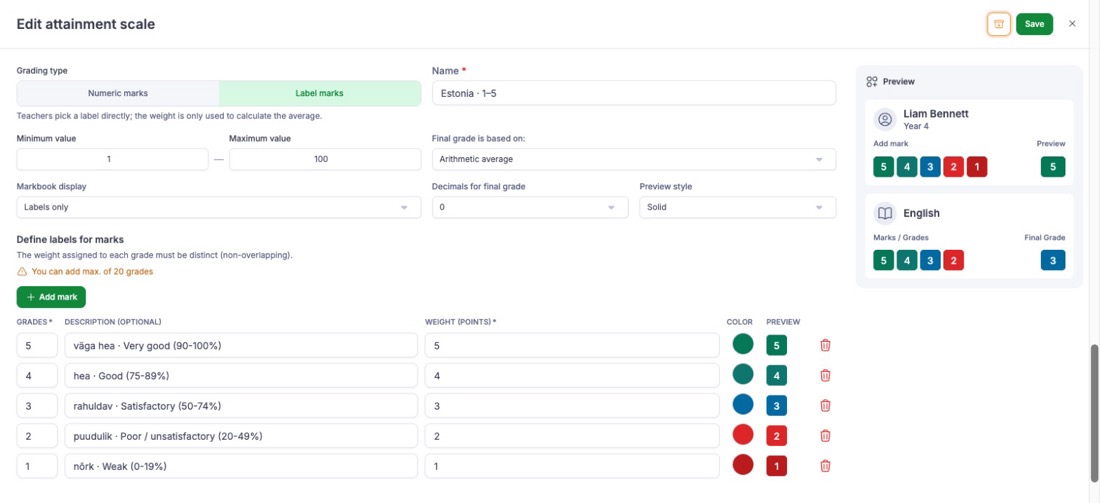
These are the scales as MarkBook shows them in the scale editor. Build yours with the same grades, descriptions and weights. Each scale links to the recipe that explains it on Set Up Any Grading System.
Estonia · 1–5
Attainment scale for years 1-6 (Põhikool I-II kooliaste (basic school stages I-II, primary)). Build it in Configuration → Assessment → Attainment scales. Recipe: Whole-number marks.
| Grade | Description | Weight | Pass |
|---|---|---|---|
| 5 | väga hea · Very good (90-100%) | 5 | yes |
| 4 | hea · Good (75-89%) | 4 | yes |
| 3 | rahuldav · Satisfactory (50-74%) | 3 | yes |
| 2 | puudulik · Poor / unsatisfactory (20-49%) | 2 | no |
| 1 | nõrk · Weak (0-19%) | 1 | no |
Before you rely on this page
Confidence: high
The percentage bands come from the Harno ENIC/NARIC factsheet; I did not open the Riigi Teataja text of the national curriculum. The date of the behaviour/diligence change (start of 2025/26) is from an ERR news article. Compulsory learning to age 18 (learning obligation) is a recent reform I did not confirm. Upper-secondary course structure may change with the new curriculum; check before relying on it.
Sources (4)
- Eurydice - Estonia: Assessment in single structure education (official)
- Eurydice - Estonia: Assessment in general upper secondary education (official)
- Harno (Education and Youth Board) - Factsheet: Grading system, examinations (2024) (official)
- ERR - The state guides schools to assess behaviour without grades (2025)