
🇬🇧 Cambridge International (Primary, Lower Secondary, IGCSE, AS/A Level)
This page describes how schools in Cambridge International (Primary, Lower Secondary, IGCSE, AS/A Level) grade pupils, from the first year of primary school (year 1, about age 6–7) to the end of upper secondary, and how to build the same system in MarkBook. Back to Find Your Country.
Check the current rules
This description comes from public sources (ministry pages, national laws, Eurydice) read in October 2026. Rules change with reforms, and schools often have local rules. Check the current official text for anything your school reports to the ministry.
How pupils are graded
Before year 1: Cambridge Early Years (ages 3-6) is not graded: observation and narrative reports only.
| Years | Stage | Scale | Pass | Recipe |
|---|---|---|---|---|
| 1-6 | Cambridge Primary (Stages 1-6) | No Cambridge in-school grading scale. Schools report with their own descriptors or percentages. The optional end-of-primary Primary Checkpoint test reports a score 0-50 in six performance bands (from 2023). | None (Checkpoint is diagnostic, no pass/fail) | Written description |
| 7-9 | Cambridge Lower Secondary (Stages 7-9) | No Cambridge in-school scale. Optional Lower Secondary Checkpoint at the end of Stage 9: score 0-50 in the same six bands. | None | School decides |
| 10-11 | Cambridge IGCSE / O Level (Upper Secondary, 2-year course) | A* (best) to G; U = ungraded. O Level A*-E. Some IGCSE subjects in the UK (Zone 3) can be taken with 9-1 grading (9 best). | Any grade A*-G is a pass (certificated); C (or 4) is widely treated as a 'good pass' by schools and universities | Letters |
| 12-13 | Cambridge International AS & A Level (Advanced) | A Level: A* (highest) to E (minimum required performance); AS Level: a to e (lower case), no a*; U = ungraded | E (A Level), e (AS Level) | Letters |
Values in Cambridge Primary (Stages 1-6)
| Value | Local word | English |
|---|---|---|
| 41-50 | Outstanding | Outstanding (Checkpoint band) |
| 31-40 | High | High |
| 21-30 | Good | Good |
| 11-20 | Aspiring | Aspiring |
| 1-10 | Basic | Basic |
| 0 | Unclassified | Unclassified |
The year. Not set by Cambridge. Schools follow their host country or British calendar: usually three terms (autumn, spring, summer) or two semesters, with a report each term and mock exams before IGCSE and A Level. Cambridge exam series: June and November (March in India); results in August and January.
Averages and rounding. In school: school policy. Common practice is a weighted mean of percentage tests per term, converted to a predicted or working grade (A*-G or A*-E) with the school's boundaries, often based on past Cambridge thresholds. Final Cambridge grades come only from Cambridge exams and coursework, using the series grade thresholds. No minimum number of marks is set by Cambridge.
Passing the year. Cambridge sets no rule for passing a school year; promotion is the school's or host country's policy. Qualifications are per subject; schools and universities set their own entry needs (e.g. five IGCSEs at C or better, or A Level offers like AAB).
Conduct. Not graded by Cambridge. Schools commonly report effort or attitude to learning on a 1-4 or A-D scale beside the attainment grade (British practice).
Differences between regions or school types. Cambridge is an exam board used in over 150 countries, so it sits on top of the host system. Many schools must also give national grades (e.g. a Romanian or Spanish school with a Cambridge stream). Cambridge English numbering has 13 years (Year 1 at age 5); in international schools Stage 1 often equals Grade 1. Only some IGCSE subjects offer 9-1 grading, and only in some administrative zones; Pearson Edexcel International GCSE (a different board) uses 9-1 everywhere.
Common practice that is not official. Percentages on class tests, mock exams graded on A*-G with last series' thresholds, 'working at' / 'target' / 'predicted' grade columns, and effort grades are British school practice, not Cambridge rules.
National exams.
- Cambridge Primary Checkpoint (optional) (year 6): 0-50 score, six bands (Unclassified, Basic, Aspiring, Good, High, Outstanding) from 2023; before: 0.0-6.0
- Cambridge Lower Secondary Checkpoint (optional) (year 9): 0-50 score, same six bands
- Cambridge IGCSE / O Level (year 11): A*-G, U (O Level A*-E); some subjects 9-1 in Zone 3
- Cambridge International AS Level (year 12): a-e, U
- Cambridge International A Level (year 13): A*-E, U
Words you will meet
grade, grade threshold, series, component, Core / Extended tier, predicted grade, Checkpoint score, performance band, statement of results, certificate
Set it up in MarkBook
Primary and Lower Secondary: a 4-level descriptor scale chosen by the school (e.g. Exceeding=4, Meeting=3, Working towards=2, Below=1) per learning objective or strand each term, period result by teacher judgement; optional Checkpoint column 0-50 mapped to six bands. IGCSE: a percentage column per assessment, a calculated term average (weighted mean, rounded half-up to a whole percent) converted to A*-G with school boundaries (e.g. A* 90, A 80, B 70, C 60, D 50, E 40, F 30, G 20, U below), plus predicted-grade and target-grade columns. A Level: same pattern with an A*-E/U scale (AS a-e). Points for calculations: A*=8 ... G=1, U=0 at IGCSE; A*=6 ... E=1, U=0 at A Level. Add an effort column 1-4.
The scales, ready to copy
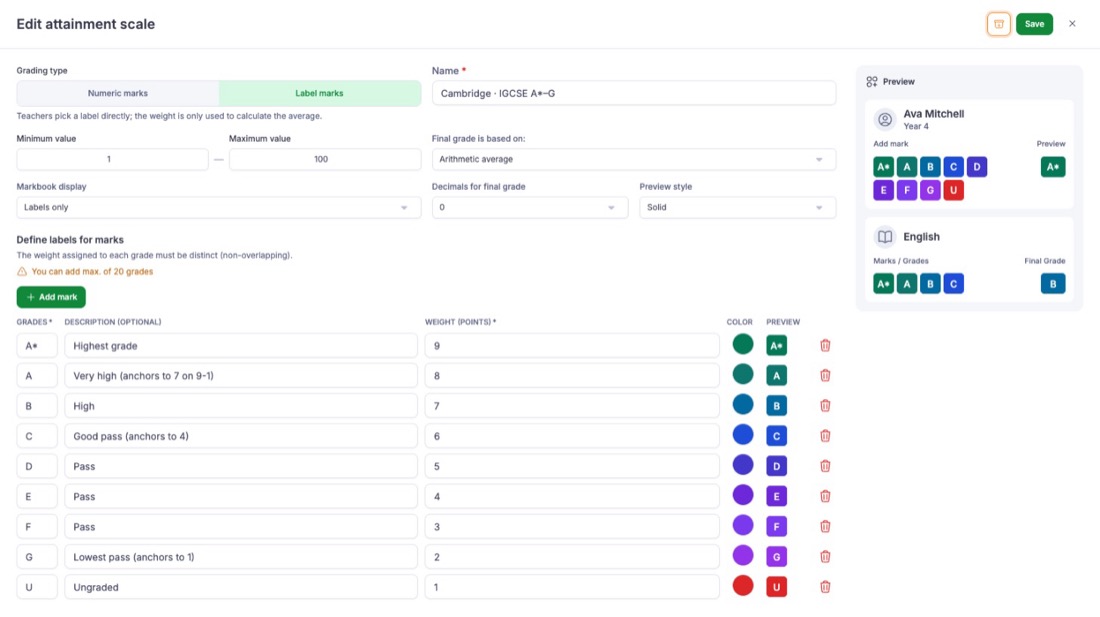
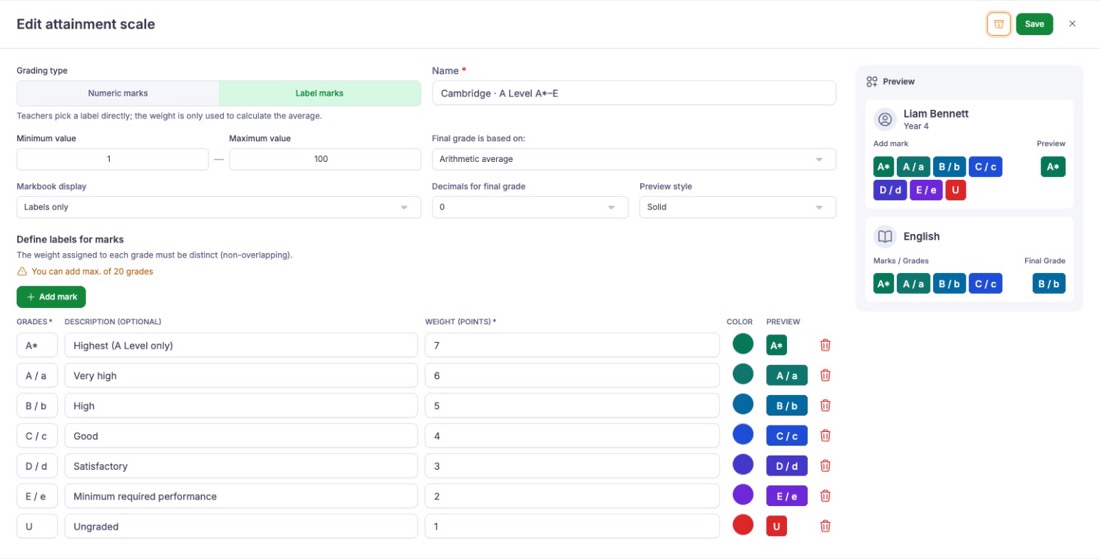
These are the scales as MarkBook shows them in the scale editor. Build yours with the same grades, descriptions and weights. Each scale links to the recipe that explains it on Set Up Any Grading System.
Cambridge · IGCSE A*–G
Attainment scale for years 10-11 (Cambridge IGCSE / O Level (Upper Secondary, 2-year course)). Build it in Configuration → Assessment → Attainment scales. Recipe: Letters.
| Grade | Description | Weight | Pass |
|---|---|---|---|
| A* | Highest grade | 9 | yes |
| A | Very high (anchors to 7 on 9-1) | 8 | yes |
| B | High | 7 | yes |
| C | Good pass (anchors to 4) | 6 | yes |
| D | Pass | 5 | yes |
| E | Pass | 4 | yes |
| F | Pass | 3 | yes |
| G | Lowest pass (anchors to 1) | 2 | yes |
| U | Ungraded | 1 | no |
Cambridge · A Level A*–E
Attainment scale for years 12-13 (Cambridge International AS & A Level (Advanced)). Build it in Configuration → Assessment → Attainment scales. Recipe: Letters.
| Grade | Description | Weight | Pass |
|---|---|---|---|
| A* | Highest (A Level only) | 7 | yes |
| A / a | Very high | 6 | yes |
| B / b | High | 5 | yes |
| C / c | Good | 4 | yes |
| D / d | Satisfactory | 3 | yes |
| E / e | Minimum required performance | 2 | yes |
| U | Ungraded | 1 | no |
Before you rely on this page
Confidence: medium
The help-centre pages returned 403. The Checkpoint 0-50 bands come from one school page, and the per-grade labels are glosses, not Cambridge wording. Cambridge help-centre pages (e.g. 'Which grades are available at IGCSE', Checkpoint band articles) returned HTTP 403 and were seen only in search snippets. The Checkpoint 0-50 band ranges come from a school page, consistent with the help-centre titles. The IGCSE Core tier grade cap (C) and Extended range are from general knowledge, not a page opened here. Percentage boundaries in the setup are illustrative school practice; Cambridge thresholds change every series. The per-grade labels (Very high, High, etc.) are glosses, not Cambridge wording. School-level grading in Primary and Lower Secondary is not prescribed by Cambridge.
Sources (4)
- Cambridge International: Cambridge IGCSE - A guide to A*-G and 9-1 grades (factsheet) (official)
- Cambridge International: AS & A Level qualification - Reporting achievement (official)
- Cambridge International: Cambridge Lower Secondary (official)
- Green Oak International: Primary school exam results (Checkpoint 0-50 bands, from January 2023)