
🇧🇬 Bulgaria
This page describes how schools in Bulgaria grade pupils, from the first year of primary school (year 1, about age 6–7) to the end of upper secondary, and how to build the same system in MarkBook. Back to Find Your Country.
Full step-by-step guide
There is a full guide for this country, with every click: Bulgaria full guide.
Check the current rules
This description comes from public sources (ministry pages, national laws, Eurydice) read in October 2026. Rules change with reforms, and schools often have local rules. Check the current official text for anything your school reports to the ministry.
How pupils are graded
Before year 1: Preparatory groups (подготвителна група, ages 5-6, compulsory) are not graded with marks. The child gets a certificate of school readiness (удостоверение за задължително предучилищно образование).
| Years | Stage | Scale | Pass | Recipe |
|---|---|---|---|---|
| 1 | Начален етап, I клас (primary, year 1) | Qualitative indicators only, no numbers. One general annual qualitative mark for all subjects together. | Any indicator except 'незадоволителен'. Pupils are not held back in I-III. | Words |
| 2-3 | Начален етап, II-III клас (primary, years 2-3) | Same qualitative indicators, but now one annual qualitative mark per subject. No term mark. | Not 'незадоволителен'. A pupil who does not master the content gets extra tuition but is not held back. | Words |
| 4-7 | Начален етап IV клас и прогимназиален етап V-VII клас (primary year 4 and lower secondary) | 2-6, 6 best. Every mark has a word and a number, e.g. 'отличен 6'. | 3 (среден). 2 (слаб) is the fail. | Whole-number marks |
| 8-12 | Първи и втори гимназиален етап (upper secondary, VIII-X and XI-XII) | 2-6, 6 best | 3 (среден) | Whole-number marks |
Values in Начален етап, I клас (primary, year 1)
| Value | Local word | English |
|---|---|---|
| отличен | отличен | Excellent |
| много добър | много добър | Very good |
| добър | добър | Good |
| среден | среден | Fair |
| незадоволителен | незадоволителен | Unsatisfactory |
Values in Начален етап IV клас и прогимназиален етап V-VII клас (primary year 4 and lower secondary)
| Value | Local word | English |
|---|---|---|
| 6 | отличен | Excellent |
| 5 | много добър | Very good |
| 4 | добър | Good |
| 3 | среден | Fair / satisfactory |
| 2 | слаб | Poor (fail) |
The year. Two terms (учебни срокове): first term September to about the end of January, second term February to June (end date differs by year group). Term marks are set no earlier than one week and no later than two school days before the end of the term (Art. 22(8)). Annual marks at the end of the school year. A start-of-year 'entry level' written test is held in the first three weeks (Art. 11(2)) and counts as one of the current marks.
Averages and rounding. Term mark: set by the teacher, taking into account the current marks and the pupil's competences, in the ratio between oral, written, practical work and class participation that the subject curriculum sets (Art. 22(1), Art. 24(1)). It is a whole number; the law does not prescribe a plain arithmetic mean. Annual mark: set by the teacher taking the two term marks into account, whole number. Minimum current marks per term (Art. 12, since 1.9.2023): 2 for subjects with up to 2 lessons per week, 3 for subjects with more than 2 lessons per week, 1 per module. No term mark if the pupil lacks the minimum because of more than 25% absence; then a term exam. Final mark for a stage: arithmetic mean of annual marks, two decimals. Diploma overall success (общ успех): mean, two decimals, of the mean of the compulsory-subject final marks and the mean of the elective-subject final marks (Art. 31).
Passing the year. I-IV: the pupil moves up regardless of marks (age condition applies); pupils with 'незадоволителен' or an annual 2 in IV get compulsory additional tuition, often in the summer. V-XII: the pupil completes the year if every annual mark is at least 3. An annual 2 leads to corrective exams in two sessions (June/July and late August/September). Failing or not sitting them means repeating the year, except in the final year.
Conduct. No conduct mark appears in the assessment ordinance. Behaviour is handled by sanctions and support measures under the Pre-school and School Education Act, not by a grade. (Not confirmed from a single explicit statement; see uncertainties.)
Differences between regions or school types. National rules apply in all schools. Differences are by school type: profiled and vocational schools grade per module; sports and arts schools have extra rules; pupils with SEN on individual programmes get only qualitative marks 'постига изискванията' / 'справя се' / 'среща затруднения'. Correspondence students over 16 get only an annual mark.
Common practice that is not official. Teachers often write intermediate marks such as 'Отличен 5,50' or use +/- in their own notes, and electronic diaries (e.g. Shkolo) show the running mean of current marks with decimals. These are not official: official term and annual marks are whole numbers. Test scoring in points with a teacher's own conversion table is common and allowed (Art. 9(4) requires conversion to the 2-6 scale).
National exams.
- Национално външно оценяване (НВО) IV клас (year 4): Points 0-100 per test, two decimals, converted to the 2-6 marks
- НВО VII клас (year 7): Points 0-100 per test, two decimals, NOT converted to marks (Art. 9(5))
- НВО X клас (year 10): Points 0-100 per test, two decimals, not converted to marks
- Държавни зрелостни изпити (ДЗИ, state matriculation exams) (year 12): Recorded in the diploma in points and as a 2-6 mark; optional ECTS letter A (6.00), B (5.50-5.99), C (4.50-5.49), D (3.50-4.49), E (3.00-3.49)
Words you will meet
оценка (mark), текуща оценка (current mark), срочна оценка (term mark), годишна оценка (annual mark), окончателна оценка (final mark at the end of a stage), учебен срок (term), успех / общ успех (average / overall success), бележник / ученическа книжка (pupil record book), удостоверение / свидетелство / диплома (certificates and diploma).
Set it up in MarkBook
Create two scales: 'BG qualitative I-III' (отличен, много добър, добър, среден, незадоволителен, no points, only незадоволителен fails) and 'BG 2-6' (6 отличен ... 2 слаб, points equal to the number, pass at 3). For I-III use only current-mark columns per term and one annual qualitative column (one general column in year I, one per subject in II-III), no term column. For IV-XII, per term: current-mark columns (at least 2 or 3, include the entry test in term 1), a calculated running mean with 2 decimals for the teacher, and a teacher-entered term mark (whole number). Annual mark: teacher-entered whole number, suggested by the mean of the two term marks. For X and XII add a calculated final mark = arithmetic mean of annual marks of the stage, 2 decimals, with the word from the 2.00-2.99 / 3.00-3.49 / 3.50-4.49 / 4.50-5.49 / 5.50-6.00 bands.
The scales, ready to copy
These are the scales as MarkBook shows them in the scale editor. Build yours with the same grades, descriptions and weights. Each scale links to the recipe that explains it on Set Up Any Grading System.
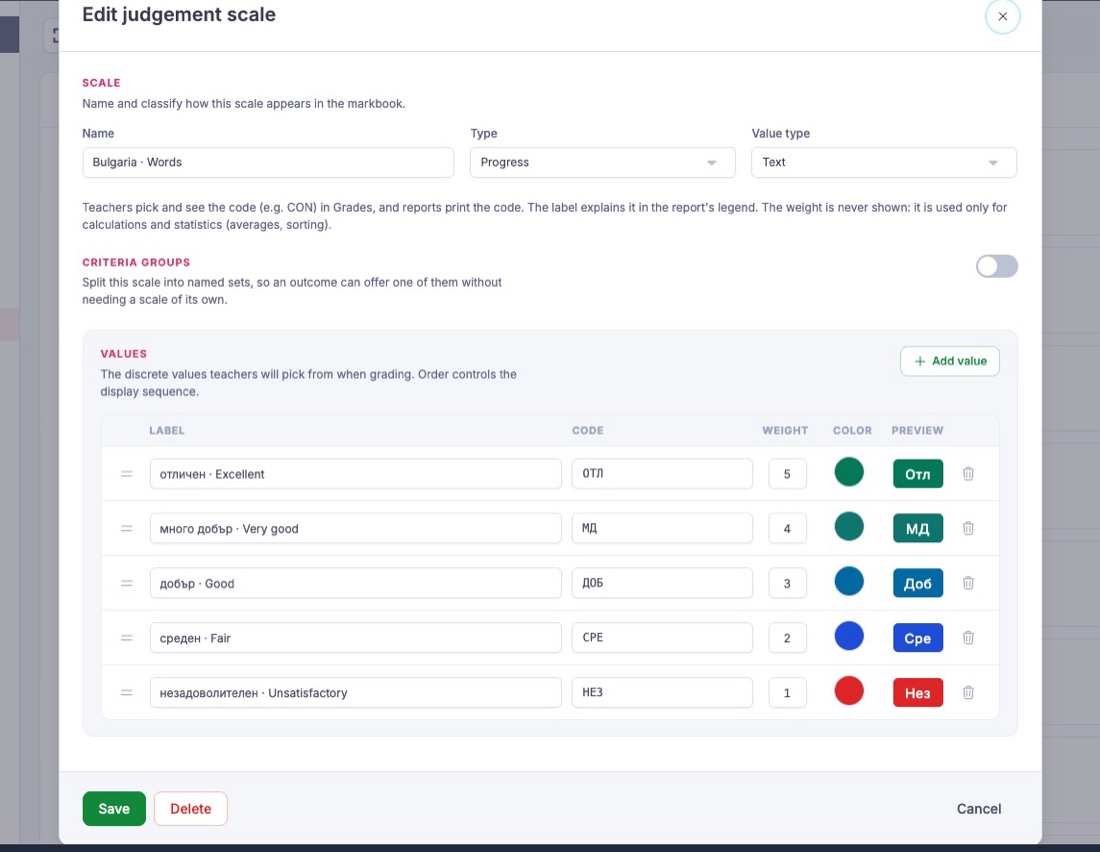
Bulgaria · Words
Judgement scale for years 1 (Начален етап, I клас (primary, year 1)). Build it in Configuration → Assessment → Judgement scales. Recipe: Words instead of marks.
| Grade | Description | Weight | Pass |
|---|---|---|---|
| отличен | Excellent | 5 | yes |
| много добър | Very good | 4 | yes |
| добър | Good | 3 | yes |
| среден | Fair | 2 | yes |
| незадоволителен | Unsatisfactory | 1 | no |
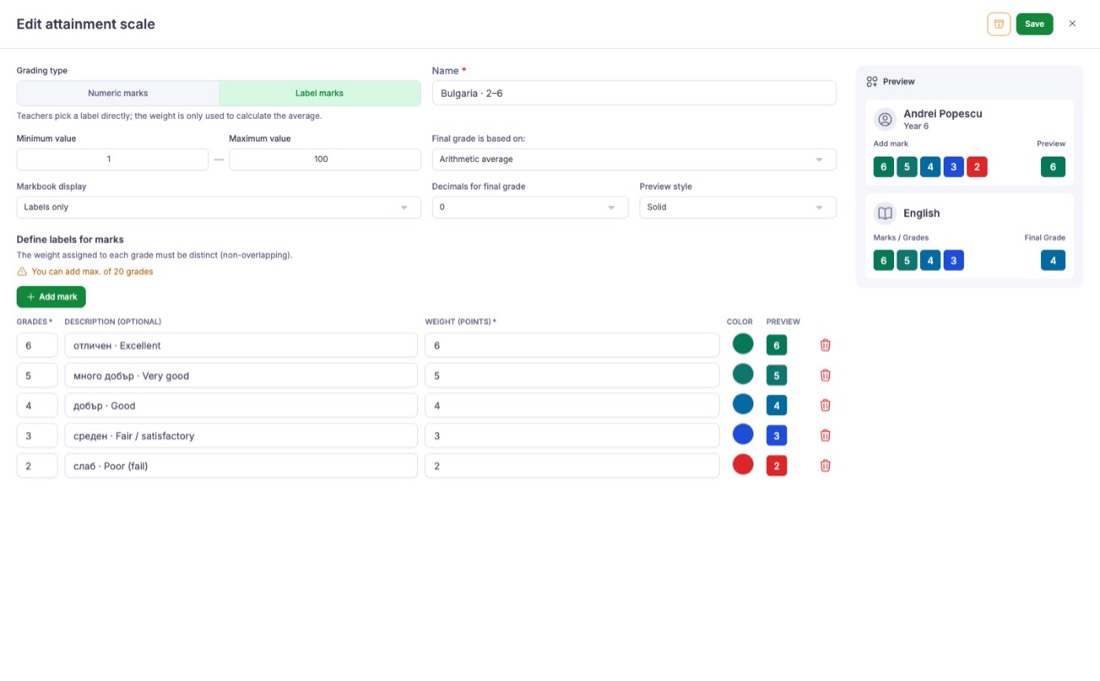
Bulgaria · 2–6
Attainment scale for years 4-7 (Начален етап IV клас и прогимназиален етап V-VII клас (primary year 4 and lower secondary)). Build it in Configuration → Assessment → Attainment scales. Recipe: Whole-number marks.
| Grade | Description | Weight | Pass |
|---|---|---|---|
| 6 | отличен · Excellent | 6 | yes |
| 5 | много добър · Very good | 5 | yes |
| 4 | добър · Good | 4 | yes |
| 3 | среден · Fair / satisfactory | 3 | yes |
| 2 | слаб · Poor (fail) | 2 | no |
Before you rely on this page
Confidence: high
The points-to-mark conversion for the DZI and for the year-IV NVO is set outside the ordinance text I read (exam-specific rules); not confirmed. The promotion rule for I-IV comes from the Pre-school and School Education Act; I saw it only in secondary sources (Az-buki 2015, an MON programme 2018), not in the current law text. Absence of a conduct mark is inferred from the ordinance, not from an explicit statement. The ordinance was amended many times (2017-2023; minimum current marks changed in 2023); check for amendments after Dec 2023.