
🇦🇹 Austria
This page describes how schools in Austria grade pupils, from the first year of primary school (year 1, about age 6–7) to the end of upper secondary, and how to build the same system in MarkBook. Back to Find Your Country.
Check the current rules
This description comes from public sources (ministry pages, national laws, Eurydice) read in October 2026. Rules change with reforms, and schools often have local rules. Check the current official text for anything your school reports to the ministry.
How pupils are graded
Before year 1: The last year of kindergarten (age 5-6) is compulsory and has no marks. Children who are of school age but not ready for school attend the Vorschulstufe inside the Volksschule; it has no marks. Since 2019/20, pupils without enough German attend Deutschförderklassen/-kurse and may be assessed as 'außerordentlich' (non-graded) in subjects.
| Years | Stage | Scale | Pass | Recipe |
|---|---|---|---|---|
| 1 to half of 2 | Volksschule, 1. Schulstufe bis 1. Semester der 2. Schulstufe (primary, first 1.5 years) | Either marks 1-5 (1 best) or, if the school decides, alternative assessment: assessment talks and a written semester/year information instead of marks | Genügend (4) | School decides |
| end of 2 to 4 | Volksschule, Ende 2. bis 4. Schulstufe (primary, end of year 2 to year 4) | 1-5, 1 best | Genügend (4) | 1 is the best |
| 5-8 | Sekundarstufe I: Mittelschule (MS) and AHS-Unterstufe (lower secondary) | 1-5, 1 best; in Mittelschule grades 6-8, German, maths and the foreign language are graded at two levels: 'Standard' and 'Standard AHS' | Genügend (4) | 1 is the best |
| 9-12 (13) | Sekundarstufe II: AHS-Oberstufe, BHS, BMS, Polytechnische Schule (upper secondary) | 1-5, 1 best | Genügend (4) | 1 is the best |
Values in Volksschule, Ende 2. bis 4. Schulstufe (primary, end of year 2 to year 4)
| Value | Local word | English |
|---|---|---|
| 1 | Sehr gut | very good |
| 2 | Gut | good |
| 3 | Befriedigend | satisfactory |
| 4 | Genügend | sufficient (pass) |
| 5 | Nicht genügend | insufficient (fail) |
The year. Two semesters. The first ends in early-to-mid February (before the Semesterferien, which vary by state). At the end of the first semester pupils get a Schulnachricht (half-year report). At the end of the year (end of June in eastern states, early July in western states) pupils get the Jahreszeugnis. In the semester-based upper level (from year 10), each semester ends with a Semesterzeugnis instead.
Averages and rounding. There is no arithmetic mean rule. LBV § 20: the teacher bases the year mark on all performances of the school year, giving 'greater weight to the most recent level of performance'; from the 10th year of schools of at least three years this applies per semester. Sources of marks: Mitarbeit (participation), oral and written checks, Schularbeiten (major class tests, count of which is set per subject and year), practical work. A single Schularbeit mark cannot alone decide the year mark. Rounding is teacher judgement; whole marks only. An early-warning letter (Frühwarnung, SchUG § 19(4)) must go to parents when a fail is likely.
Passing the year. A pupil moves up when all compulsory subjects are positive (1-4). The class conference may allow promotion with one 'Nicht genügend' (Aufsteigen mit einem Nicht genügend) if the same subject was not failed the previous year and the pupil can follow the next grade. With one or two fails, the pupil may take a Wiederholungsprüfung at the start of the next school year; failing it means repeating the year. In Volksschule there are no repeat exams. Matura eligibility: final year completed, or a fail in at most one compulsory subject.
Conduct. LBV § 18 'Verhalten in der Schule', four levels: Sehr zufriedenstellend (very satisfactory), Zufriedenstellend (satisfactory), Wenig zufriedenstellend (not very satisfactory), Nicht zufriedenstellend (unsatisfactory). On reports only in general compulsory schools in grades 5-7 (Mittelschule) and in all grades of AHS, BMS and BHS, except the last grade of each school type. Behaviour does not affect subject marks or promotion. No behaviour mark in Volksschule.
Differences between regions or school types. Grading law is federal (SchUG and LBV) and the same in all nine states. States differ in school-year dates and the timing of the Semesterferien, so the end of the first semester shifts between early and mid February; the end of the school year is end of June (Vienna, Lower Austria, Burgenland) or early July (other states). School types differ: behaviour is graded only in grades 5-7 in Mittelschule but in all non-final grades in AHS/BHS; Mittelschule uses two performance levels (Standard / Standard AHS) in core subjects; semester-based upper level applies only where the school uses it. Alternative assessment in the first 1.5 years of Volksschule is each school's choice. Private schools with their own statute (e.g. Montessori, Waldorf) may use other forms.
Common practice that is not official. Not official: + and - signs and in-between marks (e.g. 2-3, 1-) in the teacher's notebook for Mitarbeit and short checks; points and percentage keys on Schularbeiten (often 91/80/64/50% for 1/2/3/4, set by the teacher or subject team); averages as a guide for the year mark. Only whole marks 1-5 appear on official reports.
National exams.
- Standardisierte Reifeprüfung (Matura) – AHS; Reife- und Diplomprüfung – BHS (year 12 (AHS) / 13 (BHS)): 1-5, 1 best (Sehr gut … Nicht genügend)
- iKMPLUS (individuelle Kompetenzmessung PLUS) (year 3, 4, 7, 8): Competence levels and scores; no school mark
Words you will meet
Note / Beurteilung (mark); Notenstufe (grade level); Schularbeit (major written class test); Mitarbeit (participation); Semester (half-year); Schulnachricht (half-year report); Jahreszeugnis (end-of-year report); Semesterzeugnis (semester report in the semester-based upper level); Klassenkonferenz (class conference); Wiederholungsprüfung (repeat exam); Verhalten in der Schule (behaviour); Reifeprüfung / Matura (school-leaving exam); Reife- und Diplomprüfung (in BHS).
Set it up in MarkBook
Create a 1-5 scale with lower-is-better: 1 Sehr gut, 2 Gut, 3 Befriedigend, 4 Genügend, 5 Nicht genügend; points = the number; pass up to 4. Create a behaviour scale with four levels (Sehr zufriedenstellend … Nicht zufriedenstellend) for grades 5-7 (MS) or all non-final grades (AHS/BHS). For Volksschule years 1-2, add a comment column for the written semester/year information when the school uses alternative assessment. Set two periods: 1. Semester (Sept-Feb, report: Schulnachricht) and 2. Semester (Feb-June/July, report: Jahreszeugnis). Per period add columns for Schularbeit marks (weight 2), Mitarbeit and oral/written checks (weight 1), and a calculated weighted average with 1-2 decimals as a guide. Add a teacher-set whole semester mark and a year mark that gives more weight to the second semester. For Mittelschule grades 6-8 in German, maths and the foreign language, add a level column (Standard / Standard AHS) beside the mark.
The scales, ready to copy
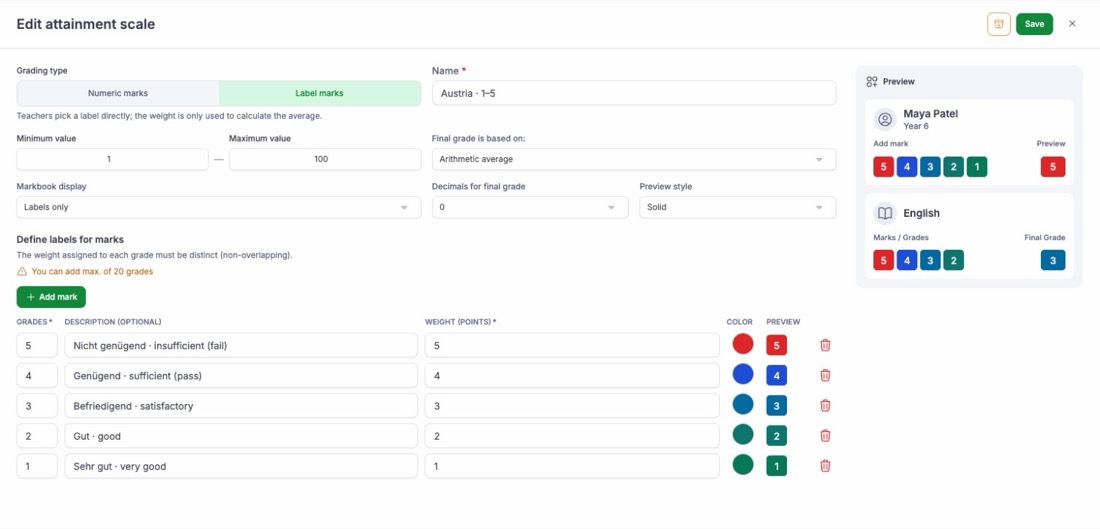
These are the scales as MarkBook shows them in the scale editor. Build yours with the same grades, descriptions and weights. Each scale links to the recipe that explains it on Set Up Any Grading System.
Austria · 1–5
Attainment scale for years end of 2 to 4 (Volksschule, Ende 2. bis 4. Schulstufe (primary, end of year 2 to year 4)). Build it in Configuration → Assessment → Attainment scales. Recipe: A scale where 1 is the best mark.
| Grade | Description | Weight | Pass |
|---|---|---|---|
| 1 | Sehr gut · very good | 1 | yes |
| 2 | Gut · good | 2 | yes |
| 3 | Befriedigend · satisfactory | 3 | yes |
| 4 | Genügend · sufficient (pass) | 4 | yes |
| 5 | Nicht genügend · insufficient (fail) | 5 | no |
Before you rely on this page
Confidence: high
I read the scale, the behaviour rules, alternative assessment (§ 23a) and weighting (§ 20) in the LBV itself. I did not confirm whether the final-year mark counts permanently in the written Matura (it was introduced during COVID). The semester-based upper level was made optional for schools around 2021; I did not confirm its current status. State-by-state school-year dates are from general knowledge, not read. The percentage keys for Schularbeiten are common practice, not law. I found no grading reform after 2020 other than the Mittelschule two-level system (2020/21) and the iKMPLUS assessments.